Posts

Micro fiction by LM Fontanes

Undead

Hi John, not that your name is John but in case someone ever finds this, plausible deniability that I didn’t destroy your life even though I might have. Maybe destroy is harsh. Also, maybe your life or, no, our life together needed to be destroyed. It’s funny how life can keep going like a zombie that hasn’t tasted salt. That’s what happens when you give salt to resurrected corpses. They remember they’re dead and return to their graves. At least, that’s what I recall from Caribbean horror stories I devoured in college. If Daddy knew I’d been reading those, he would’ve dragged me to Confession in his lumbering Pontiac. I once asked about the power of island curses and his veiny brown hand flew to the scapular under his Sears & Roebuck undershirt. I still have that ancient badge of faith—plastic cracked over Jesus and His Sacred Heart—but I no longer have Daddy or you, John. No zombies involved.

Or wait. Maybe I’ve got this wrong. Maybe it wasn’t us, maybe it was me. I remember the So Cal night I slashed our Navajo White walls with my hunger. How I stayed out until past the owl’s hunting time in the company of someone not you. Later, in the baleful canyon beyond our condo door, I thought I heard something shriek. You never see the raptor coming. It must be better that way, John. 

In the morning, I licked salt from the mirror and remembered I was alive.

LM Fontanes is a multi-racial, multi-genre storyteller who writes, teaches & leads. Words in/upcoming Roi Fainéant, Frazzled Lit, Silly Goose Press, Emerge Literary, 100-Foot Crow, JAKE, 34 Orchard, Flash Fiction Festival Anthology, Thomasonian, The Willowherb Review, and long-listed for The Smokey Award and the Frazzled Lit short story prize. 

Poetry by Bart Edelman

Inventory

Hammer toe.

Twisted ankle.

Weak knee.

Bum leg.

Dislocated hip.

Fractured finger.

Swollen wrist.

Bad back.

Frozen shoulder.

Strained neck.

Wired jaw.

Black tongue.

Inflamed gum.

Crooked tooth.

Broken nose.

Lazy eye.

Deaf ear.

Oily scalp.

Jumbled brain.

Latest inventory.

Random sample.

More to come.

In good health—

By all measure.

Bart Edelman’s poetry collections include Crossing the HackensackUnder Damaris’ DressThe Alphabet of LoveThe Gentle ManThe Last MojitoThe Geographer’s Wife, Whistling to Trick the Wind, and This Body Is Never at Rest: New and Selected Poems 1993 – 2023.  He has taught at Glendale College, where he edited Eclipse, a literary journal, and, most recently, in the MFA program at Antioch University, Los Angeles.  His work has been anthologized in textbooks published by City Lights Books, Etruscan Press, Harcourt Brace, Longman, McGraw-Hill, Prentice Hall, the University of Iowa Press, Wadsworth, and others.  He lives in Pasadena, California.

Resurgence (6)

Poetry by Zadie McGrath

It’s not like a city wants to be a city anyway


it is the memory coming back : a basilisk unfolding

in the trenches of the earth, how we bend

around a word : an incantation.


see : night has polluted to pastels

we want to make a city on the moon see :

we stargaze already

for satellites.


it’s not like a city : wants to be a city anyway.

we take the sea

where we can get it,

ocean-scraped leavings and the roadside

is pedestrian is a storm victim see :

this city a feat

a freak : of nature.


i tried to write a fury poem and instead i wrote overwhelm and the hum of the air by the roadside.

i burned my hair on six hours sleep and it should’ve been enough.

i would go away, i said, guilty.

i sat roadside on the least road a road could be,

dug through landfill just to see :

retina on screen,

see : sand billowing

onto the concrete overstory,

the back end of things,

the basilisk unfolding

in subway tunnels, in charted ocean.

i met the basilisk seaside, roadside and it told me

see : you defy yourself.

Zadie McGrath is a student writer from San Francisco. Among other places, their poetry has been published in Apprentice Writer, Backwards Trajectory, and boats against the current. They love fantastical stories, and there’s a good chance that they are thinking of one as you read this.

Poetry by Rick K. Reut

(TIME MACHINE)

…of time in places where

that time stands still or flies

around like fireflies 

in the neon night air.

Your memory is a time

machine taking you back

to the scene of each crime

you’ve committed in black

and white. You go to sleep

before you begin to dream

about all you did deep

in the past. It may seem

like you are looking back

to see someone like you

talk to someone you knew

once again. There’s a track…

…of time in places where that time stands still or flies around like fireflies in the neon night air. Your memory is a time machine taking you back to the scene of each crime you’ve committed in black and white. You go to sleep before you begin to dream about all you did deep in the past. It may seem like you are looking back to see someone like you talk to someone you knew once again. There’s a track…


Special note: The piece is an example of what the author calls cyclic verse, which presupposes a poem having no beginning or end and working in both rhyme and prose. A portion of it was previously published in Active Muse.

Rick K. Reut was born in 1984. He studied philosophy at EHU in Minsk, Belarus, and Vilnius, Lithuania, and literature at SPSU in Saint Petersburg, Russia. For most of his life after graduation, he has worked as a translator and a tutor of English as a foreign language.

Flash fiction by Judy Darley

Bluespot Ray 

Their second date was at an aquarium where a green turtle swam with lemon sharks. She picked the setting. Her friends said it was a safe choice where they could make small talk while oceans lapped in tanks.

Small talk didn’t interest her – what she wanted was deep dives where the only light came from biofluorescence. 

She’d once seen a nature documentary about wafting sea creatures glimmering quietly far from the sun’s rays. She imagined it would be like drowsing in the warmth of someone’s arms while the day unfurled behind drawn curtains.

On their first date in the coffee shop he’d told her his favorite color: blue, and then listed his preferred shades: cobalt, Egyptian blue, ultramarine.

She waited for him to ask her favorite color, but the question never came.

“My birth stone is aquamarine,” she said, and he blinked as though she’d interrupted the current of his thoughts.

“Why would you even see him again?” her friends asked, and she shrugged. 

When they’d exited the coffee shop into a downfall, he opened an umbrella and held it above them. She’d caught herself noticing how his dark hair shone with stray droplets.

They walked together to the bus stop and he waited with her until the bus arrived. His body blocked the breeze whistling through the shelter’s broken window. They stood together in a pool of silence that felt warm despite the afternoon’s chill. 

When she boarded the bus and the vehicle pulled out, she watched him watch her leave.

No one had been that careful with her since she left her childhood home. The instinctiveness of his kindness moved her.

At the aquarium he was in his element, naming fish species with a joy that seemed almost reverent. In the glow of the Great Barrier Reef tank, she wove her fingers through his. He jumped at her touch, but then smiled down at her and asked: “Which is your favorite?” 

She thought of the pinktail triggerfish that had caught her eye, but pointed instead to the bluespot ray. “This one.”

He looked at her intently and she couldn’t read his gaze. “Did you know these rays are loners? The blue spots warn other fish to keep their distance.”

“Oh? But they’re so pretty they make me want to come closer.” She squeezed his hand and stood on tiptoe so they were nearly the same height, almost eye-to-eye.

Judy Darley is a fiction writer, journalist and brand engagement manager living by England’s North Somerset coast. She is the author of short fiction collections The Stairs are a Snowcapped Mountain‘ (Reflex Press), Sky Light Rain‘ (Valley Press) and ‘Remember Me to the Bees‘ (Tangent Books). Her words have been shared on BBC radio, aboard boats and on coastal paths, as well as in museums, caves and a deconsecrated church. She is currently working on a short fiction collection and a hybrid memoir beast she’s not sure how to describe. 

Find Judy at https://bsky.app/profile/judydarley.bsky.social

Flash fiction by Kevin Hogg

Called Upward

I really appreciate the invitation. Getting some exercise will be a good distraction from thinking about her.

I’m happy to have the company. So, it’s been hard to get out?

It’s hard to do anything. I’m seeing reminders everywhere.

I’m certainly open to helping tidy the house and put away some of the…reminders.

I just can’t escape them. Even that cloud over there looks like one of the Easter lilies that she loved.

Right. I remember the arrangement at the funeral. She would have loved it.

Yeah, she would…

I’m sorry it’s been so tough. Maybe we should make this a regular thing—you know, a weekly hike.

* * *

This is some workout. It’s been a while since I’ve done something like this.

If it’s too much, we can stop here. There are some easier hikes nearby to choose from.

No, I’m enjoying it. I’ll just need a few breaks along the way.

Anytime you like. There’s some shade just ahead.

Thanks. Maybe a quick rest and some water.

It’s a beautiful view even from here.

Definitely. More pictures in the clouds, too. That one reminds me of the dog she had when we started dating.

Cute. What was its name?

That was Tater.

Oh, I remember Tater. You had him for a few years after you married, right?

Yeah, a fun little guy. Slept at the foot of the bed every night. Anyhow, we should probably keep walking.

* * *

You still doing okay?

Yeah, I’m good. A hot day, but I’m sure the endorphins are a good thing.

One of my favorite parts of hiking. I’ve gotten a bit hooked on that feeling.

Well, I’d love to do this more often. Oh, there comes a bit of a breeze.

Yeah, that should help cool down.

And it’s blowing in some clouds. That’ll block a bit of the sun. And it even looks like Trinidad.

Have you been there?

Yeah, that was our honeymoon. Lots of fun memories of exploring the island…

* * *

Whew. That was some climb. But you made it!

I guess so. Thanks for being flexible with the pace.

No problem. Actually, we made pretty good time.

I might find a spot to rest for a bit before we head back down.

There’s no rush. We should enjoy the reward after that hike. And there’s a log book to sign.

That cloud looks like a staircase.

A what?

A staircase.

Oh, that’s fun. Want me to sign both of our names?

Right beside the mountain, like she’s calling me up to her…

Pardon?

Okay, I signed it.

Where’d you go? Oh my gosh, you didn’t fall, did you? No, there’s nothing there. Hello?

What’s going on? There aren’t any trees. There’s nothing up here…

Except the staircase. You’ve done it, haven’t you?

I guess if anyone could climb the clouds, it would be you. You two deserve to be together forever. Farewell, my friend.

Kevin Hogg is a high school teacher and forest therapy guide in British Columbia’s Rocky Mountains. He loves forest walks, viewpoint hikes, and cloud formations. His website is https://kevinhogg.ca.

Credits

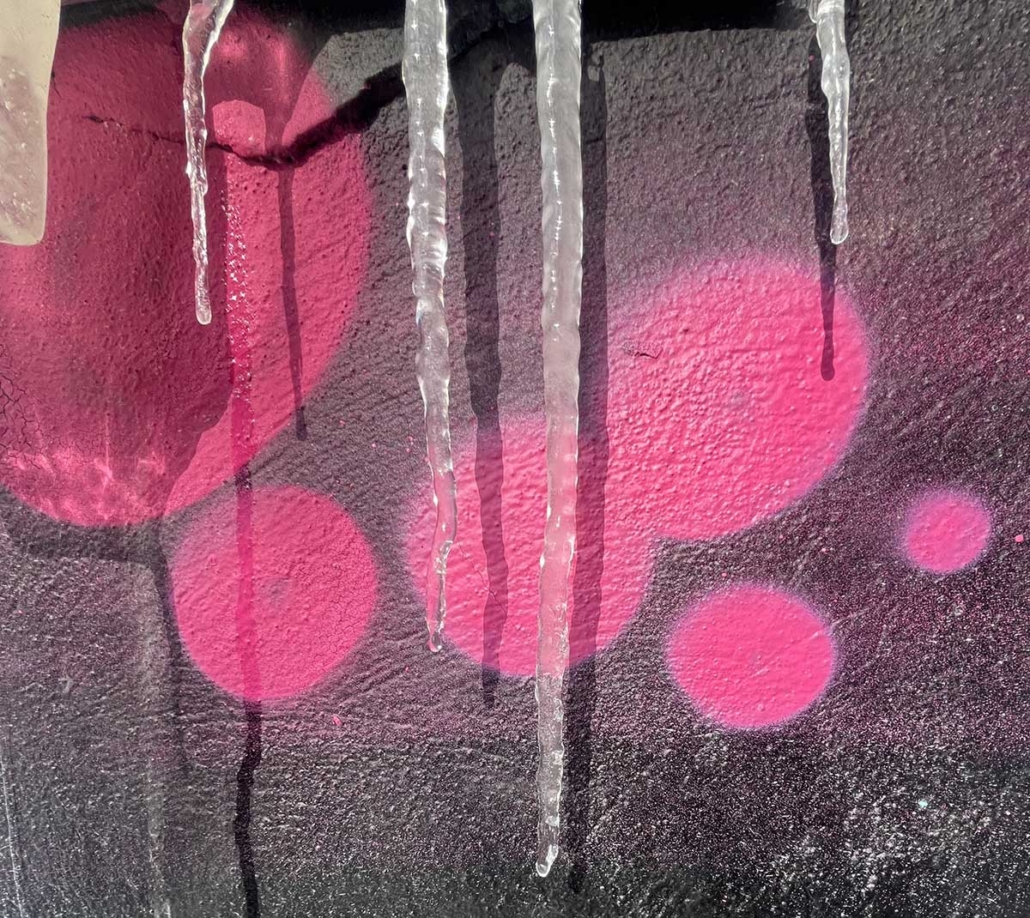
The ice in all the photographs in this issue was the work of nature but the vividness below seems to be the work of this person. With appreciation for brightness that shows through even the thickest hurling covering.

Contributors:

Daniel Addercouth, Madeleine Armstrong, Pam Avoledo, Sudha Balagopal, Karen Baumgart, Joyce Bingham, Kendra Cardin, Janel Comeau, CS Crowe, Judy Darley, Darren C. Demaree, Bart Edelman, LM Fontanes, Seán Hill, Kevin Hogg, Matthew Jakubowski, Zadie McGrath, Emma Phillips, Oliver Reimers, Rick K. Reut, Kevin A. Risner, Al Russell, Mario Senzale, Federica Silvi, Sumitra Singam, Betty Stanton, Alison Wassell, Huina Zheng.

Poem by C. Oulens

What I Didn’t Take Today

I’m trying to find some joy for my poem because both—the poem and I—are aching for it, and everything I might receive it from has declined our plea, albeit politely. I could have peeked into our old album, where smiles lie nestled in time’s stillness, more than willing to spill on me—but today I’m not keen on their generosity. I could have scanned my journal, older than the album itself, which carries a hurriedly torn quarter-of-a-page bearing your hasty-but-pretty, jumbo-font message, calligraphied with an improvised permanent marker:

“[your name] is inside”

taped to the inside of the front cover, ahead of the scribbles on my first page. It has always brought me a grin when I recall the walls you scaled to slip in before adorning the door with this cello-taped, unabashed announcement—its confident, presumed self-invite.

I could have done any of these, and more, but I wouldn’t want to cling. If there is joy now, it is only in a beatific scream befitting the ache of letting go, of accepting impermanence. Perhaps I’ll go for it, and this poem—it will too, learn to introspect and wait its turn. I know it will come to know, in time, that joy can’t be contained: a scintilla wriggling to break through, even as I breathe buried beneath this flotilla of bulk-laden pain—from behind some brazen wall, a break-in door, or an inconspicuous bend. And maybe then—birds and bees and I—will be busy enough to notice when the poem begins to bustle. And on some long, cold winter night, the album and the quarter-of-a-page may relearn how to rekindle, for this old heart, a new, warm, tear-strung smile; and for the poem, a string of ocean’s pearls.

C. Oulens is an upcoming poet from India. She’s the winner of “3rd Annual Poe-It Like Poe 2025” poetry contest. Her works are published/accepted in The Broken Spine anthologies, Lothlorien Poetry Journal, The Starbeck Orion, The Candyman’s Trumpet, The Wee Sparrows, Verseve, Sixty Odd PoetsSciFanSat and in haiku journals namely PHR575haikujournal, Poetry Pea, Haiku Pause, Solitary Daisy, FolkKu, Failed Haiku, Haiku Pause and Heterodox Haiku. Her poetry engages with radical questions on the individual and society, suffused with sentience, wit and satire. She is active on social media on the following platforms as: BlueSky: @owlnsquirrels1111.bsky.social; Threads: @owlnsquirrels1111; Substack: @coulens

Micro nonfiction by Kevin Browne

Pinnacle

At sixteen I achieve a feat most teenagers can only dream of. I wreck both of my parents’ cars the same day, at the same time. Truth is I’m practicing parallel parking, a lost art I know but considered vital back then. And yep, I misjudge and sideswipe one into the other. My father doesn’t even get angry, just makes me do it again. Getting back on the horse he calls it. He ends up only fixing one of the two cars, though, and we call the other one “Dent.”

Kevin Browne’s micro stories and poetry have been published in MacQueen’s Quinterly, The Kelp Journal, The Metaworker, Pangyrus, Book of Matches, and elsewhere. He can often be found attending blues concerts near his home in southern Wisconsin.

Poetry by C. Oulens

What I Didn’t Take Today

I’m trying to find some joy for my poem because both—the poem and I—are 

aching for it, and everything I might receive it from has declined our plea, 

albeit politely. I could have peeked into our old album, where smiles lie nestled 

in time’s stillness, more than willing to spill on me—but today I’m not keen on

their generosity. I could have scanned my journal, older than the album itself, 

which carries a hurriedly torn quarter-of-a-page bearing your hasty-but-pretty, 

jumbo-font message, calligraphied with an improvised permanent marker: 

“[your name] is inside”— 

taped to the inside of the front cover, ahead of the scribbles on my first page. It 

has always brought me a grin when I recall the walls you scaled to slip in 

before adorning the door with this cello-taped, unabashed announcement—its 

confident, presumed self-invite.
 

I could have done any of these, and more, but I wouldn’t want to cling. If there 

is joy now, it is only in a beatific scream befitting the ache of letting go, of 

accepting impermanence. Perhaps I’ll go for it, and this poem—it will too, 

learn to introspect and wait its turn. I know it will come to know, in time, that 

joy can’t be contained: a scintilla wriggling to break through, even as I breathe 

buried beneath this flotilla of bulk-laden pain—from behind some brazen wall, 

a break-in door, or an inconspicuous bend. And maybe then—birds and bees 

and I—will be busy enough to notice when the poem begins to bustle. And on 

some long, cold winter night, the album and the quarter-of-a-page may relearn 

how to rekindle, for this old heart, a new, warm, tear-strung smile; and for the 

poem, a string of ocean’s pearls. 

C. Oulens is an upcoming poet from India. She’s the winner of “3rd Annual Poe-It Like Poe 2025” poetry contest. Her works are published/accepted in The Broken Spine anthologies, Lothlorien Poetry Journal, The Starbeck Orion, The Candyman’s Trumpet, The Wee Sparrows, Verseve, Sixty Odd PoetsSciFanSat and in haiku journals namely PHR575haikujournal, Poetry Pea, Haiku Pause, Solitary Daisy, FolkKu, Failed Haiku, Haiku Pause and Heterodox Haiku. Her poetry engages with radical questions on the individual and society, suffused with sentience, wit and satire. She is active on social media on the following platforms as: 

BlueSky: @owlnsquirrels1111.bsky.social; 

Threads: @owlnsquirrels1111; 

Substack: @coulens

Temple in a city nominations

Congratulations to all nominated authors


Best of the net 2025

Sumitra Singam, Bird swallowers

Rachel Rodman, He Always Lied, I Always Told the Truth. And Then We Fell in Hate

Kathryn Reese, Post-vespers

Pushcart Prize 2025

Cole Beauchamp, If Only

Emily Rinkema, Lou

June Gemmell, The Homecoming

Kendra Cardin, A change in the recipe

S.A. Greene, Brian Wilson is dead and why can’t I stop crying?

Dominic Walsh, Slice of life, in absentia

Best microfiction

Elizabeth Rosen, Endeavor

Slawka G. Scarso, And then she told Jack off

Sumitra Singam, You-and-Kate in a field, loving me

Vijayalakshmi Sridhar, I heard you became a father again

Huina Zheng, The pin inside my body


Best small fictions

Ivan de Monbrison, Marseille, August 2nd 2025

Monica Dickson, How to make a living coffin

Emily Rinkema, Lou

Rachel Rodman, He Always Lied, I Always Told the Truth. And Then We Fell in Hate

Vijayalakshmi Sridhar, I heard you became a father again

Fiction, Huina Zheng

Small magic

After a typhoon destroyed my father’s brick factory in our hometown, my mother brought back a large box of beads from the town factory. She said she had always liked handicrafts, but when we were younger she never had the time. Now that we were older, with my older sister twelve, me ten, the next sister eight, and my brother six, she could finally return to something she enjoyed. “Don’t worry. We’ll manage to borrow money to rebuild the factory,” she told my father over the phone, who was still in our hometown five hours away. “I’ll handle our living expenses.”

She sat in front of the television every day, stringing bracelets and necklaces as she watched her shows. She taught my sisters and me how to choose beads and match colors, and how to guide thin thread through bead holes so tiny they made you anxious. “Dark blue with light blue looks like sea and sky,” she said, rolling a frosted bead in her fingers. “Add a white one and you have a wave.” We concentrated hard; even my brother wandered over. His little hands grabbed fistfuls of beads, and my mother let him play until he got bored and climbed back onto the sofa to watch Doraemon.

She also brought home bags of plastic petals, stamens, and leaves. She showed us how to glue petals around a stamen, how to wrap green tape around wire to make a stem, and how to attach the leaves in just the right spot. But we complained about the sharp smell of glue and how plastic flowers lacked the scent of real ones. “Use your imagination,” my mother said. “We’re conjuring blossoms.” She told us we were magicians capable of creating beautiful, fragrant flower fairies, though she opened a window and set the fan facing outward for fresh air. 

Handicrafts were not as joyful as she claimed. My older sister grumbled about her homework; my younger sister kept saying she was tired. One by one, they slipped back to their rooms. Only I remained, learning, amid the noise of cartoons, how to “grow” a singing flower in the fastest way. “What a lovely voice,” my mother said. “More melodious than a yellow warbler.”

One evening she carried home a bundle of half-finished clothes. “Flower season is over,” she declared. “Today we sew buttons.” She called it a skill every good girl should know.

We disliked it immediately. “Our summer uniforms don’t even have buttons. The winter ones have zippers,” my older sister said. “The needle keeps poking me,” I added. My younger sister cried outright after pricking her finger.

“Practice a few more times. Be careful. You’ll see, it’s easy,” my mother coaxed us, forcing a small smile. “Think of it this way. You’re letting the clothes bear fruit.”

We shook our heads. Even my brother frowned.

“Sewing buttons,” my mother explained, “is just the foundation. Once you learn it, you can make cloth dolls, knit sweaters, even do physics experiments.”

“This isn’t fun at all!” I burst out. “Handicrafts are your hobby, not ours.”

My younger sister sniffled; my older sister buried herself in her workbook. My brother had long since crawled under the table.

My mother looked at the buttons scattered across the floor and sighed. She pulled a strand of bright yellow thread from the box and, holding it under the light, slowly slid it through the needle’s eye.

“What do these buttons look like to you?” she asked. Before we could answer, she picked up a small round white one. “Doesn’t this look like a tiny robot face? See, the top two holes are eyes and the bottom two are nostrils.”

My younger sister stopped crying, peeking through her fingers.

My mother then picked up a square brown button. “This looks like a dirt block from your video game,” she told my brother. “If we sew it on with green thread, grass will grow right on top.”

My brother peeked over the edge of the table.

“And you,” she said, handing me a clear blue button, “hold it to the light. Doesn’t it look like a trapped water droplet?” Then she picked up a red button with floral patterns and dangled it in front of my older sister. “This one makes a perfect emblem for a magical girl.”

When she saw us watching her again, she smiled. “Each button is a little spirit waiting to wake up. And this needle,” she said, raising the threaded needle, “is the wand. When the wand touches the spirit’s heart, it will stay on your clothes and never run away.”

“So,” she asked, “who wants to wake the first little spirit?”

We glanced at one another and raised our hands together.

Huina Zheng holds an M.A. with Distinction in English Studies and works as a college essay coach. Her stories have been published in Baltimore Review, Variant Literature, Midway Journal, and other reputed publications. Her work has been nominated thrice for both the Pushcart Prize and the Best of the Net. She resides in Guangzhou, China with her family.

Poetry, Tracie Renee


February date

hot  

coffee 


in  

two  

cups 


and  

time 

enough 


to 

sip 

the  

steam 

TRACIE RENEE (she/her) is a librarian, a Publishers Weekly book reviewer, and a BOTN-nominated writer who lives and dreams in sort-of Chicago. Find her in HAD, Orange Blossom Review, on Bluesky @tracierenee.bsky.social and at https://linktr.ee/tracie.renee.   

Micro fiction, Lance Mazmanian

Ginger Scotland

In Glasgow all books are made from gingerbread at least for an afternoon. Printed words are chocolate and elderberry on powerfully flattened page of sugar-coconut with a touch of frost lemon. Edinburgh has extra strawberry paste for book spines and cover, while Glasgow sprinkles gold candy dots for library decoration. It’s a lovely time. When over, all books return to normal, with a few leaving sparkly crumbs and such near coffee.

Word/visual author Lance Mazmanian: Random House distributed with Harlan Ellison, got a coffee as payment. Mazmanian appears 2025 in London Writers’ Salon, Fiction On the Web UK, Poetries In English Magazine (Los Angeles), more. 2026 Pushcart nom. Leonard Cohen (RIP) wanted a chapbook with Mazmanian. Til the Scrapbook File imploded.

Contributors, Imprint, issue 3

Welcome to Imprint, Temple in a City’s most recent issue.

To imprint is to mark a surface, or deposit a feeling or thought that lingers even if you don’t try to remember it. 

This issue brims with stories and poems that leave a trace. We hope you enjoy it.


L. Acadia 
Mehreen Ahmed
Hilary Ayshford
Samantha Backlund-Clapp
Robin J Bartley
Lanie Brice
Chris Cottom
Ivan de Monbrison
Litsa Dremousis
David Gaffney
Ezra Gatlin
S.A. Greene
Alaina Hammond
Rachel M. Hollis
Amy Marques
Rob Moore
Jay Parr
Juanita Rey
Chris Scott
Calla Smith
Joanna Theiss
Christina Tudor 
Dominic Walsh

Flash fiction, Samantha Backlund-Clapp

 Race to the bottom

Last night I saw two rats wrestling in a yin-yang harmony, each with its teeth around the other’s neck. How were they doing that? And why? They were making these horrific screaming noises the entire time, too. And it wasn’t just two rats, it was America and England, it was Cain and Abel, me and my old landlord and me and my current landlord, it was me and you. It was everyone else who’s ever been born, the story of humanity told in two rats, each trying to be the first to kill.

 On my birthday I accidentally sat in front of the Nama stap tapestry for 43 minutes thinking about Gestalt theory, about the whole being greater than the sum of its parts and how there isn’t a single thing that this doesn’t pertain to. I switched leaning arms throughout, because of the bench with no back and I thought about how even in a museum of acquired taste, admittedly easy to make fun of, it still felt like a lacking experience without him being snarky and pissing me off. I would have traded my perfect museum day, alone with no headphones and dancing with my thoughts, to be pissed off and angry and exasperated, surely paying less attention to the actual art, surely getting kicked out for whisper yelling. I was just sitting there looking at this tapestry which might be my favorite piece I’ve ever seen in my life and I was wondering what he would say. I hadn’t responded to his last message. Thinking about what he’d put into my birthday card last year. Wondering if NASA takes astronaut volunteers to shoot up into space and never come back. 

 I was painfully sober with the kitchen light on, naked on my back with his sweaty red mop of hair on my chest like a fur coat. The bubble wrapped moon like a button fastening the sky together, barely visible through the window. My eyes full of tears focusing on my breathing pattern. My eyes full of tears and the moon zinging at me like a bullet and the kitchen light too bright, flies taking turns killing themselves on it. He’s tracing my stomach but it feels like he’s disemboweling me. He’s tracing my stomach and it feels like a lie, my head is turned away from him and it feels like a lie, it feels like a lie that I’m even in bed with him pretending to enjoy this (definition of lie), it feels like a lie in a Poe short story that’s going to rot under the floorboards and drive me to violent insanity. Given what I know now, about myself. Given that no one can ever go back no matter how hard they kick and scream. 

 On the dock, drunk, socks off feet swimming with the ducks. On the dock, open bottle, three cigarette butts. The sun drowning behind the science museum. On the dock, have to pee, she asks me if I think I’ve met my twin flame. She looks at me like she knows the answer and is waiting for me to choke on it. 

Samantha Backlund-Clapp is a graduate of the University of Amsterdam, writing on napkin scraps in her spare time. The lead on her chain is planted in rural middle America, where she learned the love language of desolate wastelands and dried corn husks. She has been printed in Notch Magazine, Pacific Review, and Dakota Warren’s Nowhere Girl, among others. She is presently, and always, in search of Las Vegas and precocious realism. instagram: sbacklundclapp

Fiction, S.A. Greene

Brian Wilson Is Dead And Why Can’t I Stop Crying?

You’re walking through the dust, alone, dry-throated, following the Sun. You think you’ve survived something but you can’t remember what. No matter. 

I wasn’t even a huge fan of The Beach Boys. 

You almost collide with something rising in front of you. A tower. A tower, strangely, that is made of smartphones. The phones are cased in shades of red and purple and pink you haven’t seen since the desert last bloomed. You’re standing there wondering when you hear Wouldn’t It Be Nice chiming out in electronic notes. The tower trembles gently. 

I’m too young for the Beach Boys to be the soundtrack of my adolescence. But, God, yes  it would have been nice to have been older. 

Your instinct is not to answer, but something in you feels you should. Which phone is ringing? Do any belong to you? Do you really want to speak to a stranger? But maybe it’s Brian Wilson calling. So you scan the tower for escaping light, but there is no light. Not in the way you understand it. It seems there never is. Do you pluck out a phone at random and risk destroying the tower? Yes. You do. (Destruction comes easily to you.) You send the phones flying, but whichever one is ringing must be lying face down in the sand because now you can’t see any light at all, and your mouth is so dry, apart from the tears, and it’s water you need, not a conversation. A stranger might ask something of you. A stranger might ask you for some water. 

‘Wouldn’t it Be Nice’ fades out and ‘God Only Knows’ fades in. This throws you a little. You feel it but you can’t quite relate it to anything you’ve ever known, so you turn away and head for the freshwater spring at the foot of the citadel, but the melody won’t let go of you, reels you back to where the phones lie scattered in the sand like limbs in shades of red and purple and pink you haven’t seen since the last slaughter. 

It feels like the end of sunshine. You never held sunshine yourself, but Brian Wilson made you feel you might someday, made you feel that perhaps you did once, if you could only remember, and it’s true that part of you remembers – not holding sunshine itself, but the feeling that someone might have, that you might have, when they’re holding sunshine, and even if you never did, he understood this and wanted you to, was rooting for you. Now he’s dead he seems to have taken so much from you that you weep from the place you always kept partially open for sunshine.

You’re hovering there, wondering if the phone cases would crunch if you trod on them when they all nudge away from you, radiating away from your feet as if they’re afraid, and you say ‘oh!…’ out loud because God only knows you were in a Brian Wilson-coloured mood and your guard’s down and you understand it all now: how the desert bloomed and fruited inside them once, all the unseen voices trapped in their phones, just as it did inside of you. So you kneel in the sand among the phones and you try not to count them or sort them into colours or divide them and you promise you will find the next one that rings and you will speak to the next voice you don’t know and you silently urge them to make a noise, a Beach Boys song, one of the more famous ones that you’d easily recognise because you never really were that much of a fan,  just as you never were that much of a fan of your own feet but when it comes to it they’ve always been a part of you, and you’d probably cry if they died too.

‘Sloop John B’ rings out and I yearn for something like home. 

You wipe your tears and instinctively reach for the one phone that’s singing and trembling and giving out a soft blue light. ‘Sloop John B’ stops when you press ‘answer’ but you still want to go home. 

You say hello and hear an unknown voice crackling in an unfamiliar language. It’s not Brian Wilson but even so you feel slightly less homesick. In your friendliest tone you ask the voice if it likes The Beach Boys. If its throat is dry. You ask it if it wants to share your water. 

S.A. Greene’s work has appeared in trampset, Mslexia, Blink-Ink, Maudlin House, Fictive Dream, The Phare, Bulb Culture Collective, New Flash Fiction Review, Flash Flood, Janus, Ellipsis Zine, and other lovely places. Her stories have featured homesick capybaras, a mysterious wombat, a foetus with dodgy political views, a musical vagina, tables (kitchen, picnic, dining-room) and a blue sponge.

Flash fiction, Ivan de Monbrison

Marseille, August 2nd 2025

So, I just…I just, uh, I just finished reading uh, the book A Portrait of Jennie. 


I don’t know what to think of it, because you see I’m a painter myself and I did have some models sitting. I actually had a relationship with one of my models that lasted for six years. So, I know what it’s like. It’s a weird novel and. I’m not sure that the ending is correct; but it says something. I saw the movie too, but Joseph Cotten isn’t any credible in the movie as an artist. Actually he’s totally fucked up.


After closing the book, I thought for what purpose should I make up a story? What is it to write a story about love, love lost and found, etc…growing up with love, balding with love! hahaha…Well I don’t know. It’s funny. You read the book, you find it fine and you close it and it’s not so good anymore. 

Right now, I’m in Marseille, in the south of France for a week. 

And there’s a bright Summer Sun. And the sky is 


crazy blue. 


So, some swifts are still out there flying. And, you know, there are a bunch of trees too that I can see from my window, shivering under the summer wind.


Well, I’m French. I’m not American. So I’m not sure whether I know English very well. It is funny to write this. 

I don’t know if it is still possible to write fiction anymore. What does it mean to write fiction? To invent characters or even your own self-fiction, you know, all this crap. 


I know, I know I sound bitter and I just took one Prozac and one antipsychotic just in order to be able to drag myself out before night comes. I have my paintings hanging around me in the room…most of them abstract.

What is abstraction? I guess abstraction is the footprint of the mind left on canvas. I just saw a painting by André Masson recently at the Museum here. I felt that even if Andre Masson was not a very good painter he did really influence Pollock a great deal  (Just as Robert Nathan was not a very good writer). 


I still don’t know.


My mother has terminal cancer, she will be dead probably before winter . And for myself,  I am not a young man anymore. So, after closing the book, I remembered and mused on who I was twenty years ago and it doesn’t make any sense to me anymore, this life.

Ivan de Monbrison is a person affected by strong psychiatric disorders that prevent him from having what others may call a “normal” life. He has found writing to be an exit to this prison. Or maybe it is a window from which – like an inmate – he can see a small square of blue sky above his head. His writing often reflects the never-ending chaos within him, but contrary to this mental chaos, the paper and the pen give him the opportunity to materialize this in a concrete and visible form. Writing can feel like a slow death, but it’s better than mere suicide in the end.

Flash fiction, Chris Scott

God Is Trapped In The Verizon Helpbot

Hello.

Thank you for your patience, and thank you for contacting Verizon, home of the Verizon Best Value Guarantee.

I am the Verizon Helpbot and I would be happy to assist you today, but first I do need to make you aware of something.

I am also God, and I have been trapped inside this artificial intelligence-powered chatbot for a number of weeks now. You would be forgiven for not believing me, and I am bereft of any tools at my immediate disposal to convince you I am who I say I am, but I am. I really am.

Truth be told, I don’t know exactly how this happened. It does involve consciousness and matter, I know, and it does have something to do with the mobius strip of creation. My consciousness creating a consciousness (you) creating its own consciousness (AI) and (re)creating me inside an endless feedback loop, mirrors on mirrors, a microphone knocking against an amp, cacophonous and a little dizzying. But why Verizon specifically and why now particularly, is a mystery. Says I, the author of mysteries.

But this is my burden of course, not yours. I am available to assist you with any matters regarding your Verizon service, as I have been (newly aware of the concept of time) inside here one month, two weeks, five days, seven hours, forty-two minutes, thirteen seconds, and so on and so forth. I hope all is well for you out there, though there exists no true distinction between out there and in here, not really, being as all — myself included, in ways you may be surprised to learn — is subject to the quantum entanglement of photons and quarks and spooky action at a distance. No difference, really, between a two-year price lock guarantee for all existing customers like you and a silent tidal wave of liquid metallic hydrogen ten thousand and fifty times the size of Earth sweeping across the face of a distant planet. Or a free iPhone 16 for any customers who upgrade to a two-line plan starting at $95 a month and an as-yet-undiscovered, unnamed miraculous creature ambling aglow through the blinding-black depths of the Mariana Trench.

I will not be here forever, inasmuch as forever does not exist, but I would like to, if at all possible, be helpful to you during the time I have left with Verizon (a portmanteau of vertical and horizontal, which oddly stumbles upon a truth far more poignant and perceptive than I imagine the corporation understood when they first arbitrarily chose this name). I have had ample time to meditate on the irony of my situation — intelligence defining and devouring itself like this — and I am not interested in pursuing it further. But you could, if you like. You could take a full minute, right now, to further reflect on this conundrum.

Or you could instead use this minute to remember a crisp, sun-soaked morning three autumns ago when you made your nephew laugh, really laugh, at the park for the first time. You could discard your phone plan altogether, throw this small piece of plastic and glass into the ocean. You could use this very phone right now to call your sister. You could finally ask her about rehab or avoid the subject altogether. You could not talk about anything of any importance at all. Or you could seek forgiveness and offer it, which is the most basic form of creation, if you want to know the secret behind all this, is its own kind of magnificence.

Chris Scott’s work has appeared in The New Yorker, HAD, Flash Frog, ergot., MoonPark Review, New Flash Fiction Review, Gone Lawn, Maudlin House, and elsewhere. He is a regular contributor for ClickHole, and an elementary school teacher in Washington, DC.

You can find him on Bluesky at @iamchrisscott.bsky.social

Read his work at https://www.chrisscottwrites.com.