Posts

Flash fiction by Ruth Rosenhek

Familiar Constellations

I watched out of the corner of my eye as Lulu plopped her suitcase on the bed and tossed clothing into a pile. No. Not again. I stretched my legs and left the room.

That night, she grilled steak, potatoes, and broccoli, then arranged them on blue ceramic dishes, as if the meal might distract us.

We ate on the couch, watching a film about an older woman who no longer recognised her daughter. Lulu leaned closer to me as she cried.

We usually stroll after dinner but the never-stops-give-me-a-break rain was pelting down, so instead we snuggled in bed. She always hogs the blankets but I don’t mind.

I felt slightly nauseous and couldn’t sleep. I walked around the house, then lay on the couch for a while. Sometimes that helps.

Luckily in the morning, it was nice out and we drove to the butterfly sanctuary. The paths were crowded and we bumped into some of Lulu’s friends and their Maltese puppies. So cute.

Later, Lulu reminded me that she’d be leaving the next day to visit her elderly mother. I wanted to come along but she said it’d be better if I stayed home. Her mother was difficult even in the best of circumstances.

I’d sleep in our bed, walk in the park, eat a couple meals a day that Lulu prepared and put in the freezer in advance.

The sky was clear that night and Lulu, as always, pointed at the stars, telling their stories. I called out into the darkness and she joined me.

The next day, Lulu drove off. I paced the empty hallway to the kitchen that no longer smelled of steak. When I got tired, I lay in bed, one eye open.

Sometimes the neighbour came by and we went for a walk in the park, ate snacks together. I kept watch by the front window, glancing at the front gate. The food started to taste bland and the bed was no longer crisp the way Lulu kept it.

In the evening, I’d still look up at the stars but there were no stories.

Finally, I heard the familiar sound of Lulu’s car. I ran outside through the side doorway and she came shouting down the driveway, ‘Frankie, I’m home!’ I threw myself into her arms, whimpering, tail wagging, then raced around the yard in circles until she picked me up and held me tightly.

‘Thanks for taking care of him,’ Lulu called to the neighbour trimming his roses next door.

‘Wanna treat?’ she asked. And just like that we were back into our routine.

That night after our stroll, Lulu and I gazed at the stars. ‘Look there, Frankie.’ She pointed upwards. ‘Doggy star!’

I pressed up against her legs and her fingers scratched behind my ears just the way I liked.

Lying in bed later, I sighed deeply, then waited. Lulu exhaled in response and we both closed our eyes as I settled my head on her arm.

Ruth Rosenhek is a writer in her sixties based in Northern NSW, Australia, and a semi-retired psychotherapist. She is the author of The Meeting Place (2025), a dystopian, place-based novel. Her flash fiction has appeared in the Epiphanies Anthology (Habitat Press), Offtopic Publishing, Bending the Arc, and Flash Fiction Magazine. She also has micro-fiction on 101words.org.

Flash fiction by Delphine Gauthier-Georgakopoulos

Something

Old

Susan’s sense of sarcasm, because it’s not politically correct anymore—or so she was told. Again—but she doesn’t care. She’s not lonely. She’s got her cats to keep her entertained; their zoomies may keep her awake, but they make her laugh. And she’s got insomnia anyway. At least now it doesn’t bother anyone.

New

The loud crack in her right knee that precedes shooting pain, her groaning as she goes up and down stairs. She’s done pretending to be young. Hair colours and Pilates don’t cover it at this point. Past her prime, her use-by date. So be it.

Borrowed

Susan’s pretense to be healthy; drinking herbal tea and eating salads. She tried the green vibe before and could only keep it going for her kids when they were little. Then all hell broke loose. She craved meat and cheese. Junk food. Coffee. Red wine. Everything but green.

Blue

Susan’s swollen ankles, calves, thighs. Blue veins and mood. There should be a registry for menopause. No party or funky cake—although chocolate chip cookies would be okay. Just blue presents: fans, water misters, ice patches, baggy clothes, comfy shoes. But it’s a woman’s issue in a man-made society. So Susan limps to the shop to get some ridiculously priced blue cheese and a bottle of curaçoa to celebrate. She embraces her blue. It’s as refreshing as rocket salad melting in the fridge. Past her prime, her use-by date. So be it.

Delphine Gauthier-Georgakopoulos is a Breton writer, teacher, mother, nature & music lover, foodie, dreamer. Her debut historical novel was a Novel Fair runner-up. She is the founder & EIC of Raw Lit, co-founder of The Pride Roars collective and was a contributor to Poverty House. Her work can be found in anthologies and magazines, including Ghost Parachute, Bending Genres, Cowboy Jamboree, BULL, and Epistemic. She lives in Athens, Greece.
https://delphinegg.weebly.com/

X/Facebook: @DelGeo14 & Bluesky: delgeo14.bsky.social

For you

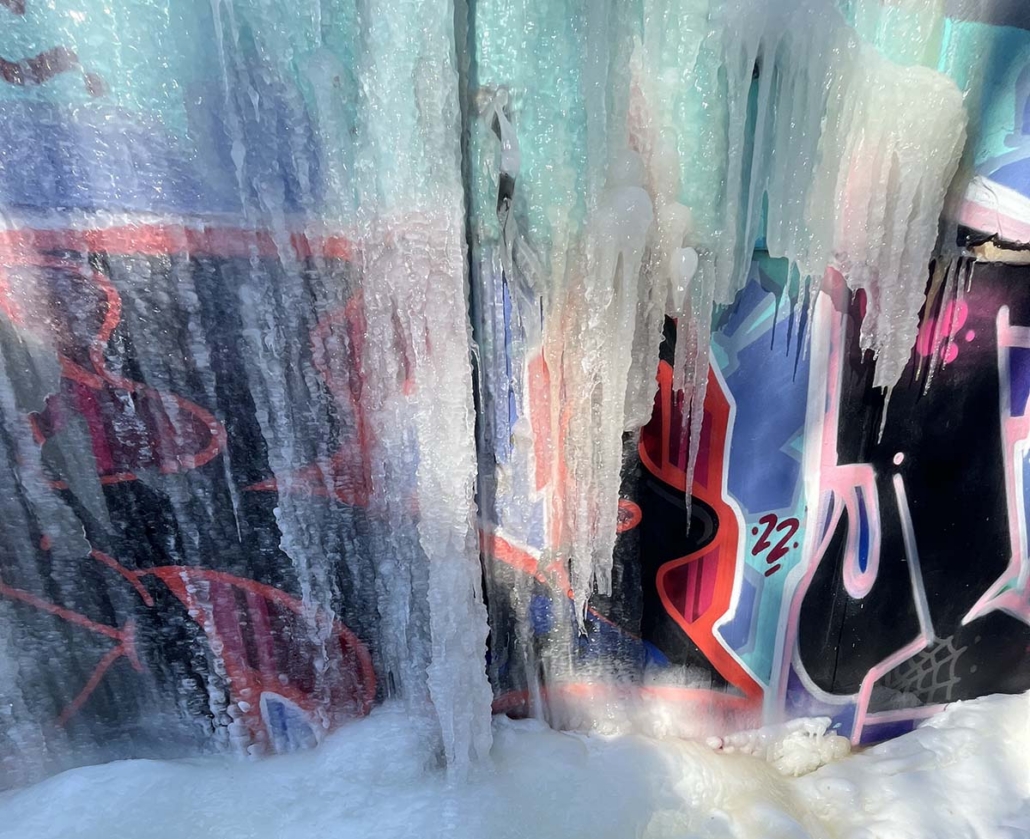
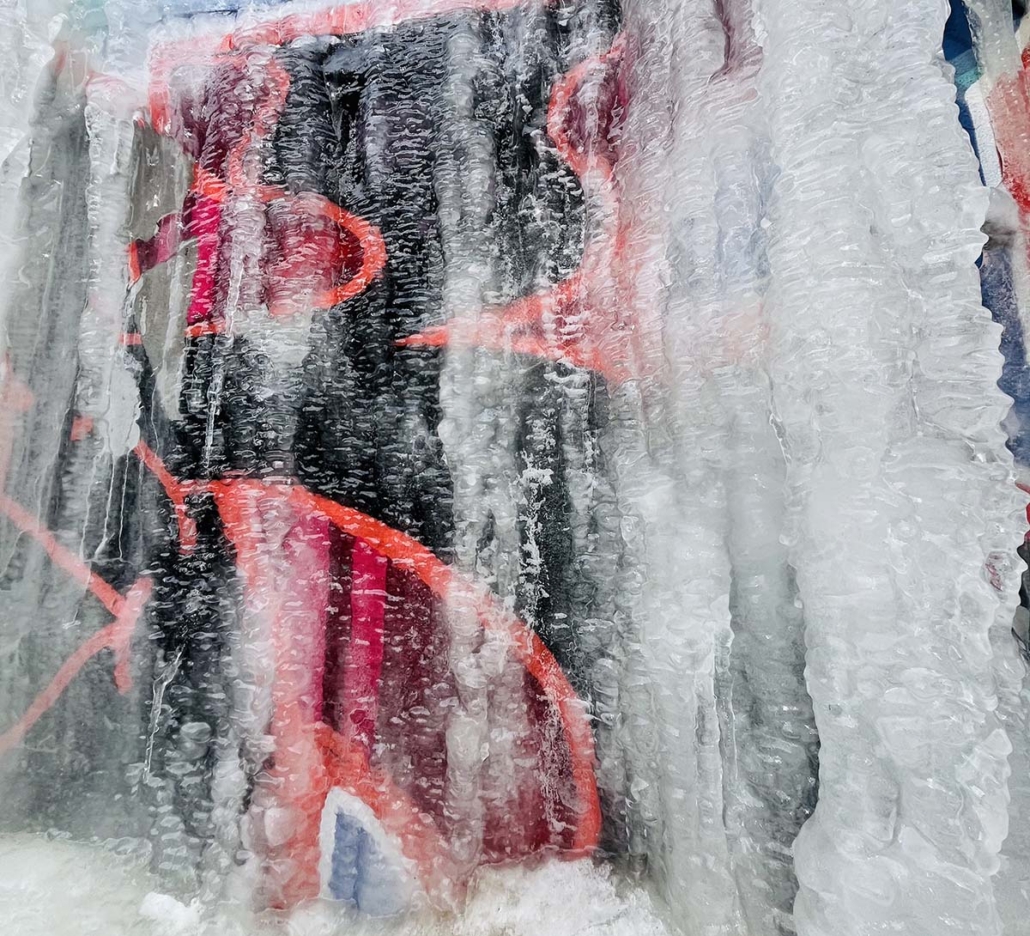
Street art by @Wade.Benedict

Fiction by Kelly Murashige

Driving Faith

when you were young, you forgot every car has a driver.

you have asked countless people if they forget too. every time, they reply, no. what the hell is wrong with you?

in your defense, you were in desperate need of glasses. once you got them, thin wire frames that glinted red in the sun, you realized there were faces behind all those windshields.

this is what you are thinking as you stand in the kitchen.

not yours. not your kitchen. yours is nowhere this nice.

this is hope’s. your older cousin’s. you two hardly ever speak.

you told your parents you don’t need a babysitter. you’re old enough to stay home on your own.

really, faith? your mom said. you’re going to fight a woman already battling cancer?

you hate when your mom plays the stupid cancer card. she claims she can, since your aunt, her older sister, did it first.

you got mad when she did that, you pointed out to her once.

yes, your mom replied, but now i have cancer, so i can.

“faith,” hope calls out.

you turn, your fingers tangled behind your back.

you never like your name but hate it most when you’re with hope. you’re like the parson’s daughters who preach love yet exude hate.

“your mom and dad just left the hospital.” hope grabs her keys. “ready to go?”

no. no, you’re not. you don’t ever want to go home.

you follow hope out of her house, then into her new car. you wish you could switch places. your mom always liked hope better.

hope starts the car, then guides it out of the driveway and down the street. you watch her house disappear in the rearview mirror.

“so,” hope begins.

you instantly wince.

“how’s your grandpa?” she asks.

the muscles in your neck spasm involuntarily.

you picture frog legs. salted frog legs. when they move, the children scream.

“my… grandpa?” you echo. “like, as in my dad’s dad?”

last week, you met up with your old childhood friend. he moved away for a while and came back all wrong. it took until now for him to seem like himself, and though your dad didn’t want you hanging out with him, convinced you would come back engaged and six months pregnant, you agreed to meet up for a while, by the beach.

how’s your grandpa doing? your friend asked at one point.

you turned to him, chilled, and said, loudly, what?

he shrugged. this didn’t really seem like an occasion on which one should shrug, but he was never the most socially aware person. it’s why you got along so well.

i remember your mom telling mine about him, he said. i was just wondering how he’s doing now. that’s all.

he died, you replied.

he blinked, caught off guard.

i—he paused; you found yourself oddly reassured to know you weren’t the only one who left gaps in each conversation—i’m sorry. i didn’t know. i thought he was still in… i mean, in—

hospice.

this, you’d discovered, was how to tell if a person had ever loved someone who had gone into hospice. those unfamiliar shied away from the word. those who’d had to see it knew it wasn’t the word that evoked fear. it was the smell, or the stare, or the wide, gaping mouth.

i’m sorry, he said again.

then it was your turn to shrug.

it was a while ago, you said, as if that made it better.

maybe it did. you wouldn’t have even remembered exactly when it had happened if you hadn’t been the one to design the funeral program.

“no,” hope says now. “your mother’s dad. how’s he doing?”

you lick your lips, wishing you could just disappear.

in your mind, you have one grandpa, now kept captive in an urn. the other is called jiji, a shortened, slightly incorrect version of the japanese word for grandpa.

“he’s okay,” you reply. “he’s tired but okay.”

tired because his two children are living with cancer.

okay because he must be. you all have to be okay.

at least, you tell yourself, your mom is still in good spirits. the last time she was on the phone with a friend, she claimed her upcoming mastectomy wouldn’t be all that bad.

on the bright side, she said, i could lose up to one whole pound.

you hate being a woman. you wish you were a car. then again, how many men act like their cars are women?

“he’s okay,” you say again, if only to yourself.

“good,” faith replies. “that’s good. i’m glad to hear.”

she pauses. you know, now, what she is going to ask next.

she spits it out: “how are you?”

you’re tired, and you do not want to talk.

you take the tissue she’s offering without understanding why.

then, once the tears start dripping down your neck, you smash her gift against your face.

when you were growing up, in addition to believing most cars drove themselves, you also thought you and your cousin had to be two separate species. she was everything you knew you could never, ever be: pretty, popular, prom queen two years running.

yet here, in her car, you see she knows you better than you’ve ever known yourself.

“thank you,” you say. then, later: “sorry.”

“don’t be sorry,” hope says. “just rest. you’ll be home soon enough.”

when you turn to the window, you find a familiar scene. if you squint—as you have to; you left your good contacts at home—you think you can see your apartment building.

“just rest,” hope repeats, her voice smoother than the road.

you force yourself to relax. the car seat embraces you.

you lean back, exhale slowly, and let hope guide you home.

Born and raised in Hawaiʻi, Kelly Murashige (https://www.kellymurashige.com/) is the author of the award-winning YA novel The Lost Souls of Benzaiten and Adam Silvera’s July 2025 Allstora Book Club Pick, The Yomigaeri Tunnel. Her 2025 short fiction has been nominated for Best Small Fictions.

Micro fiction by T.L. Tomljanovic

It don’t mean a thing

The boy is clever. He is awkward. Although he loves jazz, he never joined the middle school band. Today, he lied. The lie was why he was late coming home from school. A locker. A bully. The bruise on his forearm looks like a grape tomato, the one on his thigh looks like a bloody steak. In elementary he performed at the talent show. He’s older now. He knows better.

T.L. Tomljanovic is a judge for The Pride Roars blog and Off Topic Publishing’s flash fiction and CNF contests, and a Pushcart Prize, Best Small Fictions, and Best Microfiction nominee. Currently, she is curating a collection of microfiction titled Feast or Famine. Find her on Blue Sky @tomljanovic.bsky.social and at tomljanovic.wordpress.com/.

Flash fiction by Huina Zheng 

What we share

To him, the most romantic kind of love was a couple with white hair still standing side by side, watching the sun sink into the sea. We had only been living together for three months, yet we had already begun imagining the texture of our love: I thought of sails pitched against open water while he pictured a long, unbroken horizon. I told him he was wrong. How many couples ended up walking into the grave of marriage? How many spouses truly shared life with each other instead of bitterness? He always met my pessimism with a smile. He liked my edges; I liked the way he gave. When I came home from work and stayed up late studying for the graduate entrance exam, he would make me a cup of warm milk. Even when we had nothing, he still believed that being together was enough to make us happy. At twenty-three, we had both just graduated from college. He rented a tiny stall to repair phones; I worked as a clerk at a foreign trade company. We shared the same insecurity, only from opposite directions. Years ago, his parents had sewn all their savings into the lining of their pants and left for Guangzhou to make a living. His grandmother in the countryside forced him to stay behind. His body was left with an emptiness that could never be filled, his parents forever somewhere beyond reach. In my family, after my brother died of leukemia, my parents turned the living room into a courtroom of mutual accusations. My mother spent most of her days lying in bed, sobbing. My heart learned what it meant to feel distance at close range. We were both afraid of being abandoned. He tried carefully to please me; I planned to leave the moment he showed any sign of growing tired of me. When I had a fever, he stayed up with me through the night, poured warm water for me, checked my temperature. I clung to his gentleness. It was a hunger my body had learned to live with. He said when I was angry, I was like a cactus, bristling with sharp spines. After long hours repairing phones, his fingers always carried a sticky residue that never quite washed off. A film made of glue and sweat. Once, he brought home a pair of diagonal cutters, the blades sharp, gleaming with the cold light of a rodent’s teeth. He asked me to lie down and said he would help trim away the spines that had risen up. When the cutters closed, they made a faint sound, like fingernails being clipped. I imagined the nameless resentment that roamed beneath my skin being cut away, stripped off with precision. I wondered whether my mother had once wanted to pass something like it on as well. Whenever I was home, she would complain to me. About her headaches, her insomnia, the loudspeakers downstairs, the mold on the ceiling, every moment she felt she had been wronged. My comfort turned her into a black hole, draining me of hope. At night, I slept with my back to him, curled up like a baby. The spines along my back kept growing, sharper than before. He asked what was wrong. I said I was just tired. He asked if I had been losing sleep again, if I was having trouble breathing, and suggested we go running or hiking. His care settled in the details. I wanted to say that all I needed was a warm embrace, but my body didn’t know how to ask. He wrapped his arms around me from behind. I told him to be careful of my spines. He said it was fine. The spines pressed into his chest, like bamboo shoots searching for a place to take root between stones. Through pajamas, I could feel his body heat. I told him I loved him, that I wouldn’t leave him, using my words like a pledge to fill the emptiness in his chest. He said we would last forever. So we lay there, holding each other. Waiting for seas to dry and rocks to crumble. Waiting for our bodies to learn each other. Waiting for the future we cannot escape.

Huina Zheng either writes as an admission coach at work or writes for fun after work. She lives in Guangzhou, China, with her family.

Naturally

We mean, right?

Poetry by Nora Rawn

LHR to JFK

It will feel good to step into the 

free air of New York City, a young 

woman says, her tall companion trailing

alongside with his suitcase—hard

to tell how serious they are, 

glamorous in their youth, untroubled,

returned from London where 

petrol is up 7 to 15p, depending 

on the station, where CNN London

shows bombings of fuel depots

on one split screen, a sodomized

Palestinian prisoner on another.

Will flights be canceled? Will 

prices rise beyond the 

far horizon? The stewardess

hands out landing sweets 

down the aisle, her bowl

proffered row by row—maybe, 

one last memory of the world 

before it falls. Visual ID at the kiosk,

facial recognition complete,

no chat with customs. Past

the cab line, cloudy sky

and cold, an ICE van sits 

and waits. The taxi driver 

takes your address, and fortunate, 

you leave the worries of others 

for another day. You find 

your own worries. You are

in the free air of New York City,

the potholes being fixed, 

something festering beneath.

Nora Rawn works in subrights in publishing and lives in Brooklyn. She has pieces published or forthcoming in Dodo Eraser, Dreck Lit, Be About It Press, Hawkeye, Burial Magazine, Some Words, and Michigan City Review of Books among others. She is on twitter at @norabird.

Micro fiction by Lori Cramer

Because If I Hadn’t Taken Your Call, I Would’ve Always Wondered

if our relationship was nothing but a game to you, if you regret the words you said to me more than those you withheld, if I’m finally brave enough to tell you I’ll never be the person you’ve imagined.

Lori Cramer’s short prose has appeared in Fictive Dream, Flash BoulevardScaffold, Splonk, Whale Road Review, and elsewhere. Her work has been longlisted for the Wigleaf Top 50 and nominated for Best Microfiction and Best of the Net. Links to her writing can be found at https://loricramerfiction.wordpress.com. Bluesky: @loricramerwriter.bsky.social. X: @LCramer29.

Flash fiction by Kelly Murashige

The Prize

You have never wanted anything more than you want that giant rodent.

You bounce on the balls of your feet, your eyes glued to the pile of capybara plushes sitting behind the glass in the claw machine. Your mommy and daddy have been trying to win one for you for the past ten minutes, and you’re starting to lose hope.

You love capybaras. They’re your favorite animal in the world. That highly coveted title once belonged to unicorns, but then Justin Chun told you unicorns weren’t real and therefore don’t count, and you had to keep yourself from shouting, Or maybe YOU don’t count, JUSTIN in his stupid, ugly face.

You were sad for a while, about the unicorns. Now that you’re older—it’s been a whole three weeks—you have come to believe capybaras are the better animal. Unicorns, if real, would have turned you into a human shish kebab anyhow.

“Two more seconds,” you say, staring at the timer display. “Daddy, two more seconds!”

“I got it,” your daddy says, lifting his hand from the joystick.

He slaps the center button. You pray with all your might. You’re afraid begging God for a toy might be what your mommy would call sacrilegious, but you can’t help it. You want it so, so much.

If You give me this, you think, I swear I will be good.

You watch, your fists clenched, as the metal claw descends. 

Two silver prongs poke the capybara’s butt. Three suspenseful seconds later, they pull themselves back out.

You exhale, disappointed. Your mommy shakes her head.

“Again,” you tell your daddy. “Daddy, try again!”

Your daddy slips his fingers into his pocket. When he comes back empty-handed, just like that stupid claw, he says, “Give me a second, sweetie. I have to get more tokens.”

“More?” Your mommy frowns. “Is that such a good idea?”

You make a face. Your mommy’s silly. Of course it’s a good idea. More tokens mean more plays, which means more capybaras.

Your daddy turns away.

“I’ll be back,” he says.

Your mommy’s brows pull together. You’ve learned this means she’s mad. You try to tell yourself it’s because your daddy hasn’t won anything yet, but you’re not sure that’s it.

You’re still staring at the pile of capybaras, hoping you’ll magically develop laser vision and melt the glass separating you from the only things you’ve ever wanted in your whole entire life, when it hits you. You remember. What Katherine said yesterday.

You don’t like Katherine Miller. She stole your best friend twice. Then, yesterday, during lunch, she stood up and announced to everyone that soon, you will be poor. Her daddy is your daddy’s boss, and according to her daddy, your daddy’s losing his job.

On the way home, you told your mommy what you’d heard. She went quiet. Said don’t worry. That was a grown-up thing.

You knew then that it was true. That Katherine was right, and you’re going to be poor.

You know being poor isn’t always bad; Cinderella and Snow White were poor, and they got their happily ever afters, didn’t they?

You’re just afraid you’re not pretty or sweet or a good enough singer to make a handsome prince want to marry you.

They’re taking over you now. The Big, Ugly Feelings. You don’t know why they come, but when they do, they hit hard. All you can do is go dark. Shut down.

“All right,” your daddy says. “Let’s get you that capybara.”

You open your eyes. The tokens in his hand shine like Katherine Miller’s teeth.

You shake your head, your throat tight.

“I don’t want it,” you say.

Your daddy frowns. “What do you mean?”

“I don’t want it,” you say again. “I don’t want some stupid toy.”

Your eyes dart to the plushes. They stare back at you sadly.

It might be the guilt, or the noise, or the stress, but whatever it is, it makes you start to cry.

Your mommy and daddy exchange a look.

“Honey,” your daddy says. “What’s wrong? What happened?”

“I want to go home,” you tell him, and this, at least, is true. The music’s too loud. The lights are too bright. You’re going to be poor soon. Capybaras can’t fix that.

Your mommy looks up. Behind the panes of glass, the claw hangs limp, a wilted flower. “We didn’t get you your capybara yet.”

“I don’t care,” you say, even though you really do. “Take me home. Take me home. I just want to go home.”

They ask you, three times over, if this is what you want.

“Take me home,” you say again. How long will you have a house?

You look to the capybaras, as if you expect an answer.

They avert their gazes. They don’t want to break your heart.

“What’s wrong?” your mommy asks. “Can you just tell us what’s wrong?”

You shake your head. The Feelings. They’re too much for you again.

“Okay,” your daddy says. “We can talk this out at home.”

Your parents both reach for you, moving in perfect sync.

Yet for a moment, you’re certain they won’t be able to find you. Not when you’re lost in a sea of Big Emotions.

They pluck you out like it’s easy. Like they can’t lose sight of you. They raise you up and hold you in their safe, warm arms.

“I’m sorry,” your daddy says. “I wish I had gotten you that toy.”

You shake your head. Close your eyes. Rest your cheek against his neck.

You did not get a plush, but you won anyhow.

Born and raised in Hawaiʻi, Kelly Murashige (https://www.kellymurashige.com/) is the author of the award-winning YA novel The Lost Souls of Benzaiten and Adam Silvera’s July 2025 Allstora Book Club Pick, The Yomigaeri Tunnel. Her 2025 short fiction has been nominated for Best Small Fictions.

You’ve got this

We love the psychological clarity of this. Like it knows to meet us where we are. If we can’t be kind, exactly, if we’re not in the place or position for that, we can at least be kind(er).

Poetry by Kyla Houbolt

I have no excuse for this life

My train is here but

my heart is late.

My heart is here, all packed

and ready but the train

is late.

On the train we wonder

will it break down?

Will there be a collision

on the tracks?

These things happen,

it is often said,

to make us 

feel better

about disaster.

Kyla Houbolt is a poet and gardener living in North Carolina. Her first full length poetry collection, Becoming Altar, from Subpress Poetry, is available here: https://asterismbooks.com/product/becoming-altar-new-and-selected-poems Social media: https://bsky.app/profile/luaz.bsky.social, and website:  https://kylahoubolt.us/

Poetry by Jenny Wong

Trees & Teeth

When I am asked

Why are you so quiet –

even trees hold their memories

hushed, ringed 

in their bodies,

each year

layered

in trunks,

humming

in a frequency 

unmeasurable in syllables

until someone comes along

– a roaring saw 

teeth

demanding

answers. 

JENNY WONG is a writer, traveler, and occasional business analyst. Her favorite places to wander are Tokyo alleys, Singapore hawker centers, and Parisian cemeteries. Her work was selected for Best Microfiction 2025 and has been nominated for the Pushcart Prize, the Best of the Net, Best Small Fictions, Best Microfiction, and The Forward Prize – Best Single Poem (Written). Her debut chapbook is “Shiftings & Other Coordinates of Disorder” (Pinhole Poetry, 2024). She resides in Canada near the Rocky Mountains where she makes short poetry films and plans her next adventures. Visit her website: jenwithwords.opencorners.ca or find her on Instagram/X/Bluesky: @jenwithwords.

Flash fiction by Hugh Behm-Steinberg

Every Night I Go to Sleep I Dream I’m Standing on a Pier, Staring Out at the Sea

I call my parents at three in the morning. “Why are you calling us at three in the morning?” my dad says.

“I was having bad dreams,” I tell him.

“You’re fifty-seven,” he says. “You’re supposed to be having bad dreams. Go back to sleep.” He hangs up the phone.

So I go back to sleep, and in my dream I’m calling my parents, but they never pick up the phone.

*

I think about what my dad said and I call my parents the next day to apologize profusely, but they don’t remember I’ve called. “Okay,” I say. “But you said something about how I’m supposed to have bad dreams at my age. What is that supposed to mean?”

“What do you think it means?” my dad says. “The older you get, the worse it gets. Haven’t you figured that out yet?”

“Wait,” I say. “What are your dreams like then?”

“Nothing but screaming,” my dad says. “Sometimes I fall out of the bed. Sometimes it’s your mother.”

“And the tentacles,” my mom says. “Don’t forget about all the tentacles.”

“Tentacles?” I ask, doing my best not to sound alarmed.

“Just you wait for the tentacles,” my mom says. “Are you still going to have lunch with us Sunday at 1:00?”

“Let’s meet at Howard’s on the pier,” my dad says. “I’ll make the reservation.”

*

At Howard’s my parents order octopus. I order the fried squid. “You should take it easy on all the fried food,” my mom says. “You’ll get bad dreams.”

“But if I’m going to get bad dreams anyway,” I say, “why shouldn’t I eat whatever I want?”

“Bad dreams AND high cholesterol,” my dad says, sticking a fork with a chunk of octopus on it at me. Like he knows what he’s talking about.

“You think it’s hard running in your dreams now,” my mom says. “Wait till you find out.”

“Try running anywhere after your first heart attack,” my dad says.

I flag the server and change my order to a salad.

*

In my dreams there is so much cholesterol, and I don’t care. I’m eating the fried chicken of my childhood, the fried clams, the fried everything.

The ocean seethes. I’m sitting on a bench, my greasy fingers reaching into the to-go bag, pulling out a French fry, a clam strip. 

Each thing I eat in this dream is only going to make it worse. I know that, nobody has to tell me. But I keep eating, I’m enjoying every morsel I put in my mouth. The crunch. The salt, the chewy bits, everything.

*

My son calls me to tell me about his dreams. It’s always summer, he’s in the car with us on our way to go to the beach, but the car breaks down. We fix it and something else breaks. We fix that but now it’s dark. But we’re nearly there, so we go to the beach in the middle of the night, in the dark. Other people are there too, some families; pairs sneak off. They sound like birds. They don’t return.

The moon is full, we’re busy eating.

We don’t mind it when our kids go swimming in the ocean. We don’t mind when they never come back. We don’t even call.

“What do you think that means?” my son asks. 

“Have you ever just sat there,” I say. “Looking out for something nobody can see?”

“Sometimes,” my son admits.

“Keep doing that,” I say. “You’ll see.”

Hugh Behm-Steinberg (he/him/his)’s fiction can be found in X-Ray, ergot, Hex, Heavy Feather Review and The Coffin Bell. His short story “Taylor Swift” won the Barthelme Prize from Gulf Coast, and his story “Goodwill” was picked as one of Wigleaf’s Top Fifty Very Short Fictions. A collection of prose poems and microfiction, Animal Children, was published by Nomadic/Black Lawrence Press. He lives in Barcelona, where he’s the fiction editor of Mercuriushttps://linktr.ee/hughsteinberg.

❤️❤️

Segment of street art by @ps.loveishere

Two poems by Yuan Changming

Summer twilight

  All the flaring of the day

Dissipates, leaving cracks

For waves of winds

    To sweep in a clear-cut night

12 Heart Metaphors: a Chinglish Poem in Collocations

心房: heart house for a soul to dwell in 

心扉: heart door always ready to be opened

心鼓: heart drum to be beaten rhythmically 

心匣: heart case where to store one’s feelings

心镜: heart mirror to reflect one’s inner self

心田: heart field in which to grow the seeds of hope

心原: heart wildland for the will to roam freely

心谷: heart valley where one can camp for the night

心河: heart river to drift along on a sunny day

心海: heart sea to navigate towards the sun

心空: heart sky under which to fly against light

心坎: heart threshold for a traveller to step over

Yuan Changming co-edits Poetry Pacific with Allen Yuan. Yuan’s poetry, fiction, and creative nonfiction have appeared in Best of the Best Canadian Poetry (2008–2017), BestNewPoemsOnline, and over 2,200 publications across 52 countries. He has published sixteen chapbooks and received multiple Pushcart Prize and Best of the Net nominations. A former poetry juror for Canada’s National Magazine Awards, he began writing fiction in 2022. His recent books include The TunerFlashbacksReturn to Roots, and the novel trilogy Towards, all available on Amazon.

Flash fiction by Jay Chesters

Take A Bite Of The Big Apple

A terrible roar shook the Earth to its molten middle. In the skyscraper’s timeless Art Deco facade, the improbably large dinosaur saw its mirrored reflection. An enemy!

Taking a bite out of the Big Apple’s iconic terraced crown, the behemoth sent a deadly rain of glass, steel, and bricks to the avenue below.

People from all walks of life found common ground in running, screaming, for their lives.

Wholly by coincidence, a conspiracy theorist convention was meeting across the street that day. Upon hearing the news, the conference organisers cancelled the informal breakout sessions. Drastic times called for similar measures; they convened an impromptu emergency panel discussion.

Debate raged like civil war between radical factions. Was it all an authoritarian government false flag power grab, or hallucinogenic fluoride in the tap water?

But on something they did agree, and so they flocked outside with one mind, intent on proving there was no danger.

The leviathan lizard’s attention turned to its prey.

“It’s a hologram, a cheap hoax!” said the overpaid keynote speaker to his acolytes.

The beast separated the speaker’s head from his body with one swift bite. The sickening crunch made any further debate redundant.

On the 31st floor, a menace of stone gargoyles roosted peacefully, their wings outstretched. For decades, they had guarded the building’s corners, sightlessly watching life come and go.

Under the unrelenting monstrous assault, their solemn watch ended with an inelegant swan dive to the street.

As an armoured convoy armed with anti-dinosaur bazookas rolled up 42nd Street, the cinema audience cheered in their seats.

“This is fantastic!” the director turned in his VIP recliner to the man slumped next to him. “When does any film ever get this reaction?”

The writer’s story was a hit, but to him the technicolour picture’s was drab grey. His salted buttermilk popcorn? Flavourless cardboard.

He was inconsolable; he should have known the director wouldn’t get it.

The writer had kissed his late wife at the skyscraper’s 71st-floor observatory on their first date. The building represented his love.

The dinosaur? His raging grief.​​​

Jay Chesters is a Western Australian transplant with a penchant for the peculiar and blurring genres. They come from a long tradition of people who are, at best, today described generously as ‘eccentrics’. Lacking skills in swordfighting, horseback riding, or swordfighting on horseback, and finding few opportunities for getting fired out of cannons, Jay writes stories instead. Jay’s published books are The Cat Who Hated Bird and Year of the Bear. These tales share good company with those in two printed collections from Night Parrot Press and various stories published online. Collectively, Jay explores identity and connection, and the surprising beauty of the human experience. They acknowledge the unceded boodja of the Wadjak Noongar people on which they live and write.

Creative nonfiction by Travis Flatt

A Box Under the Christmas Tree Looks Suspiciously Like a PlayStation 5

A box wrapped in green and red plaid paper, which looks suspiciously like a PlayStation 5, appears under the Christmas tree. Like, almost three feet tall by ten inches wide, this box, not just a console jankily wrapped in paper—the things have a distinctive look, like a science fiction toaster.

At the moment, a PlayStation 5 is impossible to find at Target, Walmart, etc. You can buy one online for almost twice its official price and you’re likely to get scammed. 

For this and other reasons, such as existential guilt that I have better shit to do with my free time (reading, writing, exercising), which is ample after losing my job—our boutique bookstore finally closed last month—I told my wife I didn’t want a PlayStation 5. If I ever get one, I’d wait until they were available in stores and cheaper.

I’m not handy. I don’t own any tools. My wife is, and she’s got a whole, for real toolbox. Today, while she’s at work advising students at the university, I check in her toolbox for measuring tape and don’t find any. I do find a ruler in the drawer of my stepson’s school supplies. 

I Google the exact dimensions of the PlayStation 5 box.

The box under the tree is just a little too short, half an inch, but maybe the measurements I found online aren’t up to date. Maybe this is some kind of new packaging. Second-hand and repackaged by eBay scalpers. For the life of me, I can’t figure out what she’d buy for me that would come in a rectangular box this size. 

I peek through a fold of wrapping paper. I find a loose place where I can just slightly lift and peep in with a flashlight—gently, so as not to rip the paper. The box inside is white. The PlayStation 5 box is white. I accidentally tear the paper, just the tiniest bit, trying to catch a glimpse of the logo or any writing, so I quit.

When my wife comes home from work, she sets immediately to cooking dinner. I’m a miserable cook. She dislikes anything I make and isn’t polite about it. She’s the kind of honest that doesn’t smile and eat shitty food. She wanted to go to cooking school but couldn’t afford it. She can bake difficult things like sticky toffee pudding and did so when my mom asked last Christmas. 

I follow her around the kitchen, wanting to ask her about the mystery box, and worry she’ll notice I tampered with it. I can think of nothing but the box and seem distracted until she finally asks me what’s up? 

I break down and ask. 

(By the way, I’ve already called my mom to tell that I suspect my wife bought me a PlayStation 5. My mom says that sounds like something only my wife would do. She means that as a compliment.) 

I confess everything—the measuring, the peeking.

Well, I try to, anyway; she cuts me off at the “tearing the wrapping paper” part and tells me it’s a pasta maker. 

I start crying. Feel helpless. Mortified. 

Besides books, which I normally buy for myself, I haven’t asked for anything for Christmas in years. We’re poor. Not miserably so, just fine. I don’t enjoy shopping or spending money. 

She says it’s okay to want things

When we go to, say, Target or TJ Maxx, and my wife just goofs around and browses things while I stand silently—like a dick—and think, “junk,” ruining the whole normal American thing for her.

I lie, promise I’m alright, that a pasta maker sounds fun, and we talk about cooking pasta, our mutual love of pasta, the time we’ll spend together, how I’ll learn something (improve my cooking; just improve at something), but I’m half talking and half listening. I’m entirely hoping she’s lying, that it is a PlayStation 5 and this has been subterfuge, that somewhere there’s a PlayStation 5 hiding—in her closet, in the attic, in her office, somewhere.

Travis Flatt (he/him) is an epileptic teacher and actor living in Cookeville, Tennessee. His stories appear in Necessary Fiction, Cleaver, Iron Horse, Scaffold, and elsewhere. He enjoys theater, dogs, and theatrical dogs.  

Poetry by Madison Golding

The Bookshop at the End of Wanting

I found you between the cracked spines in the vellichor of a shop where someone else’s marginalia said yes, exactly! in pencil beside the line I needed most.

I looked through paned glass, its glazing chipped.

Every stranger outside the window carried their whole catastrophic life in a canvas tote. All of us, separately, immolated.

Obsession. Infatuation. 

These are neighborhoods I keep moving back to. The rent is cheap. Great light. I swear I’ll leave some day. 

I never do.

We stayed up past reason. The sky went indigo and misty, ice clouds lit from below. You said you knew what it meant like you always do.

The same wanting returns each morning.

Relentless.

Madison Golding writes from the Washington D.C. area about the people history invented and systems tried to silence. Their poems explore desire, the body, spiritual longing, and tenderness smuggled through toughness. They publish at substack.com/@madisongolding.

Word

A while ago we moved from a small city to a big one, into a place that was half the space and twice the price. On the coldest day of the year. Everything was frozen. We were nervous, aware of what we were losing but not yet what we’d gain. Someone helping us move had a habit of saying ‘nice!’ when he went into each new room, or with each new haul of boxes. ‘You’ll be happy here,’ he said when everything was in. He had no idea how much that helped us but we’re passing it on. Nice!