Posts

Poetry by Zadie McGrath

It’s not like a city wants to be a city anyway


it is the memory coming back : a basilisk unfolding

in the trenches of the earth, how we bend

around a word : an incantation.


see : night has polluted to pastels

we want to make a city on the moon see :

we stargaze already

for satellites.


it’s not like a city : wants to be a city anyway.

we take the sea

where we can get it,

ocean-scraped leavings and the roadside

is pedestrian is a storm victim see :

this city a feat

a freak : of nature.


i tried to write a fury poem and instead i wrote overwhelm and the hum of the air by the roadside.

i burned my hair on six hours sleep and it should’ve been enough.

i would go away, i said, guilty.

i sat roadside on the least road a road could be,

dug through landfill just to see :

retina on screen,

see : sand billowing

onto the concrete overstory,

the back end of things,

the basilisk unfolding

in subway tunnels, in charted ocean.

i met the basilisk seaside, roadside and it told me

see : you defy yourself.

Zadie McGrath is a student writer from San Francisco. Among other places, their poetry has been published in Apprentice Writer, Backwards Trajectory, and boats against the current. They love fantastical stories, and there’s a good chance that they are thinking of one as you read this.

Poetry by Rick K. Reut

(TIME MACHINE)

…of time in places where

that time stands still or flies

around like fireflies 

in the neon night air.

Your memory is a time

machine taking you back

to the scene of each crime

you’ve committed in black

and white. You go to sleep

before you begin to dream

about all you did deep

in the past. It may seem

like you are looking back

to see someone like you

talk to someone you knew

once again. There’s a track…

…of time in places where that time stands still or flies around like fireflies in the neon night air. Your memory is a time machine taking you back to the scene of each crime you’ve committed in black and white. You go to sleep before you begin to dream about all you did deep in the past. It may seem like you are looking back to see someone like you talk to someone you knew once again. There’s a track…


Special note: The piece is an example of what the author calls cyclic verse, which presupposes a poem having no beginning or end and working in both rhyme and prose. A portion of it was previously published in Active Muse.

Rick K. Reut was born in 1984. He studied philosophy at EHU in Minsk, Belarus, and Vilnius, Lithuania, and literature at SPSU in Saint Petersburg, Russia. For most of his life after graduation, he has worked as a translator and a tutor of English as a foreign language.

Flash fiction by Judy Darley

Bluespot Ray 

Their second date was at an aquarium where a green turtle swam with lemon sharks. She picked the setting. Her friends said it was a safe choice where they could make small talk while oceans lapped in tanks.

Small talk didn’t interest her – what she wanted was deep dives where the only light came from biofluorescence. 

She’d once seen a nature documentary about wafting sea creatures glimmering quietly far from the sun’s rays. She imagined it would be like drowsing in the warmth of someone’s arms while the day unfurled behind drawn curtains.

On their first date in the coffee shop he’d told her his favorite color: blue, and then listed his preferred shades: cobalt, Egyptian blue, ultramarine.

She waited for him to ask her favorite color, but the question never came.

“My birth stone is aquamarine,” she said, and he blinked as though she’d interrupted the current of his thoughts.

“Why would you even see him again?” her friends asked, and she shrugged. 

When they’d exited the coffee shop into a downfall, he opened an umbrella and held it above them. She’d caught herself noticing how his dark hair shone with stray droplets.

They walked together to the bus stop and he waited with her until the bus arrived. His body blocked the breeze whistling through the shelter’s broken window. They stood together in a pool of silence that felt warm despite the afternoon’s chill. 

When she boarded the bus and the vehicle pulled out, she watched him watch her leave.

No one had been that careful with her since she left her childhood home. The instinctiveness of his kindness moved her.

At the aquarium he was in his element, naming fish species with a joy that seemed almost reverent. In the glow of the Great Barrier Reef tank, she wove her fingers through his. He jumped at her touch, but then smiled down at her and asked: “Which is your favorite?” 

She thought of the pinktail triggerfish that had caught her eye, but pointed instead to the bluespot ray. “This one.”

He looked at her intently and she couldn’t read his gaze. “Did you know these rays are loners? The blue spots warn other fish to keep their distance.”

“Oh? But they’re so pretty they make me want to come closer.” She squeezed his hand and stood on tiptoe so they were nearly the same height, almost eye-to-eye.

Judy Darley is a fiction writer, journalist and brand engagement manager living by England’s North Somerset coast. She is the author of short fiction collections The Stairs are a Snowcapped Mountain‘ (Reflex Press), Sky Light Rain‘ (Valley Press) and ‘Remember Me to the Bees‘ (Tangent Books). Her words have been shared on BBC radio, aboard boats and on coastal paths, as well as in museums, caves and a deconsecrated church. She is currently working on a short fiction collection and a hybrid memoir beast she’s not sure how to describe. 

Find Judy at https://bsky.app/profile/judydarley.bsky.social

Credits

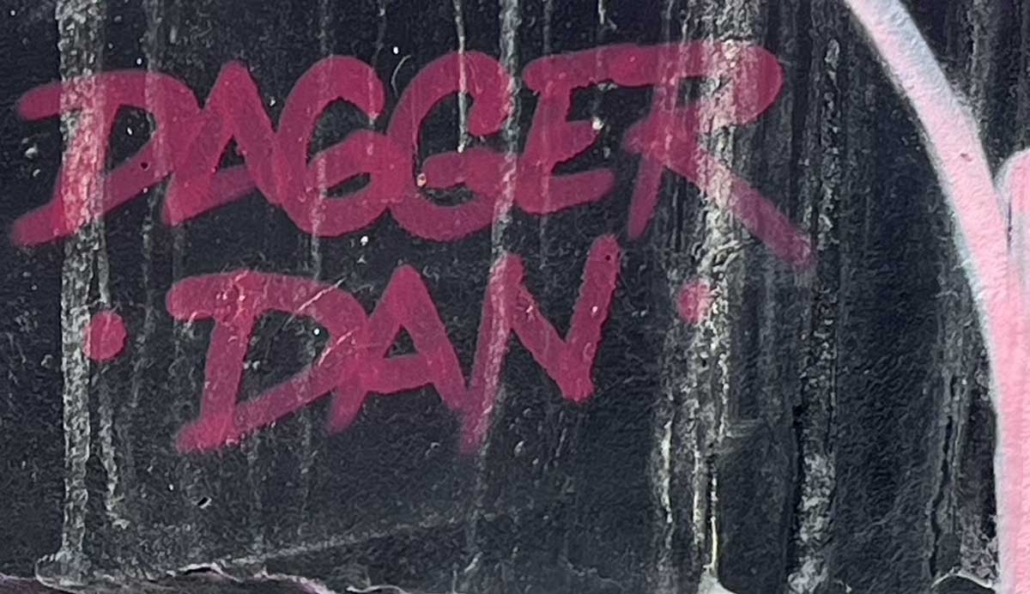
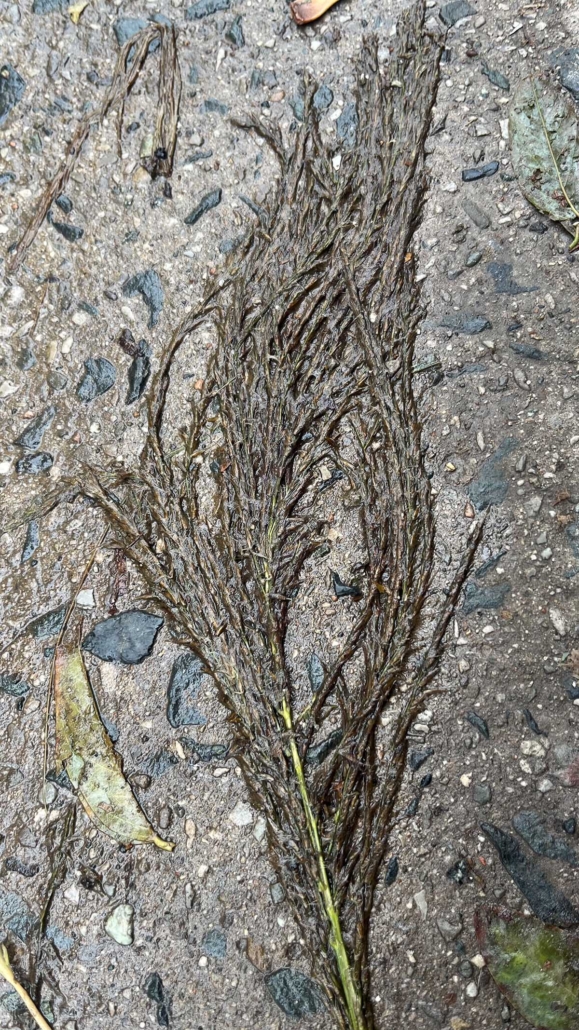
The ice in all the photographs in this issue was the work of nature but the vividness below seems to be the work of this person. With appreciation for brightness that shows through even the thickest hurling covering.

Contributors:

Daniel Addercouth, Madeleine Armstrong, Pam Avoledo, Sudha Balagopal, Karen Baumgart, Joyce Bingham, Kendra Cardin, Janel Comeau, CS Crowe, Judy Darley, Darren C. Demaree, Bart Edelman, LM Fontanes, Seán Hill, Kevin Hogg, Matthew Jakubowski, Zadie McGrath, Emma Phillips, Oliver Reimers, Rick K. Reut, Kevin A. Risner, Al Russell, Mario Senzale, Federica Silvi, Sumitra Singam, Betty Stanton, Alison Wassell, Huina Zheng.

Poem by C. Oulens

What I Didn’t Take Today

I’m trying to find some joy for my poem because both—the poem and I—are aching for it, and everything I might receive it from has declined our plea, albeit politely. I could have peeked into our old album, where smiles lie nestled in time’s stillness, more than willing to spill on me—but today I’m not keen on their generosity. I could have scanned my journal, older than the album itself, which carries a hurriedly torn quarter-of-a-page bearing your hasty-but-pretty, jumbo-font message, calligraphied with an improvised permanent marker:

“[your name] is inside”

taped to the inside of the front cover, ahead of the scribbles on my first page. It has always brought me a grin when I recall the walls you scaled to slip in before adorning the door with this cello-taped, unabashed announcement—its confident, presumed self-invite.

I could have done any of these, and more, but I wouldn’t want to cling. If there is joy now, it is only in a beatific scream befitting the ache of letting go, of accepting impermanence. Perhaps I’ll go for it, and this poem—it will too, learn to introspect and wait its turn. I know it will come to know, in time, that joy can’t be contained: a scintilla wriggling to break through, even as I breathe buried beneath this flotilla of bulk-laden pain—from behind some brazen wall, a break-in door, or an inconspicuous bend. And maybe then—birds and bees and I—will be busy enough to notice when the poem begins to bustle. And on some long, cold winter night, the album and the quarter-of-a-page may relearn how to rekindle, for this old heart, a new, warm, tear-strung smile; and for the poem, a string of ocean’s pearls.

C. Oulens is an upcoming poet from India. She’s the winner of “3rd Annual Poe-It Like Poe 2025” poetry contest. Her works are published/accepted in The Broken Spine anthologies, Lothlorien Poetry Journal, The Starbeck Orion, The Candyman’s Trumpet, The Wee Sparrows, Verseve, Sixty Odd PoetsSciFanSat and in haiku journals namely PHR575haikujournal, Poetry Pea, Haiku Pause, Solitary Daisy, FolkKu, Failed Haiku, Haiku Pause and Heterodox Haiku. Her poetry engages with radical questions on the individual and society, suffused with sentience, wit and satire. She is active on social media on the following platforms as: BlueSky: @owlnsquirrels1111.bsky.social; Threads: @owlnsquirrels1111; Substack: @coulens

Poetry by Abraham Aondoana

The Umbrella That Refused


The umbrella refused to open.

The raindrops were courteous on its surface,

then danced elsewhere.

People stared,

some annoyed,

some enchanted.

I carried it anyway,

as in possession of a little uprising.

in my lap,

like walking with a thought

that had legs of its own.

It didn’t shelter me,

but it made me look.

It made me believe

a little in nonsense.

Abraham Aondoana is a writer, poet and novelist. He is a recipient of Idembeka Creative Writing Workshop 2026. His works has been published in Kalahari Review, Prosetrics Magazine, Rough Diamond Poetry, The Cat Poetry Anthology, IHTOV, The Literary Nest, Ink Sweat and Tears (UK), Rogue Agent, Ink in Thirds Magazine, Interwoven Anthology (Renard Press), Writing on the Wall, Alien Buddha, Blasphemous Journal, Rust Belt Review, Speculative Insights and elsewhere.

Poetry by C. Oulens

What I Didn’t Take Today

I’m trying to find some joy for my poem because both—the poem and I—are 

aching for it, and everything I might receive it from has declined our plea, 

albeit politely. I could have peeked into our old album, where smiles lie nestled 

in time’s stillness, more than willing to spill on me—but today I’m not keen on

their generosity. I could have scanned my journal, older than the album itself, 

which carries a hurriedly torn quarter-of-a-page bearing your hasty-but-pretty, 

jumbo-font message, calligraphied with an improvised permanent marker: 

“[your name] is inside”— 

taped to the inside of the front cover, ahead of the scribbles on my first page. It 

has always brought me a grin when I recall the walls you scaled to slip in 

before adorning the door with this cello-taped, unabashed announcement—its 

confident, presumed self-invite.
 

I could have done any of these, and more, but I wouldn’t want to cling. If there 

is joy now, it is only in a beatific scream befitting the ache of letting go, of 

accepting impermanence. Perhaps I’ll go for it, and this poem—it will too, 

learn to introspect and wait its turn. I know it will come to know, in time, that 

joy can’t be contained: a scintilla wriggling to break through, even as I breathe 

buried beneath this flotilla of bulk-laden pain—from behind some brazen wall, 

a break-in door, or an inconspicuous bend. And maybe then—birds and bees 

and I—will be busy enough to notice when the poem begins to bustle. And on 

some long, cold winter night, the album and the quarter-of-a-page may relearn 

how to rekindle, for this old heart, a new, warm, tear-strung smile; and for the 

poem, a string of ocean’s pearls. 

C. Oulens is an upcoming poet from India. She’s the winner of “3rd Annual Poe-It Like Poe 2025” poetry contest. Her works are published/accepted in The Broken Spine anthologies, Lothlorien Poetry Journal, The Starbeck Orion, The Candyman’s Trumpet, The Wee Sparrows, Verseve, Sixty Odd PoetsSciFanSat and in haiku journals namely PHR575haikujournal, Poetry Pea, Haiku Pause, Solitary Daisy, FolkKu, Failed Haiku, Haiku Pause and Heterodox Haiku. Her poetry engages with radical questions on the individual and society, suffused with sentience, wit and satire. She is active on social media on the following platforms as: 

BlueSky: @owlnsquirrels1111.bsky.social; 

Threads: @owlnsquirrels1111; 

Substack: @coulens

Temple in a city nominations

Congratulations to all nominated authors


Best of the net 2025

Sumitra Singam, Bird swallowers

Rachel Rodman, He Always Lied, I Always Told the Truth. And Then We Fell in Hate

Kathryn Reese, Post-vespers

Pushcart Prize 2025

Cole Beauchamp, If Only

Emily Rinkema, Lou

June Gemmell, The Homecoming

Kendra Cardin, A change in the recipe

S.A. Greene, Brian Wilson is dead and why can’t I stop crying?

Dominic Walsh, Slice of life, in absentia

Best microfiction

Elizabeth Rosen, Endeavor

Slawka G. Scarso, And then she told Jack off

Sumitra Singam, You-and-Kate in a field, loving me

Vijayalakshmi Sridhar, I heard you became a father again

Huina Zheng, The pin inside my body


Best small fictions

Ivan de Monbrison, Marseille, August 2nd 2025

Monica Dickson, How to make a living coffin

Emily Rinkema, Lou

Rachel Rodman, He Always Lied, I Always Told the Truth. And Then We Fell in Hate

Vijayalakshmi Sridhar, I heard you became a father again

Fiction, Huina Zheng

Small magic

After a typhoon destroyed my father’s brick factory in our hometown, my mother brought back a large box of beads from the town factory. She said she had always liked handicrafts, but when we were younger she never had the time. Now that we were older, with my older sister twelve, me ten, the next sister eight, and my brother six, she could finally return to something she enjoyed. “Don’t worry. We’ll manage to borrow money to rebuild the factory,” she told my father over the phone, who was still in our hometown five hours away. “I’ll handle our living expenses.”

She sat in front of the television every day, stringing bracelets and necklaces as she watched her shows. She taught my sisters and me how to choose beads and match colors, and how to guide thin thread through bead holes so tiny they made you anxious. “Dark blue with light blue looks like sea and sky,” she said, rolling a frosted bead in her fingers. “Add a white one and you have a wave.” We concentrated hard; even my brother wandered over. His little hands grabbed fistfuls of beads, and my mother let him play until he got bored and climbed back onto the sofa to watch Doraemon.

She also brought home bags of plastic petals, stamens, and leaves. She showed us how to glue petals around a stamen, how to wrap green tape around wire to make a stem, and how to attach the leaves in just the right spot. But we complained about the sharp smell of glue and how plastic flowers lacked the scent of real ones. “Use your imagination,” my mother said. “We’re conjuring blossoms.” She told us we were magicians capable of creating beautiful, fragrant flower fairies, though she opened a window and set the fan facing outward for fresh air. 

Handicrafts were not as joyful as she claimed. My older sister grumbled about her homework; my younger sister kept saying she was tired. One by one, they slipped back to their rooms. Only I remained, learning, amid the noise of cartoons, how to “grow” a singing flower in the fastest way. “What a lovely voice,” my mother said. “More melodious than a yellow warbler.”

One evening she carried home a bundle of half-finished clothes. “Flower season is over,” she declared. “Today we sew buttons.” She called it a skill every good girl should know.

We disliked it immediately. “Our summer uniforms don’t even have buttons. The winter ones have zippers,” my older sister said. “The needle keeps poking me,” I added. My younger sister cried outright after pricking her finger.

“Practice a few more times. Be careful. You’ll see, it’s easy,” my mother coaxed us, forcing a small smile. “Think of it this way. You’re letting the clothes bear fruit.”

We shook our heads. Even my brother frowned.

“Sewing buttons,” my mother explained, “is just the foundation. Once you learn it, you can make cloth dolls, knit sweaters, even do physics experiments.”

“This isn’t fun at all!” I burst out. “Handicrafts are your hobby, not ours.”

My younger sister sniffled; my older sister buried herself in her workbook. My brother had long since crawled under the table.

My mother looked at the buttons scattered across the floor and sighed. She pulled a strand of bright yellow thread from the box and, holding it under the light, slowly slid it through the needle’s eye.

“What do these buttons look like to you?” she asked. Before we could answer, she picked up a small round white one. “Doesn’t this look like a tiny robot face? See, the top two holes are eyes and the bottom two are nostrils.”

My younger sister stopped crying, peeking through her fingers.

My mother then picked up a square brown button. “This looks like a dirt block from your video game,” she told my brother. “If we sew it on with green thread, grass will grow right on top.”

My brother peeked over the edge of the table.

“And you,” she said, handing me a clear blue button, “hold it to the light. Doesn’t it look like a trapped water droplet?” Then she picked up a red button with floral patterns and dangled it in front of my older sister. “This one makes a perfect emblem for a magical girl.”

When she saw us watching her again, she smiled. “Each button is a little spirit waiting to wake up. And this needle,” she said, raising the threaded needle, “is the wand. When the wand touches the spirit’s heart, it will stay on your clothes and never run away.”

“So,” she asked, “who wants to wake the first little spirit?”

We glanced at one another and raised our hands together.

Huina Zheng holds an M.A. with Distinction in English Studies and works as a college essay coach. Her stories have been published in Baltimore Review, Variant Literature, Midway Journal, and other reputed publications. Her work has been nominated thrice for both the Pushcart Prize and the Best of the Net. She resides in Guangzhou, China with her family.

Poetry, Tracie Renee


February date

hot  

coffee 


in  

two  

cups 


and  

time 

enough 


to 

sip 

the  

steam 

TRACIE RENEE (she/her) is a librarian, a Publishers Weekly book reviewer, and a BOTN-nominated writer who lives and dreams in sort-of Chicago. Find her in HAD, Orange Blossom Review, on Bluesky @tracierenee.bsky.social and at https://linktr.ee/tracie.renee.   

Contributors, Imprint, issue 3

Welcome to Imprint, Temple in a City’s most recent issue.

To imprint is to mark a surface, or deposit a feeling or thought that lingers even if you don’t try to remember it. 

This issue brims with stories and poems that leave a trace. We hope you enjoy it.


L. Acadia 
Mehreen Ahmed
Hilary Ayshford
Samantha Backlund-Clapp
Robin J Bartley
Lanie Brice
Chris Cottom
Ivan de Monbrison
Litsa Dremousis
David Gaffney
Ezra Gatlin
S.A. Greene
Alaina Hammond
Rachel M. Hollis
Amy Marques
Rob Moore
Jay Parr
Juanita Rey
Chris Scott
Calla Smith
Joanna Theiss
Christina Tudor 
Dominic Walsh

2 poems, Juanita Rey


PRESENCE

I never thought she’d be present

at the birth of her first great-grandchild.

She’s buried in Santo Domingo these many years.

But her ghost doesn’t just haunt the old neighborhood,

it can travel as well.

I’ve been carrying the eggs of her daughter’s eggs.

The shells have cracked.

A brown-skinned boy with a squawk like an eagle

and dark curly hair, 

is curled up in both our arms.


That was her phantom in the delivery room.

Quite spry for someone the age she would have been.

She peered over the shoulder of the doctor.

She helped the nurse to steady the newborn,

gently nudge the fear out of him.

Those are her hand-prints in the blood,

on my brow. 


So the line never stops.

Maybe her mother is around as well.

And the mother before that.

Pregnancy is not a singular event

but the latest in a long line.

Everyone embraces this new human flesh.

They tap the back.

They get the lungs working.

They kiss the cheeks so gently

it’s like a warm breeze from the islands.


IT’S ALL IN HERE

He doesn’t get my poetry.

To him it’s just words and more words,

sprinkled randomly on the page.


And yet he can’t help reading

this stuff I write.

As abstract, as arbitrary as it may be,

I am the author.


He tried conversation.

But found it unrevealing.


So he figured there’s

no other way into me

than through my creations.


What can I say?

Nothing.

Lines on a page.

is how I really feel.

Juanita Rey is a Dominican poet, US resident. Her work has been
published in Mixed Mag, The Mantle, The Lincoln Review, Lion and Lilac
amongst others.

Poetry, Ezra Gatlin

rose-colored glasses


sometimes, i think about dying

in a place where my sins backlight my regrets

i am the poltergeist 

seamripping crushed velvet in my sleep

i am the dancing santa 

on the dashboards of a suicide heist

drunk off cherry wine and cyanide rum


for a few short weeks in april, 

cherry blossoms fall like rain

homesick kanzan kiss the foreheads 

of unsuspecting travellers,

begging the wind to take them home

stupid sakura petals don’t know,

they’ll die dusting rooftops

i want to be good

where soul meets body

i want to be beautiful 

when pain flays passion

i want to drive past my guilt

while death becomes her


washing expensive stationery in watermelon juice

pressed magnolias and dessicated pulp

crumble beneath my fingers

i found god in a whore house

and on barren beach

just before the tsunami of

japanese cherry blossom

dances with the birds

Ezra Gatlin (they/any) is a black, transmasculine poet from Aurora, Colorado. They have new or forthcoming publications in Bluebird’s Scribe Review, Arcana Poetry Press, Page Gallery Journal, and more. They are a 2025 Poet–in–Residence with Bitter Melon Review, and are seeking publication for their first manuscript, “I think there’s something wrong with me.” They can be found at @bloodbornepoetry on Instagram.

Two poems, Amy Marques


Misundershared

My grandmother always kept a notebook

overflown with wonderings on whether anyone cares

about things left unsaid, unheard, misundershared

always writing, often feeling less than understood


Overflown with wonderings on whether anyone cares,

I temper thoughts,               pace the volume of speech

always writing, often feeling less than understood

crafting whole landscapes to explain the inexpressible 


I temper thoughts,             pace the volume of speech

for there are those who care to listen and join in

crafting whole landscapes to explain the inexpressible

because shared language translates the misheard  


For there are those who care to listen and join in

bravely, tenderly, exploring the spaces between

knowing how shared language translates the misheard

willing to plow and plant in common ground 


Bravely, tenderly, exploring the spaces between

attentive to sunrises, gathering clouds, seasons

willing to plow and plant in common ground

nurturing seeds of truths


Attentive to sunrises, gathering clouds, seasons

of birth, of growth, of dormancy, of decay

nurturing seeds of blossoming truths

making time to harvest words, share stories


Of birth, of growth, of dormancy, of decay

things left unsaid, unheard, misundershared,

making time to harvest words, share stories:

my grandmother always kept a notebook.

Overture

Tell your daughter about the day of her birth


Tell her how you said let’s go, but not 

calm, not as together as you are now

maybe even panicking a little, driving

her mother to the clinic with the speed

of a glaucomic grandmother behind 

the wheel of a jeep you bought 

with a first grownup paycheck 

and how you stopped the car to yell

I’m having a baby to the closed clinic door

and how the nurse opened

what?

And you explained that it was your wife

having a baby and you could feel your heart

contract and blood push when they said

it was time, but not time, so there was time

to settle, to hold her mother’s 

hand until your daughter came 

perfect

and cried perfectly and breathed

until she didn’t and you didn’t and you didn’t


Tell her they grabbed her and ran

and her mother said go

and you raced to follow, to ask, to protect 

but they didn’t explain and she didn’t cry

then they said she needed help to breathe

to be

that maybe she wouldn’t learn, wouldn’t walk, 

wouldn’t


so they took her in an incubator, and you rushed,

chased them like a racer, like a father 

bargaining with God, with life, for


days, you sped from child to mother,

helpless hopeful prayers

threating God with boycotts of faith

pleading promises

waiting


You still remember, although it’s been

twenty-three years and your daughter’s fine—

has always been fine—she knows you know that

But maybe she doesn’t know that on the day she arrived

you almost lost her and you said you’d give 

life to protect her

and all you’ve done since

is try.

Amy Marques grew up between languages and places and learned, from an early age, the multiplicity of narratives. She’s been nominated for multiple awards, longlisted twice in Wigleaf 50, and has visual art, poetry, and prose published in journals such as Streetcake Magazine, South Florida Poetry Journal, Fictive Dream, Unlost, Ghost Parachute, BOOTH, Chicago Quarterly Review, and Gone Lawn. She is a contributor to the collective The Pride Roars, editor & visual artist for the Duets anthologies, author & artist of the chapbook Are You Willing? and the found poetry book PARTS. More at https://amybookwhisperer.wordpress.com.

Stories at: amybookwhisperer.wordpress.com Twittert: @amybookwhisper1 IG: @amyiscold

Two poems, Ben Macnair 


A poem about Christopher Walking

This is a poem about Christopher, walking,

because he doesn’t feel like driving.

He just needs some bread and some milk,

easy to carry in his on-ya bag.


I know that you are expecting this poem to

be about the Hollywood star Christopher Walken,

with his idiosyncratic way of speaking,

of dancing, and being in some classic films.


But no, this is just a poem about some bloke

called Christopher, going for a walk

because it is a nice day.

Cairo

We didn’t speak until Cairo,

I felt it rude to interrupt,

and he did seem to be having,

such a good time,

telling himself stories that 

no one else would believe.


Every sentence lasted ten minutes,

every paragraph was an hour,

every silence, a wasted opportunity

to shoehorn in another topic,

that wasn’t all about him.

Ben Macnair is an award winning poet and playwright from Staffordshire in the United Kingdom. Follow him on Twitter @benmacnair

Poetry, Kathryn Reese

Stim

The alphabet is an instrument and she’s in the kitchen strumming  “Coco banana!”

as she goes about breakfast. All the buzz—a whirlpool of milk, cocoa, banana

vanilla, cinnamon, honey smeared on the bench. She’s gone into improv—

doesn’t need the conductor. Just stage crew to clean or pass her cocoa, banana

cinnamon cinnamon honey no mango banana pushed through a sieve 

the lumps pushed from her mouth, the fruit pushed through her fist, banana

all we did right—and even     that pushed into the underside of the red tray table

and abandoned.         She made a bridge: coco-coco-coco-banana

peels to the sky. A whirlpool of milk. The buzz. The breakfast. The honey 

the honey the honey, the love. The incorrect proportions: cinnamon, cocoa, banana

The sludge.                                           The quiet part. 

What can’t be said, the alphabet, the instruments, the broken strings. The reason (banana)

we can’t enter that room (banana) the cocoa marshmallow the soothing 

the strumming. The long note. Banana. 


Kathryn Reese writes poetry & flash. She lives on Peramangk land in Adelaide, South Australia. She works in medical microbiology and enjoys solo road trips, hiking and chasing frogs to record their calls for science. Her poems can be found in The Engine Idling, Epistemic Literary, Kelp Journal and Australian Poetry Journal. She was a winner of the Red Room Poetry’s #30in30 competition & the Heroines Women’s Writing Prize 2024. https://instagram.com/katwhetter? BlueSky: @kathrynreese.bsky.social


Poetry, Kristin Houlihan

Hibiscus


Lone blossom

First of the season 

Fuschia joy

Kristin Houlihan is a disabled poet, wife, and mother striving to live and love to the fullest while bedridden with Long Covid. She is cofounder and Poetry Editor at Epistemic Literary and Nimblewitlit Magazine, and her chapbook of micropoetry, Lift the Mask, is available widely. www.kristinhoulihan.com, Bluesky: kristinwrites.bluesky.social

Poetry, Karen Walker

Roof Manifesto as read atop 4402 Zurich St E on July 14 2026


Tomorrow, everyone will be talking about our art. Will be looking up.

Terribly simple the art. The word. 

Roof. 

Three letters on four walls. 

Art expects trouble:

“authorities” broadcasting, “Come down immediately,”

know-it-all pigeons (warning: they’ve actually read the roof literature we said we did) cooing rooftop psychology about why we don’t and therefore write

about rooftop bourgeoisie

: infinity pools, potted palms, spiced chicken lettuce cups. 

Roof Viktoria and Roof Allison, that’s why we’re up here. 

Never ever take the shining corrupting elevator, Roof Akiel. 

Fire escape escape. 

Roof revolution, Roof Michelle and Sherri and

others barely in favour of ourselves. 

So repeat after me: 

Roof, roof, roof. 

Roo roo, roo, 

Oo, oo, oo 

then just f. F this, F that far, far below.

F everything heavy and rotting, sticky or not worth the $29.99. 

Go mad. Up here, lose consciousness but carefully.  

Roof is where world soul goes to get away. 

In the question of aesthetics, height is key.  

I shall now dispense with gravity. 

Float hand in hand Roof Joe and Roof Kamal.  

Blow away, risky Roof Rosa.  

In the question of connections, key is how the roof sits on the building and hangs from the sky. 

Dispense with convention to free the o to fool and roam, to meow and moan as if in the throes:

yoof  

moof  

yoof di moof

Roof is where it ends and begins. 

poof

boof 

goof 

boof boof

spoof 

proof.   

Karen Walker draws and paints and writes in Ontario, Canada. Her recent work is in Full House LiteraryWeird Lit Magazine,Trash Cat Lit, Blink Ink, Switch, Turn and Work, and Temple in a City. @kawalker.bsky.social

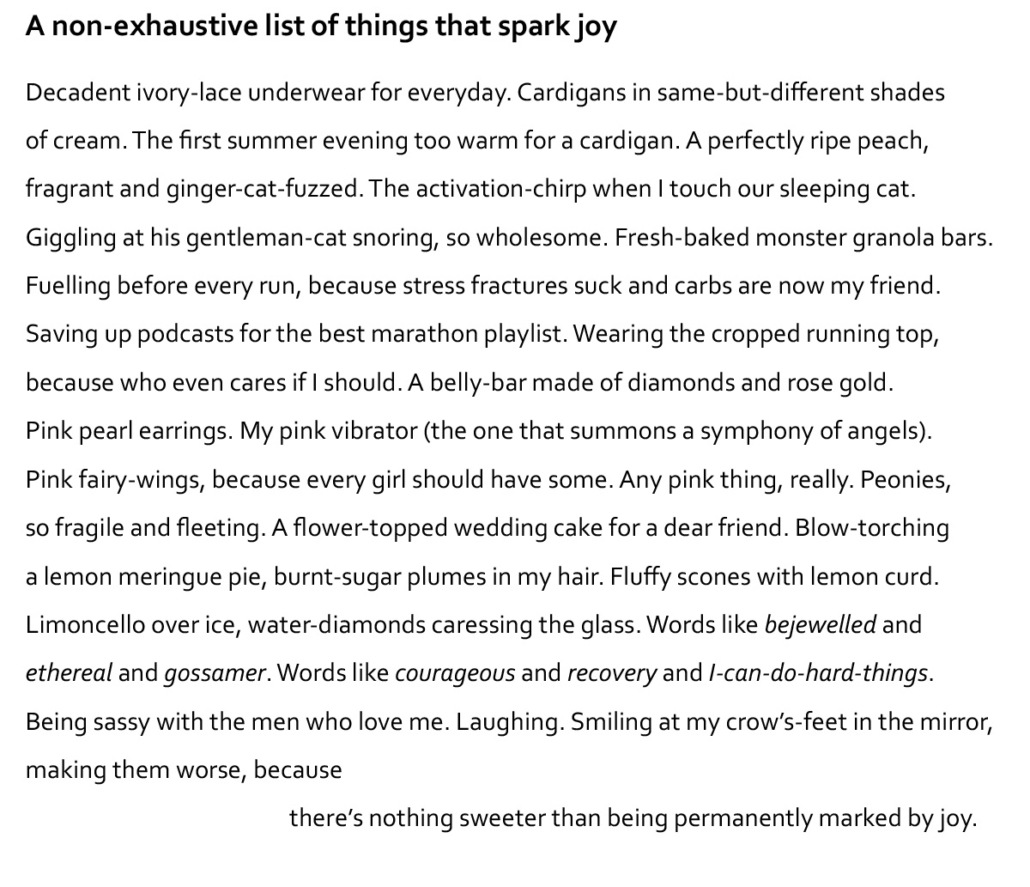
Poetry, Karen Baumgart 

Karen Baumgart lives in Australia and adores beautiful quotes, pink things, cats, and chai lattes. She loves working in human services policy, especially when it enables marginalised people to have a voice. Karen used to be an English teacher and is quite certain that writing is, indeed, the best therapy. Instagram: @miss.cake.girl Bluesky: @cake-girl.bsky.social Twitter / X: @cake_girl__

Outtake

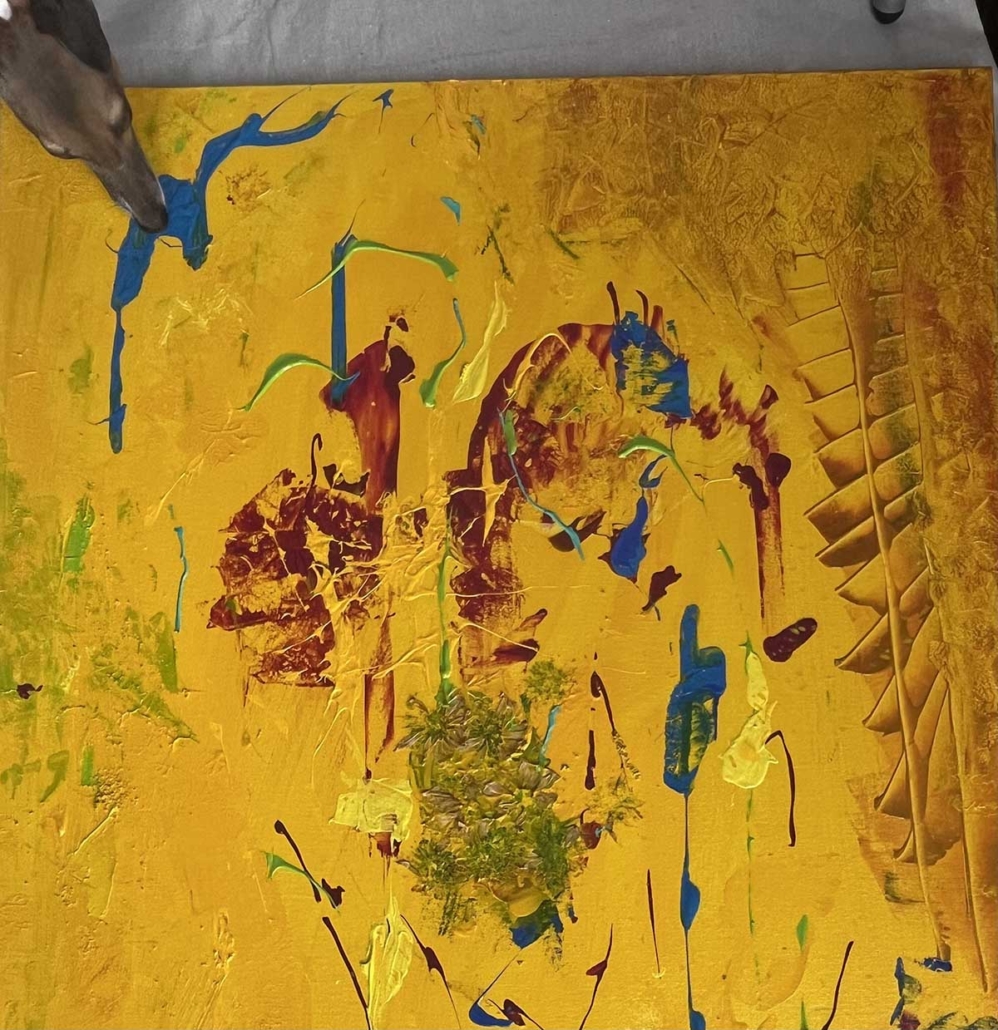
Inquisitive photo bomber interrupts the shoot.