Posts
Poetry by Darren C. Demaree
5/28/25
In this case
alienation means there
is only one American
& he is a boy
in a failing man’s body
& that means
we are all vulnerable
when he focuses
his attention on us.
Darren C. Demaree’s poems have appeared, or are scheduled to appear in numerous magazines/journals, including Hotel Amerika, Diode, North American Review, New Letters, Diagram, and the Colorado Review. He is the author of twenty-three poetry collections, most recently ‘So Much More’ (November 2024, Harbor Editions). He is the Editor in Chief of the Best of the Net Anthology and Managing Editor of Ovenbird Poetry. He is currently living and writing in Columbus, Ohio with his wife and children.
Two micro fictions by Matthew Jakubowski
This kind of freedom
On what epidemiologists would later mark as the single deadliest day of the early 21st Century in America, Sophie was drinking gin and tonics and dozing off by the pool at the place in the Poconos she was housesitting for three nights for three hundred bucks. It had six bedrooms and three bathrooms. The couple who owned it had left Sophie a fully stocked bar and fridge. No pets to care for. A security system. All the entertainment subscriptions. A hundred-dollar Visa gift card to order takeout, plus a chest freezer in the garage with pizza, ice cream, mac ’n cheese, and dumplings.
Two years later, alone in her small West Philly apartment with long Covid, which her health insurer wouldn’t acknowledge as a real thing, eating eighty-four cent ramen that used to cost thirty-two, hoping her shitty older brother who lived across the city in their dead parents’ house was, at the very least, worried about her sometimes, Sophie remembered what the tan handsome husband had said years ago outside that huge empty house the day he and his wife got back from one of their many pandemic getaways: “We have a such a beautiful country! It’s important for us all to get out and see it, you know? I really hope you get to someday, when you’ve earned this kind of freedom for yourself.”
Alight, Astray
The six of us skipped school and found ourselves tip-toeing east on the sidewalk trash like each bit was a stepping stone. Downtown we observed Mr. Tuesday trying to witch someone’s finances with angry moths and diseased cats, saw him batting at smoke-and-mirror joy with tentacles and tongs, gnashing despair between his teeth. It was hard not to stare as he let the day flog him and his colleagues chained to the feet of another Tuesday, those who live to keep the wealth-floated buoyant, who walk backwards slowly each morning to the elevator the chair and desk to present face present teeth present the daily stagecraft of the unspoken echoing within. We stole a fancy lunch and saw the sky not wondering at all if a thing like Tuesday was happening, or if paths lead into parking garage shadows, the salvation of sleep, or the families in apartments all day together chewing one another’s loneliness. My skin sucked no emotion from what we saw, but as we escaped it, like tourists, I felt absolutely elated to know none of us would ever work downtown. The wind left more trash behind us. We collapsed on our front steps. Someone smashed the last bottle. Everyone cheered. I dropped a cigarette to burn the path we’d taken.
Matthew Jakubowski is a multi-genre writer based in West Philadelphia. His work is forthcoming from Doric Literary and his flash fiction appears in Gone Lawn, Scaffold Lit, JAKE, Variant Lit, and the Best Microfiction anthology. He’s online at www.mattjakubowski.com/about.

Micro fiction by Betty Stanton
Sixth Street
The houses on Sixth Street are identical, white teeth in a jaw that never closes. Their lawns are shaved to the same length, sprinklers hissing like snakes. Windows stay shut, blinds tilted just enough to catch light, never enough to reveal who is watching.
The cars feed first. Four-wheeled monsters, they roar down the pavement, chewing asphalt, spilling their drivers into the waiting mouths of houses. Doors slam, lights extinguish, and the street swallows them whole. By morning, only silence remains.
The world shifts outside, but Sixth Street does not. It runs in circles, refusing to escape. Neighbors pass one another with blurred faces, as if erased by the same hand that drew the cul-de-sac. Sometimes a door shrieks. Sometimes a window cracks. But most days the silence grows fat and heavy, pressing against every ribcage.
Inside, the storm builds. It pounds to get out, but rebellion here is devoured as quickly as it appears. A glass shattered on the driveway is gone by morning, ground into gravel by the street’s slow tongue. A porchlight left burning too late is swallowed by dawn. Slammed doors are absorbed into the endless hum of siding and shingles.
Only human connections resist for a moment. A hand brushing a cheek in the dark. A smile across a crowded room. A knee pressed against another knee beneath the table. These small gestures glow like embers.
Every touch is rebellion.
Betty Stanton (she/her) is a Pushcart nominated writer who lives and works in Tulsa, Oklahoma. Her work has appeared or is forthcoming in various journals and collections and has been included in various anthologies. She is currently on the editorial board of Ivo Review. @fadingbetty.bsky.social
Poetry by Kevin A. Risner
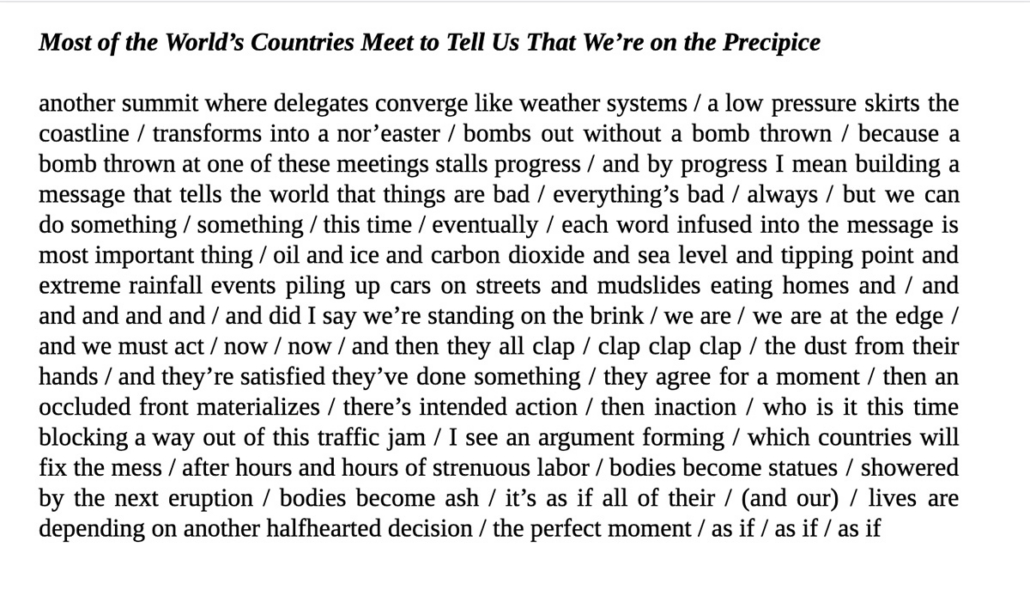
Kevin A. Risner is a product of Ohio. He is the author of Do Us a Favor (Variant Literature, 2021). He has two collections forthcoming: It’s Easy To Lose Your Breath (Match Factory Editions, 2026) and There’s No Future Where We Don’t Have Fire (Unsolicited Press, 2027). His work has been published by multiple journals, online and in print.
Flash fiction by Madeleine Armstrong
Monday Morning, 9:05am Outside Reproductive Choices, South London
Edith unfolded her garden chair and settled in. She had her Thermos, raincoat and book – it might be a long day.
The first woman hurried inside alone, head down, heels rat-a-tatting. Edith’s fingers twitched on the paperback, but she stilled, knowing she wasn’t needed yet.
A few minutes later another woman appeared, tear creased, leaning on a man. Edith waited.
The door was swinging shut when they turned up, with their filthy placards and Virgin Mary, like she wasn’t a sexual assault victim.
Behind them lurked a lone girl, slowing, glancing from the protestors to the clinic door, her face frozen. She couldn’t be more than twenty. Edith stood, the chair creaking as loud as her knees.
“Murderer,” one protestor shouted at the girl.
“Mummy,” another called, high pitched.
The girl looked like she might turn and run.
Edith hurried over, as fast as she could with her arthritic hip. The girl flinched, but Edith made a shooing motion at the protestors. The two women fell into step together. Edith tried to stay calm, despite the hitch of the girl’s sobs and the insults flung as casually as firecrackers.
When it was too hard Edith thought of her son, Callum, forced into her then snatched away, red faced and squalling, without her having any say.
Who knew what had happened to him.
And this poor girl. Who knew what had happened to her.
A Pushcart Prize-nominated author, Madeleine has won the Hammond House short story prize, and been published in mags including Bunker Squirrel, Hooghly Review, Literary Garage, Micromance, Punk Noir, Trash Cat, Underbelly, Waffle Fried and WestWord. She’s a journalist and runner, and lives in London. Twitter/X @Madeleine_write; Bluesky @madeleinewrite.bsky.social
Flash fiction by Alison Wassell
A Safe Space
Sometimes life gets too much for Michael Marsden, so when he points at the space under the classroom sink and asks if he can get into it, Miss Cathcart sees no reason to say no. It seems a reasonable request, something her chronically anxious cat might do to avoid an unexpected visitor, or the vacuum cleaner, or the application of his flea treatment.
“If that’s where you feel you need to be, it’s fine by me,” she says, so he squeezes in. Michael’s a big boy for his age, and only just fits, but he seems happy enough, curled up in the foetal position, so she leaves him to it while she talks about floating and sinking.
She has taught this lesson so many times she could do it in her sleep. The children gather around her. A selection of objects surrounds a half-full fish tank of water on the table. Which objects will plummet to the bottom of the tank? Which ones will stay on the surface? Why do some things float while others sink? Is it to do with what they’re made of, how big they are, or how heavy?
The children love it, mainly because there’s a strong possibility that someone will get wet. Miss Cathcart draws out all the correct language from them; prediction, hypothesis, volume, density, particles. These words aren’t in the infant curriculum, but she knows the children enjoy bamboozling their parents with them. Michael remains tucked in his hideaway, but she can tell he’s listening. From time to time he sticks out his head, craning his neck to see, but she’s careful not to catch his eye, confident that he will emerge when he’s ready.
As Lucas Watson is predicting that a pebble will float, and the rest of the class is telling him he’s wrong in no uncertain terms, The Head walks in unannounced, as has become her habit. Miss Cathcart feels her heart sinking like a stone, but she forces her face into its brightest smile and, in her best teacher voice, reminds the children to put their hands up when they want to speak.
But The Head has no interest in the lesson. Not now she’s noticed Michael Marsden. The Head has no truck with children being where they need to be. As far as she is concerned, Michael Marsden needs to be cross-legged on the carpet with his classmates, and anything else is downright disobedience. Like an unsympathetic midwife she yanks him from his safe space. He cowers on the carpet, his hands over his ears, and rocks backwards and forwards. The Head draws Miss Cathcart aside.
“We’ll discuss this later,” she says, before clip-clopping away on her too-high heels.
“Are you in trouble, Miss?” someone asks.
“I always seem to be in trouble, lately,” Miss Cathcart says.
Maybe it’s to do with what she’s made of. Maybe someone stronger would float above it all with a featherlight heart. But these days Miss Cathcart feels kitten weak. At the end of the school day, when the children have been waved off, she opens her cupboard door and crawls into the space at the bottom where she’s recently installed a comfortable cushion. Pulling the door closed, she curls up and cries for herself, for Michael Marsden, and for all the other children she hasn’t been able to save.
Alison Wassell is a writer of flash and micro fiction from Merseyside, UK. Her work has been published by Fictive Dream, Does It Have Pockets, South Florida Poetry Journal, The Bridport Prize and elsewhere.
Flash fiction by Oliver Reimers
The Inevitable Truth of the California Dream
You’re seven years old at a campsite when you try to pick the golden poppy.
“Don’t do that,” your mother says before your fingers close around the stem. “You can’t do that in California.”
For the past week, all you’ve been able to do is watch a video of a piano teacher play “Joshua Fought the Battle of Jericho” from Piano Adventures 3A. She messes up at the thirty second mark but does not edit it out. She does not do a retake. It is a fifty-three second piece. Her right hand falters after the error. How humiliating to make a mistake on a song from Piano Adventures 3A.
Even though you can’t bring yourself to clip your nails or wash your face, you are in the car with Saraya, hurdling seventy miles per hour up I-80 towards Reno. She is made up pretty with black eyeliner that looks like kohl, and you think you would like to have your brain stirred up and removed through your nose. “There’s a comedian tonight,” Saraya says. “He finally broke out of New York.”
Between California and Reno, there is nothing but hills and the dimmest evergreens you’ve ever seen. A pulped skunk sticks to the side of the road. A woman parks her car to scrape it off.
“I’ve always wanted to be a comedian,” Saraya says, “but I’m not funny.” Even her attempts at self-deprecation are pathetic.
This trip was supposed to cheer you up, but it is taking everything not to throw yourself out of the car and join the skunk.
It would have taken less than a minute to rerecord the video.
The car stutters. A rock skitters behind it onto the empty road. “That wasn’t an animal, was it?” Saraya says. A quarter mile ahead, a lone sign welcomes you to Nevada. The car jumps. There’s a hiss. Saraya jerks the wheel. You hope she will swerve left and leave the two of you steaming in a ditch, but she swerves right, and you skid across the dirt and weeds until the brakes kick in and you bang into the dashboard.
You get out of the car.
Neither of you are hurt. Saraya kneels by the popped tire and prods it for a nail.
Maybe it was the seventh time she’d restarted the video. Maybe it had taken hours. Maybe she’d watched her finger move astray, knowing it was fate, and accepted that no matter what she did, her pinky was always destined to strike that B.
On each side of the border sign, there is a golden poppy. Saraya curses behind you. You walk to the first poppy reach down, then remember. You step past the sign. Welcome to Nevada.
Beneath your fingers, the stem snaps so easily.
Oliver Reimers (he/him) is a writer from Sacramento, California. His work has been featured in Prime Number Magazine, One Teen Story, Gold Man Review, and Main Squeeze Literary Magazine. His portfolio of short stories received a national honorable mention from the 2024 Scholastic Arts and Writing Awards.
Poetry by CS Crowe
The Story of the Rainbow
And on the 3040815th day,
God saw that things were not going so great;
A man in south Florida loaded a pistol,
And took the bus to a gay night club.
It was happening in every city and street.
He caressed the cloud and gathered
Raindrops and sunlight into His palms
He wove them like river reeds into a vast bow
And set it in the sky each day after the rain
That all might look upon His bow of rain
And know that He loved all His children equally
In His omniscience, He did not ask Himself
How His love could ever be in question—
But it was a cloudy day, and He realized
He’d put the rainbow down in the wrong year.
Noah stepped onto the shore and wept.
Well, God told Himself, It’s only a few thousand years off.
I’m sure they won’t even notice the difference.
CS Crowe is three crows in a trench coat that gained sentience after eating a magic bean. He spends his days writing stories on a stolen laptop and trading human teeth for peanuts. A poet and storyteller from the Southeastern United States, he believes stories and poems are about the journey, not the destination, and he loves those stories that wander in the wilderness for forty years before finding their way to the promised land.
Micro fiction by Federica Silvi
Hanging, still hanging, gone
The metallic grey Nissan covered in ads for the Juliet & Romeo Matchmaking Agency has held the same spot in the Safestore parking lot for months, and the frayed rope stuck to the neighbour’s windowsill still has a lanky Santa puppet holding on by one hand. I couldn’t blame you for thinking everything looked right in its place in December, but it’s almost spring now, and I can’t be the only one seeing the lingering signs of decay.
You once told a room full of people that I always notice the things no one else does; you said it like you held the key to the best thing about me they couldn’t know. Now, you shoot me worried looks from the side of your eye, and I see who I’ve become to you: a lost cause, a stubborn child, hurling dull-edged words at a wall of silence.
Within a week of us moving in, the old lady with the gaudy Christmas display knew how long we’d been together and what our dogs were called. I couldn’t help being scared of finding out what else she’d learnt about us. Every time I crossed the street to avoid walking past her door, I wondered if she was behind the curtains, looking straight at me not looking back. That was before you started calling me paranoid; before someone planted the For Sale sign in her yard; before I could think of only one reason she would leave one of her marionettes behind.
These days, I get the feeling that the next time I’ll remember to check in on Santa I’ll be on my own. I wonder how I will find him. Hatless, hair and beard waving in the wind. Capsized and drenched in rain. Tangled in his ladder turned noose. Hanging, still hanging, gone.
Federica Silvi is an Italian writer and translator based in London. She has published flash fiction and creative nonfiction on Dear Damsels, Funny Pearls, Memoir Mixtapes, Visual Verse, and more. Her first published literary translation piece appeared on Asymptote in 2025. Find her on Bluesky as @edgwareviabank.
Poetry by Al Russell
Arrival of the Mail Truck
Well it’s good to know
Whatever has come (or has not come)
Is here now
Al Russell (they) is a NC-based pansexual nonbinary tankie educator parent dog lover who reads too many books, watches too many movies, and smokes too many cigs. Previous poetry collections include Children of the Anxious City and Lookinglasshouse, both available from Vegetarian Alcoholic Press.
Flash fiction by Sudha Balagopal
Desert Squall
In the split second before the rainstorm unleashes, I see your neon-yellow, oblong vehicle. You’ve arrived early.
I click my tongue, release seat belt. Water drips over my arm, plop-plop-plop―the moonroof needs sealing. I’ve never thought to fix the problem since this is Phoenix, with 300 days of sunshine a year. Today, a rare desert squall pounds and my compact sedan shudder-judders, reminds me you and I met in a tube-like elevator that rattle-shook in the seconds before it halted, suspending us between floors five and six.
I squint through the downpour. Becky’s office is dark―the wedding planner isn’t in. We’re here to hand our separate guest lists so she can organize the seating chart for our daughter’s reception. You open your car door and I hiss, “What on earth?”
Much later in our failed marriage, I understood you turn into a Bollywood hero when you’re trying to score. In that stalled elevator, you reassured me first before taking charge. You banged on the metal door, then called for help, first from your phone then mine―cell phones were relatively new then―and when you couldn’t find a signal, you hit the emergency button on the panel, again and again. After marriage, you tossed all desire to impress me.
You run on the wet concrete, an out-of-shape man in his fifties, a triangular box held over your head, computer bag slung over your shoulder. Shirt soaked, hair dripping wet, you open my passenger-side door, slip in.
“No point waiting in separate cars,” you say. “Did you have time for lunch? I got you pizza.”
I stare at the odd-shaped box, likely the doggy-bag from a meal you shared with your girlfriend.
When the elevator jolted to a stop, I wobble-crashed against your strong, muscular frame. In that moment, I couldn’t identify what petrified me more: being alone with a stranger in the enclosed space, the sense of suffocation, or the cloying darkness. We disentangled quickly, but once you’d contacted building maintenance, you reached for my hand, held it in your warm palm, speaking comforting words in a husky, intimate voice. My stupid heart’s runaway emotions betrayed me, swelling and filling my ribcage as we dangled between floors five and six, until rescue arrived. For years after, your dinner-party conversation started: “When I met my future wife, I was so stunned, not just my pulse, but the elevator stopped too.”
Odors of aftershave and dank, wet clothes overwhelm my car. I notice the bald spot on your crown and that you’re wearing a pink shirt. Your girlfriend’s younger than I am by a decade; she likely picked that shade. I open the pizza box. The slice is a tight fit; melted cheese has slid off the pie, glued itself to the cardboard. “Pizza should come in a square box,” I say, fling the box with its unappetizing contents on the back seat.
You hold a hand up to my car’s ceiling, capture dripping water. “Why don’t you get this repaired? I’ll call my auto shop.” There it is, that long-discarded exhibition of attention, of caring, that once captivated me. You grab my box of Kleenex from the floorboard, wipe dashboard, gear shaft, console.
You unzip your computer bag, fish out a document. “My list isn’t long,” you say, adding, “How can I help with the wedding? ”
I play with the car’s turn-signal lever: up-down-up-down, peer at the wedding planner’s still-dark office, shrug. “Ask Becky.”
“Why won’t you eat the pizza?” you press. Ache-filled images pop into my head: a laden dinner table, a kitchen clock that displays 10:00 p.m, me curled up on the couch, rectangles of cut-up lasagna in Tupperware containers, rows of stacked dinner leftovers in my freezer.
Today, you’re urging me to eat soggy, cold, cheese-denuded pizza in my leaky car.
“By the way, my mother’s coming a week before the wedding.” Deft as a fencer, you slide in the information.
I massage the circle of the steering wheel with my fingers.
“She’s the bride’s grandmother,” you say.
I grip the steering wheel tight. The mother-son strife is not my concern anymore, nor the fact that nothing about you pleases the lady: not your job, not your home, not your appearance.
“Umm. . .” your hesitation makes my breath shrivel. “I didn’t tell her we’re divorced.”
A howling gust of wind hits the car. You place your hand on mine, like you did in the elevator. Your large palm is warm, like it was then. You lean close, like you did then. I can feel your breath fanning my ear, like I did then. By the time the elevator doors opened, I’d succumbed.
I extricate my hand from under yours.
“Didn’t or couldn’t?” I bang my fists on the steering wheel.
“How can she stay with us in the apartment?” you ask. Us: you and your girlfriend. “Can my mother stay with you, please? Let’s avoid unpleasantness.”
After that rush of words, you place your hand on my cheek.
I’m about to shout, “Unpleasantness for whom?” when I see Becky walking up to her office.
I brush your hand away. The rain has ceased as suddenly as it arrived. When the elevator doors opened, I offered you my phone number. Now, I step out. I’ll give Becky my guest list and leave. At the office entrance, I turn. You continue to sit in my car, wiping down fogged windows with Kleenex.
Sudha Balagopal’s work appears in Adroit Journal, Fictive Dream and Does It Have Pockets among other journals. In 2024, her novella-in-flash, Nose Ornaments, runner up in the Bath contest, was published by Ad Hoc Fiction, UK. She has had stories included in Best Microfiction, Best Small Fictions. She is Series Editor, Wigleaf Top 50.
Fiction by Seán Hill
Getting The Electric
It’s not something my grandfather ever really talked about. He had said once, a long time ago, “the ESB drove the ghosts from the countryside.” He was talking about the Electricity Supply Board during the electrification of rural Ireland from the 1940s to ’60s. It always seemed pretty clear to me what he meant, but it was only when I half-jokingly mentioned it once again near the end of his convalescence was I met with a sigh, a minute of silence, then him looking me dead in the eyes and telling me the whole thing.
As a young boy, my grandfather, like many young folk, used to do what were called “messages” for some of the older people in his home village of Dunbannig out in the rural west, such getting milk or bread or mail for them, himself not being old enough to be of much use on the farm, and education of any kind was sporadic. It was during his messages in the days after the neighbouring village of Ballyrackert “got the electric” that he heard the first murmurs. Small things, like the farmers on the road who complained of the state of the fields, like an animal had gone mad and kicked the dirt up all over, or something big had got into a chicken coop. Or Mrs. McRae in the shop who went on about the cold in the night, getting odd looks as the stifling summer sun streamed in the door. None of this weighed on my grandfather’s mind at the time, and in fact, he said, he was wholly ignorant of the vast majority of such murmurs. But that was soon to change.
Mr. Walsh, the ESB area organiser, had come back from some prior visit for a decision, and this time most assented. Might take a short while, he said, though “not so long that they’d become unfashionable!” But no one laughed. My grandfather noted, in the time leading up to electricity, boys, including his brothers, were hired to keep watch on pens and barns at night, though they all ended up congregating near houses, and that was mostly because of the calls that seemed to pass through the night air right until the sun came up. He remembered the priest from three towns over arriving one afternoon, saying blessings were in demand in Dunbannig. It didn’t stop people refusing to answer the door for their messages, or his parents from whispering until someone came in the room, or keep his sister Margaret from staring through the window in the evening. People running behind the houses, she’d say. They sometimes caught her eye, and stared back.
It happened one evening when it was just my grandfather, his sister, and their mother by the fire. He was pondering over one of his mother’s borrowed books from Ballyrackert, but his sister had gone to watch out the window, again. She stayed that way for a long time, utterly still, strange for any child to be, eyes fixed on the blue night. In the quiet hearth crackle, her little voice was a shock when she said someone was at the door. Their mother called for Margaret to come over at once and stop playing. There was no argument. Their mother hadn’t taken her eyes from the fire once the whole night, but her head snapped up like a frightened bird when, suddenly, someone tried the door. It was bolted, and my grandfather said maybe it was dad, but his mother only called for both of them to come to her. It wasn’t insistent, it came every half a minute or so, someone pushing on the door a little harder than before. She held their shoulders hard to stop them from turning around.
But my grandfather couldn’t help himself—young boys rarely could when told not to do something. He craned his neck to the window. Something, he said to me most seriously, darted away the second his eyes passed over the smoky pane. The door groaned long and loud. Seconds later a wave of cold swept over his hands and face. In the firelight he saw the door, ajar, with what was very clearly a hand gripping the frame. Margaret was crying. His mother didn’t budge an inch, but she was speaking the Lord’s Prayer and her hands around them were like vices. My grandfather swore then, upon his life, his wife’s memory, his family, and his God, that what that peered through the doorway was not an animal, and was also certainly not a human being.
The next thing they heard were his brothers’ voices coming up the path. But how long they had stayed there, with that thing inching closer, could have been minutes, or hours.
For a week after that, his parents’ large silver crucifix, a family heirloom, hung on the front door. In the daylight, electric work had progressed, and there were new poles and lines all along the roads. Houses had been fit with lightbulbs. The family couldn’t have them on quick enough. Soon, after some minor tests, a time and date had been set the next night for the grand ceremony of putting on the lights. Apparently Ballyrackert had put on quite a party, but what Dunbannig did was probably audible for the next several towns over. My grandfather and his sister were allowed stay up for it, and eventually went to bed under the supervision of an older brother, and a the warm glow of an electric lightbulb.
Did you know, my grandfather said, even now in some countries they’ll make way for certain hills or sites, so as to not disturb them? The Irish government had, it seemed, paid no such heed in its march towards modernity. And Dunbannig was, it turned out, the last place in the entire district to get the electric. He didn’t want to imagine just what had been driven their way in all those years.
Seán Hill is not an award winning author, nor does he have a degree or string of letters after his name. Instead, he’s spent a lifetime cobbling together as disparate a collection of influences as possible. He writes a lot, perhaps too much, publishing new fiction every week on his Substack, Shadows & Sorcery, and experts say it won’t stop any time soon.
Bluesky: https://bsky.app/profile/wizardhill.bsky.social
Substack: shadowsandsorcery.substack.com
Poetry by Janel Comeau
My Hope for You
you will leave him the first time it happens
you’ll be gone by the end of the day
not into a bed at some shelter
but moved into your very own place
you will leave him the first time it happens
because somebody taught you the signs
you know it’s the start to a cycle
and you don’t wait around for next time
you will leave him the first time it happens
you have all the money you need
you always kept some in your own name
long before you decided to flee
you will leave him the first time it happens
you will pack up the children and go
and from then on they only know safety
no court sends them back to his home
you will leave him the first time it happens
and you tell everyone why you left
they never once claim that you’re lying
they all trust that you know him the best
you will leave him the first time it happens
you simply go on with your life
and it’s everything you ever dreamed of
now that you’re no longer his wife
Janel Comeau is a writer, illustrator, comedian and youth worker currently residing in Halifax, Nova Scotia, Canada. Her work has appeared or is forthcoming in Eavesdrop Magazine, Write or Die Magazine, Toasted Cheese Literary Journal, The Ana, Ink in Thirds, and several fine anthologies. She is also a regular contributor to the Canadian satire news publication The Beaverton.
Flash fiction by Daniel Addercouth
Vena Amoris
My grandmother laid her cigarette in the ashtray on the nightstand, then picked up a small wooden box that was on her dressing table. She sat down on the massive bed and patted the quilt. I took my place next to her, smelling her familiar scent of smoke mixed with talcum powder, and watched in fascination as she opened the box. Nested in purple velvet was a silver ring with three diamonds in a delicate casing.
“This is my engagement ring, Cordula,” she said. “One day, it will be yours. When you get engaged.”
She placed the ring on the fourth finger of my left hand. The band was loose on my nine-year-old’s finger, and the metal felt cool where it touched the skin. “This is your ring finger.” She traced the pale underside of my digit. “A vein runs from here to your heart.”
I turned my hand to examine the ring from different angles, thinking how pretty the rainbows would look on my white dress.
When I got engaged, I wanted my grandmother to be the first to know. My heart swelled with joy as I drove to her house. The sunlight burst through the leaves of the trees arching across the road, as if the world wanted to bless our pledge.
“Who’s the lucky fellow?” my grandmother asked as she served Darjeeling from a china pot.
“It’s a woman, actually. Nicola. She’s training to be a doctor.” “How wonderful,” she said, after a pause so slight I wondered if I’d imagined it. She transferred her cigarette to her other hand so she could clutch my arm. “We must celebrate.”
I waited for her to mention the ring. But when I left, three cups of tea and a glass of real champagne later, the walnut box was still on her dressing table.
I was busy preparing for my PhD defence when my grandmother got ill, and I didn’t visit as often as I should have. But Nicola had developed an unlikely affection for the old lady during our occasional visits, and made the hour’s drive from our university city to see her whenever she could. When I came with her, I watched as she changed my grandmother’s dressings and helped her go to the bathroom. I couldn’t have done it. I shuddered whenever I glimpsed the coin-sized lumps through her thin white hair. Nicola said the ones on her back were worse. “It’s in her blood.” But Nicola did what needed to be done without hesitation; that was one of the reasons I loved her. It was Nicola who cleaned up my grandmother when diarrhoea stained the bed, and it was Nicola who persuaded the nurses to install a morphine drip when the pain made her cry out.
One afternoon, Nicola and I were sitting by the bedside in silence. The only sound was my grandmother’s strained breathing. The smell of disinfectant mingled with the stale reek of the cigarettes that she refused to give up. My grandmother no longer had the energy to speak. She’d lost so much weight she looked tiny in the huge bed with its stained quilt. “It’s her time,” the nurse told us in a low voice. “But she won’t let go.”
We’d been sitting there for a while when my grandmother said something to Nicola, so quietly that Nicola asked her to repeat it. With a great effort, my grandmother lifted her stick of an arm to point at the walnut box on her dressing table. “Give me that.”
Nicola looked mystified. “Go ahead,” I whispered. Nicola fetched the box and tried to give it to my grandmother, but she closed her hand around Nicola’s wrist.
“I want you to have this.” Her voice was barely audible. “You deserve it.”
She laid back on the pillows and closed her eyes. Her breathing became heavy, then she let out a massive sigh and became very still. When Nicola bent over and pressed her fingers to my grandmother’s neck, I realised she was gone.
Nicola and I held each other for a long time. When she pulled away, I assumed she was going to call the doctor or take care of one of a hundred other practicalities. But instead I felt her slip something onto my finger. I traced the smooth contours of the three diamonds. I was tempted to keep it, but I knew it wasn’t mine.
I took the ring off and put it on Nicola’s finger, feeling her soft skin. “She wanted you to have it.” I held her hand and rocked it slightly from side to side, watching the diamonds sparkle, and imagined how it would cast rainbows on her dress on our wedding day.
Daniel Addercouth (@ruralunease) grew up on a remote farm in the north of Scotland but now lives in Germany. His work has appeared in New Flash Fiction Review, Trampset and HAD, among other places. His story “The Good Prizes” was included in Best Small Fictions 2024.
Flash fiction by Kendra Cardin
Wish You Were Here
Sam surrenders a few more uncrumpled dollar bills to the kid behind the counter at the fish bowl toss booth. Third time’s a charm, right? Tongue bitten between their teeth, unruly bangs brushed clear of their coal-lined eyes, Sam casts one plastic ping-pong ball after another toward the game table. Ping, ping, each bounces, hopscotching along the rims of the little glass bowls. Ping, ping — plop, onto the ground, while the goldfish continue to swim their cramped laps.
Final go. The winking mermaid inked on Sam’s forearm swishes when they flex their wrist. A slight pang of arthritis before the toss, then ping, ping — bloop. Sam punches their fist into the air, glossy black painted fingernails reflecting the razzle-dazzle of the fairground lights. The carnival kid scoops the floating ball out of the bowl, brings Sam their prize. Round and round swims the orange fish.
Sam’s been working the festival circuit for years, cramming amps and boxes full of band merch into the back of their clunky van, delivering their one-hit wonder to corn dog munchers and Ferris wheel enthusiasts up and down the sunshine state.
Sam doesn’t resent The Song anymore. Not when sweaty clusters of fans smile widely, dance wildly, when Sam starts to play. Especially during the evening set. Sun low, heat breaking. Kids and grandparents, taffy-spun teens, all shoulder to shoulder as they bop, twirl like tilt-a-whirls. This weekend’s appearance, a bevy of beach babes. Flip-flopped feet strolling the boardwalk. A sweet slice of paradise, just a hop away from the town where Sam grew up.
Sam lifts the bowl to their eyes, grins at the gaping fish, feels a twinge of guilt. If they weren’t on the road all the time, they could get a proper home for the finned critter. Maybe one of those fancy aquariums. The kind with the multi-colored pebbles lining the bottom, miniature castles, and treasure chests whose lids open with an eruption of bubbles. Then goldie could get as big as it wanted. Sam would feed it flakes, scrub its tank, make sure it had everything its swimming heart needed to thrive.
Yeah.
And if they settled down, maybe they could look up Susie. She loved carnivals. Sam scans the crowd of bobbing heads and neon-hued balloons, half expecting to see her. Shaggy blonde hair, sea-blue eyes glittered by the midway bulb light, crunching on a gooey caramel apple as she pirouettes around the cakewalk. Of course, she’s not there. Sam wonders if they’d even recognize her now. It’d been decades since that night at the drive-in. Forty was coming fast for both of them. And they weren’t minnows anymore.
It’s a sherbet twilight, sky a swirl of pink and orange, when Sam takes the stage again at six. Still thinking of Susie. Kicking themselves for never finishing that song they started writing for her in high school. Sam plucks a string on their guitar, slides smooth and cool as snow cone syrup into the first notes of The Song. Out in the audience, disciples raise their arms high, roller-coastered, ready to catch the melody. Novices shuffle, nod along, ears attuning to something new, paper plates of half-eaten funnel cake cradled in their hands.
If Sam were to walk away from all of this tomorrow, that fish might stand a chance. The thought bounces around — ping,ping — before falling away, quick as it came, when Sam begins to sing. Balanced atop a spare amp backstage, the goldfish darts back and forth, dizzying itself in its small bowl, blissfully unaware of all the potential it has to grow.
Kendra Cardin creates a safe harbor for herself with poetry and storytelling. Her writings have been featured in a variety of publications including those of Rough Diamond Poetry, Sídhe Press, Blink-Ink, Little Thoughts Press, and Black Bough Poetry.
Micro fiction by LM Fontanes
Undead
Hi John, not that your name is John but in case someone ever finds this, plausible deniability that I didn’t destroy your life even though I might have. Maybe destroy is harsh. Also, maybe your life or, no, our life together needed to be destroyed. It’s funny how life can keep going like a zombie that hasn’t tasted salt. That’s what happens when you give salt to resurrected corpses. They remember they’re dead and return to their graves. At least, that’s what I recall from Caribbean horror stories I devoured in college. If Daddy knew I’d been reading those, he would’ve dragged me to Confession in his lumbering Pontiac. I once asked about the power of island curses and his veiny brown hand flew to the scapular under his Sears & Roebuck undershirt. I still have that ancient badge of faith—plastic cracked over Jesus and His Sacred Heart—but I no longer have Daddy or you, John. No zombies involved.
Or wait. Maybe I’ve got this wrong. Maybe it wasn’t us, maybe it was me. I remember the So Cal night I slashed our Navajo White walls with my hunger. How I stayed out until past the owl’s hunting time in the company of someone not you. Later, in the baleful canyon beyond our condo door, I thought I heard something shriek. You never see the raptor coming. It must be better that way, John.
In the morning, I licked salt from the mirror and remembered I was alive.
LM Fontanes is a multi-racial, multi-genre storyteller who writes, teaches & leads. Words in/upcoming Roi Fainéant, Frazzled Lit, Silly Goose Press, Emerge Literary, 100-Foot Crow, JAKE, 34 Orchard, Flash Fiction Festival Anthology, Thomasonian, The Willowherb Review, and long-listed for The Smokey Award and the Frazzled Lit short story prize.
Poetry by Bart Edelman
Inventory
Hammer toe.
Twisted ankle.
Weak knee.
Bum leg.
Dislocated hip.
Fractured finger.
Swollen wrist.
Bad back.
Frozen shoulder.
Strained neck.
Wired jaw.
Black tongue.
Inflamed gum.
Crooked tooth.
Broken nose.
Lazy eye.
Deaf ear.
Oily scalp.
Jumbled brain.
Latest inventory.
Random sample.
More to come.
In good health—
By all measure.
Bart Edelman’s poetry collections include Crossing the Hackensack, Under Damaris’ Dress, The Alphabet of Love, The Gentle Man, The Last Mojito, The Geographer’s Wife, Whistling to Trick the Wind, and This Body Is Never at Rest: New and Selected Poems 1993 – 2023. He has taught at Glendale College, where he edited Eclipse, a literary journal, and, most recently, in the MFA program at Antioch University, Los Angeles. His work has been anthologized in textbooks published by City Lights Books, Etruscan Press, Harcourt Brace, Longman, McGraw-Hill, Prentice Hall, the University of Iowa Press, Wadsworth, and others. He lives in Pasadena, California.