It’s cold inside the church, as cold as charity. Maria shuffles up the nave under the anguished gaze of Jesus, her down-at-heel brogues slap-whispering on the flagstones dinted by thousands of feet before hers. The feeble winter sun stripes the grey pillars with pastel colour.
She eases her bag down carefully onto the altar steps and rubs her aching shoulder.
‘I brought you these,’ she says. ‘I couldn’t think what else to do with them.’
Her words bounce off smoke-stained pillars, echoing round the vast, vaulted roof.
‘It’s not a peace offering,’ she adds, in case God gets the wrong idea. ‘I’ve not forgiven you for taking him.’
Her voice sounds strange, unfamiliar to her. These days, now Patrick isn’t there to to talk to, she listens more than she speaks. She still visits the hospice every day, even though he’s been in the ground for months. Now she sits with those who have nobody, holding their crepe paper hands and stroking wispy tendrils of hair from their faces as the end approaches.
Sometimes, they tell her things – shameful things they don’t want to be buried with: clandestine affairs; a secret love child; crimes that went unpunished; slights and spites, things said and unsaid.
Maria doesn’t know what to do with these confessions, so she puts them in her tote bag and takes them with her. But they’re weighing her down, immobilising her; she can’t go back, but moving forward is like wading through treacle. Today, unable to bear the increasing heft of them any longer, she brings them here.
‘They’re yours now,’ she tells God. ‘I never asked for them. I’ve got enough burdens of my own without carrying other people’s.’
She upends the bag, and a stream of guilt, regrets, recriminations, weaknesses and missed opportunities flows out across the chancel; they collect in crevices, form shallow pools, disappear down cracks. The surge of relief leaves her breathless.
On her way out, she pauses to light a candle for Patrick. A wisp of smoke drifts upwards, lifting the weight from her soul; the flickering flame pierces the grey fog of her grief. Slinging the empty bag over her shoulder, she leaves the church with a renewed lightness in her steps and in her heart.
Hilary Ayshford is a former science journalist and editor based in rural Kent in the UK. She writes flash fiction and short stories and has been nominated for Best Of The Net and Best Small Fictions. She likes her music in a minor key and has a penchant for the darker side of human nature. https://hilaryayshford-writer.weebly.com Bluesky: @hilary55.bsky.social Threads: hilaryayshford X: @hilary553
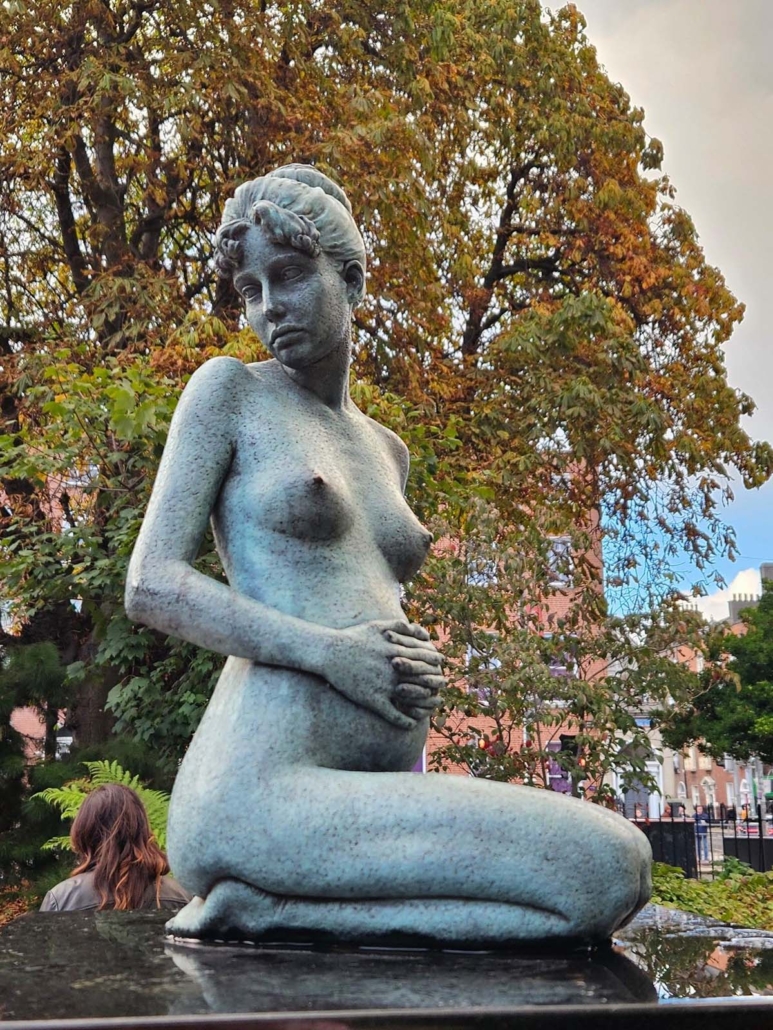
[Regarding the Sculpture of Constance Lloyd Wilde Holland at the Oscar Wilde Memorial Statue in Central Dublin]
Naked and pregnant, kneeling small, exposed in your shame before all of Dublin, your face the frown of trust betrayed as you look back at your larger-than-life Oscar, who ignores your wounded gaze to leer at the lithe torso of the ancient Greeks’ licentious Dionysus (later rendered Sir Rubens’ voluptuous Bacchus) a man to whom you have turned your back, but the world has cast you and him of the same weathered bronze, while your sometime Oscar, rendered resplendent in colorful stones collected from four continents, his hands bedecked with your wedding ring flanked by scarabs of good and ill fortune, the tie of his beloved Trinity glazed at his throat, lounges on a boulder stolen and lugged from the Wicklow Mountains—Oscar, in death as in life, ever the fulcrum of the V, the focus of endless scandal, of scorn tempered with admiration, infamy with fame, as you are pushed to one side, to change your name yet again, from Wilde to Holland as once from Lloyd to Wilde, in the vain hope of pulling your sons from the shadow of your still-husband their father’s endless scandals, exiled by outrageous fortune to the continent, to die forgotten in the periphery, of a botched surgery for a condition yet to be understood, and to be immortalized here, naked and cold on a pedestal of his words—his words, not yours, in the park of his childhood, not yours, even your nude form borrowed from a friend of the artist—your humiliation and your shame laid bare for all to see.
Jay Parr (he/they) has never been to Dublin (unless you count Dublin, Virginia). He lives with his partner and child in North Carolina, where he did an MFA at UNCG in the early ’00s and is now a lecturer in their online liberal and interdisciplinary studies program. He’s honored to have work in Elegant Variations (at Stanchion), Roi Fainéant, Bending Genres, Five Minutes, MIDLVLMAG, Reckon Review, Bullshit Lit, Identity Theory, SugarSugarSalt, Discretionary Love, Streetcake Magazine, Variant Literature Journal, and elsewhere.
https://templeinacity.com/wp-content/uploads/2025/02/Temple-In-A-City-Logo5.png00Eirenehttps://templeinacity.com/wp-content/uploads/2025/02/Temple-In-A-City-Logo5.pngEirene2025-12-07 16:01:002025-12-07 16:26:09Ekphrastic, Jay Parr
On the Singer your grandmother left you, you sew the bodice, tack a thousand white feathers to the paunch, and carve breathing holes into the black leather beak. Zip until you feel metal on the base of your neck, then flex your arms in their wire-and-mesh wings. On a lark, you honk until your granddaughter joins you in front of your full-length mirror. She anoints you Silly Goose with her plastic princess wand.
Wearing the costume out of the house – ducking through the doggie door, waddling across the cul-de-sac – brings you attention you forgot you missed. Men step into gutters when your painted orange flippers slap the pavement. Packs of teenagers intent on their phones clear the way after you honk with the bicycle horn sewn into your dewlap. Nice to be noticed, to be seen, to be invited to the Halloween parade, in step beside your granddaughter, who is wearing your old lace coronation gown, your tiara pinned in her hair.
You’re on top of the world until you’re not, until you totter past your granddaughter’s room and hear her asking a Magic 8 Ball if Grandma will ever come back. Outlook not so good. Until her little friends visit and your goosey excretions stain the trains of their taffeta dresses. Until you remember that geese aren’t made for company.
When frost encrusts the lawn, the clover loses its flavor, and you decide you’ve had it with this disguise. You reach behind your back, but your wingtips can’t manage the zipper’s pull. You have no thumbs to unshod the flippers, no voice beyond your beak. You honk for rescue, for transformation, for your granddaughter to put on a sweater and help you out. You honk until the neighbor bangs on the fence and threatens you with cookery.
In this suburban backyard, it’s getting colder, and your granddaughter has pulled her curtains closed. You understand. You did the same to your grandmother. Your world was bright pink, and hers had turned downy white, her face an embarrassing reminder of the shortness of one’s reign.
Settling your wings back into place, you hunker down in the crook of the fence, seeking the earth’s last bit of warmth before your end. A flock flies overhead, a rollicking V of Canada geese. Their honks are frivolous, reviews of golf courses and grubby inland lakes, but they stir something, nonetheless. In pining for what you’ve lost – satin slippers, petal-soft cheeks, golden thrones – you’ve forgotten what you’ve gained.
The backyard is just long enough for a runway. Once you begin, nature takes over. Air balloons under your feathers, feet flatten against your paunch. The higher you rise, the richer the winter smells. This is the world, this sky: bigger and stronger and wider and more permanent than princessy fixations. You may be a silly goose, but you, you have learned to fly.
Joanna Theiss (she/her) is a former lawyer living in Washington, DC. Her fiction and poetry have appeared in The Penn Review, Chautauqua, Peatsmoke Journal, Milk Candy Review, and Best Microfiction, among others. You can find links to her published works and her mosaic collages at www.joannatheiss.com. Bluesky: bsky.app/joannatheiss.com
The boy painted the sky pink, purple and gold, holding tight to the boar bristle brush as thick paint globs ran down the handle.
“One splash, two splashes,” he recited as he threw the inky colors into the air. Then he swirled and swirled until they married into one long, feathery horizon.
“Hello, Grandma,” he said, kneeling down to touch the smooth stone, cold and wet from the morning dew. He smiled and held the messy paintbrush out in front of him like a bouquet, clutching it with both hands, stained by the soft warm colors. “I brought you the sunrise.”
Brigitta Scheib lives in Harrisburg, PA with her husband, daughter and 3 orange cats. She just recently got back to writing, a hobby she last pursued in high school and college. @bscheib.bsky.social
You and Kate are you-and-Kate with no interruption and that is how you love me. You-and-Kate found me, a mouse hiding in a hole and enticed me out with bits of cheese and memes of wet cats. You-and-Kate laugh like the earth is yearning for your voice and you-and-Kate make me open my throat with your smiles like staves waiting for my notes. You-and-Kate make dinners of bacon-baked bean-avocado-toast and I suggest vegemite to round it out, and you-and-Kate smack your foreheads and say, of course, the very thing! Like my idea has completed an unfinished puzzle, my mouse body nestled within you, the perfect filling to the sandwich. You-and-Kate say it is time to explore now that we are fed, and you-and-Kate hold my trembling, saying I’ll be okay because I’ll be with you. You-and-Kate lift tiny, empty travel bottles from the chemist for our road trip to the Big Banana, and fill some with vodka, and I fill some with hummus so we can be drunk and also responsible, and you-and-Kate hug me and thank me for my mouse sense. Me, and you-and-Kate drive across the vast, red country eating banana-shaped lollies, making banana jokes, singing banana-themed music that is mostly Bananarama. Halfway there, in a field at dawn, the grass thigh-high, none of us thinking of snakes, you-and-Kate run zoomies around me saying you love me like the field loves the burrowing of small animals. We collapse onto the grass, bindis seeding our skin, me, and you-and-Kate. The sky is ink, waiting for our story to unspool into the night. And the story is this. It is you-and-Kate in a field, loving me.
Sumitra Singam is a queer, neurodiverse Malaysian-Indian-Australian coconut who writes in Naarm/Melbourne. Her work has been published widely, nominated for a number of Best Of anthologies, and was selected for BSF 2025. She works as a psychiatrist and trauma therapist and runs workshops on how to write trauma safely, and the Yeah Nah reading series. She’ll be the one in the kitchen making chai (where’s your cardamom?). You can find her and her other publication credits on Bluesky: @pleomorphic2 & sumitrasingam.squarespace.com
When Jack ripped my favourite doll’s arm, I would no longer play with her.
‘She’s ugly,’ I moaned.
Grandma yelled at me. She said love isn’t about prettiness. Then she put a ‘doll hospital’ sign in the front garden:
‘Any girl can bring her doll. Go tell your friends.’
In line, Lorena, Angela and I we waited our turn: torn dresses, broken arms, half-shaved heads, loose button-eyes.
She took our crippled dolls, with their lopsided haircuts, their lives already damaged, and turned them into models – like those in Paris, she said. So, when we hugged them back, we said Merci.
Slawka G. Scarso works as a copywriter and translator. Her words have appeared in Gone Lawn, Ghost Parachute, Fractured Lit and Scrawl Place among others. She was shortlisted for the 2023 Bridport Flash Award and for the 2023 and 2024 Oxford Flash Fiction Prize. Her debut novella in flash All Their Favourite Stories is available from Ad Hoc Fiction. She lives in Italy. More words on www.nanopausa.com
https://templeinacity.com/wp-content/uploads/2025/02/Temple-In-A-City-Logo5.png00Eirenehttps://templeinacity.com/wp-content/uploads/2025/02/Temple-In-A-City-Logo5.pngEirene2025-11-12 11:25:502025-11-12 11:25:54Micro fiction, Slawka G. Scarso
The summer the sky burned, our town got a new pool and only opened it three times
We held our breath above and below, heat battling smoke, our lungs stretched, the sun permanently imprinted on our eyelids. We were all new proportions and unmet potential. We were the promise of a future. We held our dreams close. We did our best to live in the moment. We did not know enough to worry about what if.
We saved our spare change for fast food and bruised fruit and cheap wine.
We saved our spare breath for each other’s lips.
Rachel Abbey McCafferty has been writing since she first learned that was a thing people could do. Her work has appeared in journals like HAD, Maudlin House and formercactus.
Kristin Houlihan is a disabled poet, wife, and mother striving to live and love to the fullest while bedridden with Long Covid. She is cofounder and Poetry Editor at Epistemic Literary and Nimblewitlit Magazine, and her chapbook of micropoetry, Lift the Mask, is available widely. www.kristinhoulihan.com, Bluesky: kristinwrites.bluesky.social
Roof Manifesto as read atop 4402 Zurich St E on July 14 2026
Tomorrow, everyone will be talking about our art. Will be looking up.
Terribly simple the art. The word.
Roof.
Three letters on four walls.
Art expects trouble:
“authorities” broadcasting, “Come down immediately,”
know-it-all pigeons (warning: they’ve actually read the roof literature we said we did) cooing rooftop psychology about why we don’t and therefore write
Roof Viktoria and Roof Allison, that’s why we’re up here.
Never ever take the shining corrupting elevator, Roof Akiel.
Fire escape escape.
Roof revolution, Roof Michelle and Sherri and
others barely in favour of ourselves.
So repeat after me:
Roof, roof, roof.
Roo roo, roo,
Oo, oo, oo
then just f. F this, F that far, far below.
F everything heavy and rotting, sticky or not worth the $29.99.
Go mad. Up here, lose consciousness but carefully.
Roof is where world soul goes to get away.
In the question of aesthetics, height is key.
I shall now dispense with gravity.
Float hand in hand Roof Joe and Roof Kamal.
Blow away, risky Roof Rosa.
In the question of connections, key is how the roof sits on the building and hangs from the sky.
Dispense with convention to free the o to fool and roam, to meow and moan as if in the throes:
yoof
moof
yoof di moof
Roof is where it ends and begins.
poof
boof
goof
boof boof
spoof
proof.
Karen Walker draws and paints and writes in Ontario, Canada. Her recent work is in Full House Literary, Weird Lit Magazine,Trash Cat Lit, Blink Ink, Switch, Turn and Work, and Temple in a City. @kawalker.bsky.social
It is an ordinary Wednesday afternoon when she is suddenly overtaken by the spirit of Clarissa. She has been going about her usual chores after a dreary day in the office, dashing to the supermarket to get some frozen pizzas for dinner and checking that the dry cleaner will still be open by the time she gets out of the store. Carrying out the endless chores of a single mum.
And then it happens.
She stops in the middle of the street. A sudden impulse fills her.
She must buy flowers.
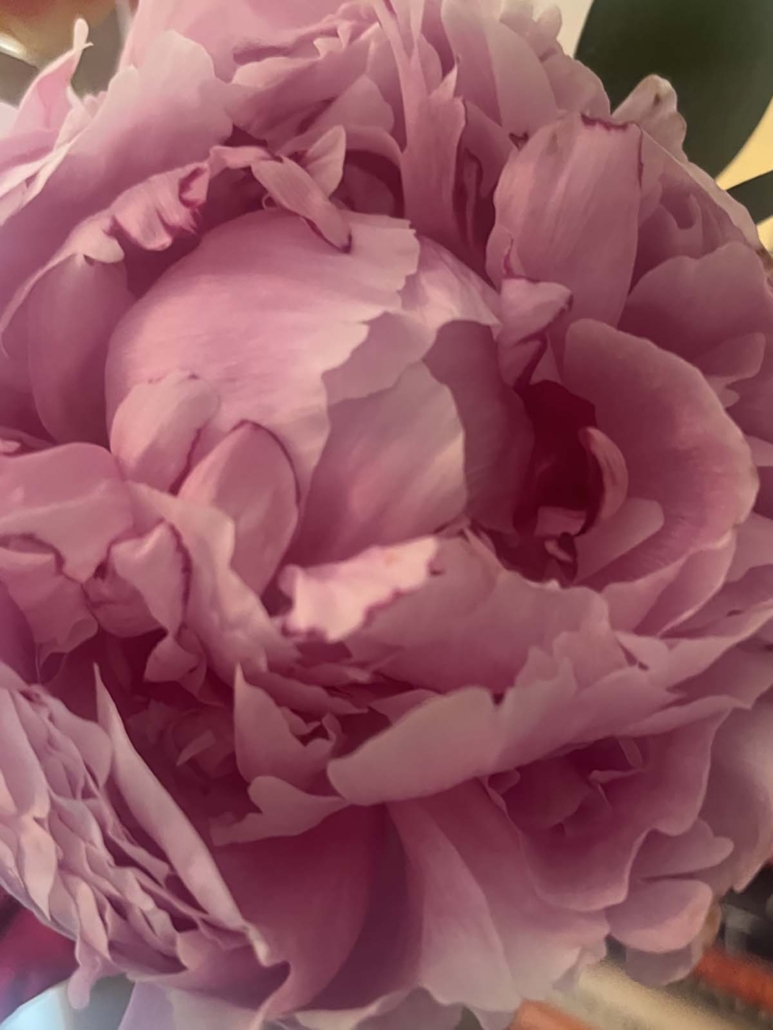
Peonies, she thinks, imagining blousy pink blooms in childhood gardens. She turns back towards the independent florist shop in the high street.
She has never been inside before, has always thought of flowers as an unnecessary luxury. As the bell announces her entry with a tinkling tune, an unfamiliar calm descends upon her. The owner is behind the counter, her fingers twisting stems into a bouquet of roses and gypsophila.
Walking between rows of zinc pots filled with a variety of blooms, her fingers drift across the petals, releasing a whoosh of perfume. She leans towards a rose, inhales it. She is an elegant lady in a Waterhouse painting.
“I need peonies. For my party.” She says to the florist, already visualising an imaginary soiree in her dining room.
Reaching home, she drops her parcel of blooms onto the rarely used dining table. As the children have grown into teenagers, they have migrated to sprawling on sofas at meal times. Screens have replaced conversation. But tonight will be different. She trims the stems and arranges them into a glass vase, rescued from beneath the sink. Soon she has covered the table with a glitter of forks and knives.
She can see the children’s shock when they return from school. They halt, stunned by the heady scent of flowers filling the hallway.
“Just time to change for dinner…” she announces in a calm voice. And smiles. The muscles in her face twitch at the unfamiliar upward movement.
The children nod, walking upstairs in bemused silence.
Tonight, she thinks, they will eat together and share stories of their day across the table. They will laugh, smile. And for one glorious night, she will be Mrs Dalloway.
Denise Bayes’ writing has appeared in various places including NZ Micro Madness, Oxford Flash, Free Flash Fiction, NFFD Anthology, 100 Word Story, Thin Skin, Temple in a City and Underbelly Press. Denise lives in Barcelona, Spain with her husband and a cavalier called Rory, who is usually under the desk. @deniseb.bsky.social
scarf and belt that disrupt ecosystems of narrative
hem of my skirt teaches forgotten lessons
how to rot with purpose
who could reject an offer of metamorphosis?
I grow extra joints to leap from logic
weave moss, reed, algae into wisdom
this marshy garment redefines sweetness:
witch-selves I drowned re-emerge
to croak twilight joy
Ignius Benevolus
Joy is an elusive light, a path that leads
to insubstantial ground
in dark forests, untrustworthy flutters
and sparks at the edges of sight:
what guides my doubtful steps?
Perhaps not all flickers of
luminescence intend deception.
What if delight can be captured, what if hope’s phantasm
has solid edges—in the right shadow?
Perhaps you teach my feet
lightness, how to dance through swamps
so that when toes meet water’s edge
reeds coalesce into cobblestone
shifting shape like the joy of being
beckoned down a safe path that restores
my faith in ethereal candles
that lures me
home.
Jessica Coles (she/her) is a poet from Edmonton, Alberta, Canada, where she lives with her family, a tuxedo cat named Miss Bennet, a tarantula named Miss Dashwood, and a green keel-bellied lizard named Bao Long. Her work has appeared in print and online at Prairie Fire, Moist Poetry Journal, Full Mood Mag, atmospheric quarterly, Stone Circle Review, CV2, The Fiddlehead, Capital City Press Anthology (Vol. 4), Ghost City Review, slips slips, and elsewhere. She has self-published two chapbooks, Unless You’re Willing to Evaporate and The Lyrics Prompt Poems: Ultimate Collector’s Edition (prairievixenpress.ca). Find her on Bluesky @prairievixen.bsky.social
https://templeinacity.com/wp-content/uploads/2025/02/Temple-In-A-City-Logo5.png00Eirenehttps://templeinacity.com/wp-content/uploads/2025/02/Temple-In-A-City-Logo5.pngEirene2025-11-12 11:15:042025-11-12 11:15:08Two poems, Jessica Coles
Karen Baumgart lives in Australia and adores beautiful quotes, pink things, cats, and chai lattes. She loves working in human services policy, especially when it enables marginalised people to have a voice. Karen used to be an English teacher and is quite certain that writing is, indeed, the best therapy. Instagram: @miss.cake.girl Bluesky: @cake-girl.bsky.social Twitter / X: @cake_girl__
Just two days before this, I turned fifty. It’s possible, if unlikely, that the sun launched the coronal mass ejection that caused this display on my birthday; maybe even at the exact moment of my birth + a half-century.
I sat out under this sky for a couple hours, watching the lights dance for everyone but also for me. They were better by far than candles on a cake. I thought of Kurt Vonnegut’s uncle’s saying—If this isn’t nice, I don’t know what is—and I smiled.
Patrick Johanneson writes prairie-flavoured science fiction & fantasy. His work has been published in On Spec, Tesseracts 14, Daily Science Fiction, and Parallel Prairies, among others. He won the Manitoba Short Fiction contest in ’04. He’s also a WordPress Multisite maven, an amateur photographer who appreciates a good aurora, a judo instructor and referee, an aficionado of Canadian and indie cinema, and a lover of Norse mythology. Patrick lives in Manitoba with his wife Kathleen. Check out his website at https://patrickjohanneson.com/
https://templeinacity.com/wp-content/uploads/2025/02/Temple-In-A-City-Logo5.png00Eirenehttps://templeinacity.com/wp-content/uploads/2025/02/Temple-In-A-City-Logo5.pngEirene2025-11-12 11:11:312025-11-12 11:11:36Creative non-fiction micro, Patrick Johanneson
Welcome to JOY, a special popup edition of Temple in the City. This edition isn’t meant to change the world or make light of the darkness so many feel and see around them. But we hope it will act like a sudden sunburst. A reminder that good things, beautiful things, glorious things happen all the time, all around us. Life grows in the most inhospitable places. We grow with it, whether we like it or not.
Some of the work here is just a few words. Or just the right words. Sometimes nonsense words or nonsense use of words. Words to make you smile or laugh or feel, for a moment, the warmth of a friendly sun, the touch of a loving breeze, the touch of another being, human or animal, equally in the dark, equally looking for strength to keep going. That moment can fuel the next moment, and the next. It doesn’t need anything else. It just is.
This idea started as a single, one-off micro edition but joy can’t be captured or limited. So we’re going to keep it alive and moving by making it an ongoing, open-ended issue. When a spark of joy comes our way, we’ll add it here.
Please let this issue wash over you. Let it give you some relief amid the burdens of being alive, with all that trying. Don’t ask it to be anything more or less than it is, then give yourself that same kindness.
We hope you find joy, here and everywhere you can.
Contributors
Karen Baumgart, Denise Bayes, Jessica Coles, Kristin Houlihan, Patrick Johanneson, Rachel Abbey McCafferty, Ben MacNair, Lance Mazmanian, C. Oulens, Tracie Renee, Kathryn Reese, Slawka G. Scarso, Brigitta Scheib, Sumitra Singam, Karen Walker, Huina Zheng.
The day before the Dairy Princess finals at the State Fair, Lou sits in a refrigerated room for six hours while a sculptor carves her shoulders, her neck, her chin, her cheeks, her ears, her hair out of a 90 pound block of Grade A Minnesota butter.
Her mom promised this would be it, that if she just did this one last pageant, she’d never ask her to wear a dress again, and yes, fine, she could even cut off her hair. But Lou won her county last weekend, a surprise to everyone except her mother and Judge Mackey, her mom’s high school boyfriend, and now here she was, one of ten Dairy Princess finalists having their busts carved out of butter.
After, Lou waits in the cold room for her mother to pick her up. She stares at her butter self, at the smooth skin, at the gentle curve of the nose, at the high, feminine cheeks. She wonders if this is what others see when they look at her, if her own image of herself could be this far off. She runs her finger down the cheek. The sculptor had left off the scar on her forehead. The inch-long half moon above her right eyebrow is her favorite thing about her face. With her thumbnail, she cuts the scar into the butter.
*
The next afternoon, Lou stands in the kitchen holding her Runner Up sash while she watches her father make room in the refrigerator for the sculpture of her head. She’d gone straight to her room to change into shorts and a t-shirt when they got home, and then she’d practiced what she would say when she handed the sash to her mom. But now that she’s here, sash in hand, she can’t do it.
Lou’s dad stacks tupperware on the counter in order to make space. He works quickly because it’s 90 degrees in the kitchen and already the butter is starting to soften. They’d driven it home in the back of the air conditioned van, but moving it from the refrigerated room at the state fair to the van and then from the van to the kitchen in this summer heat has caused the left cheek to droop.
“You’re lucky,” her mom says, staring at the sculpture. “When I won Dairy Princess only the winner got to take home her bust. All the others were donated to Craymore’s for the pigs,” she laughs. “Those were some happy pigs!”
Lou’s dad lifts the head into the refrigerator. She notices he doesn’t look at it while he’s moving it. He hadn’t been at the judging this afternoon, said he had to help out at the calf barn because they were short handed. She wonders if he knew she was going to lose, if he didn’t want to be there with all the other fathers when her name wasn’t called.
“Done,” he says, and walks out of the kitchen. The screen door slams shut behind him as Lou’s mom turns the pale yellow sculpture a little bit to the right, and then back. She squints at the face, lit by the fridge light, the up-do that had been so carefully carved into hundreds of distinct strands now melted together into a helmet and the left eye slightly lower than the right. “So pretty, Louisa,” she says, and sighs.
“That’s not my name,” Lou says, which is as close to honesty as she can get.
Her mom shuts the refrigerator door. “Remember this moment,” she says, but all Lou can think about is the face in the fridge, stuck between the iced tea and a tupperware full of chicken broth.
*
Lou can’t sleep thinking about the head so she sneaks into the kitchen and opens the refrigerator. It’s late and the house is silent. It’s heavier than she imagined, and she knocks over the mayonnaise as she tries to lift it off the shelf.
“Need some help?” her dad says from behind her. He must have been sleeping in the living room again. He says it’s cooler. He doesn’t wait for her to answer, just reaches his hands in next to hers, and after a moment, they have the head on the table.
“It looks nothing like you,” he says.
“It melted some,” Lou replies.
“Even before,” he says, and then gestures at the head. “What next?”
“I hadn’t thought it that far through,” Lou says.
*
Lou’s dad cradles the head in his arms like a newborn calf. They stand by the creek, her favorite place on the farm. She used to fantasize about building a tiny house right on the bank with a porch that hung out over the water, but now all she can imagine is getting as far away from this town as she can, from people who will never see her.
“Sure you want to do this?” Her dad asks, and she nods. They take a step towards the water.
“I don’t know what to tell mom,” she says.
“I’ll take care of your mom,” he says. “She’ll get there, Lou.”
He passes her the head. The butter feels cool against her skin and she looks down at her face, at the girl looking up at her.
“I hate it so much,” she says. She waits for her father to say something, but he clears his throat and turns away.
Lou steps forward and drops the head into the water. She wants it to float away, to be carried swiftly by the current, but it just bobs for a moment and then floats into the bank, where it wedges against the exposed root of a tree. Her father takes off his boots and steps into the water. He leans over and gently pulls the head away from the bank. He guides it into the middle of the creek and lets go.
Emily Rinkema lives and writes in northern Vermont, USA. Her writing has recently appeared in Variant Lit, Flash Frog, Fictive Dream, Ghost Parachute, and Wigleaf, and she won the 2024 Cambridge Prize and the 2024 Lascaux Prize for flash fiction. You can read her work at https://emilyrinkema.wixsite.com/my-site or follow her on X, BS, or IG (@emilyrinkema)
There’s a pin beneath my skin. It’s lodged under my right breast, between the ribs, like a stubborn thorn. X-rays show nothing—I’ve been to five hospitals. The doctors all say it’s anxiety.
But at night, the sharp sting wakes me. My fingertips can trace its shape—sometimes upright, sometimes flat, sometimes slanted deep in the flesh.
Is the pin real?
Or just a figment of my mind?
Yet the pain is undeniable.
When my daughter runs through the park, the ache returns. Just as I open my mouth to call her, she falls on the gravel path, blood beading on her knee. Her cry sharpens the sting, drives it into bone. My husband’s key turns in the lock—it digs deeper. When he vents about clients, reeking of alcohol, I feel it drifting through my veins. My father’s fist. My mother’s trembling arms. The dull thud of flesh against flesh. Maybe that’s when it pierced me—quiet, unnoticed.
How do I ask a surgeon to find the pin buried between my bones?
The Cloud on the Balcony
When the humid spring days in Guangzhou came to an end, a tuft of white cloud appeared on the first-floor balcony behind iron railings in my building. The balcony faced the narrow path I took home from school, right beside the main entrance. Every day after class, I’d tiptoe to peer inside until one day, the cloud moved. It was a puppy. She let out two soft barks, her nose pressed against the gaps in the railing.
Before long, she learned to squeeze through the bars, darting toward me like a bolt of white lightning before rolling onto her back, pink belly exposed. “She wants you to pet her,” my mother said. “Dogs love that.” And she did. As I stroked her soft stomach and the fluffy fur on her forehead, her eyes would drift shut. But if my father was the one picking me up, he’d march straight upstairs, muttering “Disgusting,” the same word he used when fighting with my mother.
Seasons passed, and the puppy grew familiar with everyone in the building. On rainy days, her fur hung in damp clumps; on sunny ones, it fluffed up like dandelion seeds. One evening, I watched her bound joyfully toward a neighbor carrying grocery bags. But the woman kicked her away with a sharp “Scram!” The puppy whimpered. That same night, no matter how many times my mother explained the math problem about ratios and age differences, I couldn’t understand. She slapped me and I cried, but the numbers still refused to make sense.
Most days, the puppy had little freedom. Often, she was locked in a tiny cage, watching me pass with wide, dark eyes. Other times, they tied her up, and no matter how hard she strained against the rope, she couldn’t reach me. She never barked because her owners would beat her with clothes hangers if she did. My father would pull me upstairs, and we’d stare at each other through the bars until I was dragged out of sight.
Now, she’s gone. I don’t know when it happened. Just that one day, the balcony was empty, as if she’d never existed. Like my father, whose slippers vanished from the doorway one afternoon, whose clothes disappeared from the closet. “Don’t ask about him,” my mother said. “He is a terrible and irresponsible man.” So I filled my notebook with white clouds, one of them with chocolate-brown eyes, wagging its tail on the balcony.
Huina Zheng holds an M.A. with Distinction in English Studies and works as a college essay coach. Her stories have been published in Baltimore Review, Variant Literature, Midway Journal, and other reputed publications. Her work has been nominated thrice for both the Pushcart Prize and the Best of the Net. She resides in Guangzhou, China with her family.
She stood in front of the old house and breathed it in. The summer breeze lifted the dust from the warm pavement, ruffled the bushes at the front door with its fingers. The windows seemed different now, darker, empty of life. But the front garden looked broadly the same, just more tired. Overgrown shrubs framed the lawn, untidy limbs spilling out in all directions.
She hadn’t been here since the the clearing out of her mother’s furniture and belongings. The boxes of photographs, assorted cheap jewellery and tea sets still lay untouched in her garage two hundred miles to the south. She had selected one photograph from the box, her favourite, and put it into a silver frame. It was of her mother as a young woman wearing her new summer dress and a homemade daisy chain, hair windblown and eyes squinting into the sunlight.
Someone else lived here now. She didn’t want to trespass, but no one seemed to be around. The driveway sat empty of cars. Someone was sawing in a distant garage, and she could hear the murmur of a lawnmower further up the street.
The first paving slab on the path was still split in two and she traced the line with her toe. A parched little geranium at the front door tipped its head to the side and stared at her sadly. She raised her eyes to the windows again. The curtains were different, alien. Unfamiliar ceramic cats sat on the windowsill.
On summer days she had sat on this doorstep, mixing rose petals with water and sugar in jam jars, making perfume. On winter days she had kicked snow off her boots against the top step, fingers numb. Her mother would be there with a hot cocoa to grasp between freezing hands. Her mother was always there, for scraped knees, cut fingers, and later, wiping away tears when boys broke her teenage heart.
She had no memory of her father. He had left before she was two, and he was never spoken of afterwards. For her whole childhood it was just her and her mother.
For a moment she thought she saw movement at the window, and she caught her breath, but it was just the reflection of clouds scudding across the blue sky. No sound came from the house, no shuffle of slippers up the hallway, no call of a voice.
On either side, the neighbouring gardens were altered, fences pulled down, walls put up, driveways pushed into front gardens. She wondered if any of the ghosts of the long gone neighbours were still there, looking out of their windows, watching her.
She hadn’t been here much in her mother’s later years. Mainly because she lived so far away. She should have phoned more often, she knew, but after she moved, her mother was more sullen over the phone. She would give short, clipped answers to her questions, always giving the impression that there was something else she would rather be doing. And at the end… well she hadn’t made it up from Manchester in time. She swallowed hard at the memory. She should have left earlier, but there were things to be organised at work.
Her mother had died as she drove over the border. The hospital phoned. She sat in the lay-by for a long time, not sure how she felt, not sure what to do next.
In the end she had driven to the hospital to see her mother who was serene, but absent. She felt she should say something, but what? Goodbye? She couldn’t break the silence in the death room with words. None were sufficient or appropriate.
The next week was spent in activity, funeral preparation, lawyer’s meetings. She arranged for the house to be cleared except for the few boxes she took home with her.
She walked up the side of the house. The old lilac bush had seen better days. It still pushed out a few isolated blooms here and there between the bare twigs. She held back from pressing a blossom to her face. She was worried the remembered fragrance would be missing, or not the same. But the flowers reached out as she passed, and brushed her arm.
Like a thief, she padded round to the back. She remembered the ping and echo her footsteps used to make in the small narrow space between the two high walls. She breathed in the air, as if the same air would still be there after all these years. She did feel in a strange way that something of the small child she had been was left here. And she searched, in vain, for a sense of her mother.
The washing line between the two concrete posts was gone, replaced by a modern whirlygig hung with striped towels, spinning in the drying wind. There was a new garden hut, a scattering of colourful plastic toys across the lawn, and a swing with a shiny aluminium frame and a red seat.
She knew that her mother hadn’t come to terms with her move to England, but it was where the work was. She ran her fingers along the ridged plastic seat of the swing. She seated herself on it and scanned the back windows for signs of life. Nothing moved.
Slowly, slowly she moved her legs to and fro. Higher and higher she swung with flushed cheeks and hair blown backwards and forwards, above the fences and hedges. She laughed aloud. Just at that moment she pictured a dark haired woman hanging out the washing, sheets flapping on a summer day. The woman bent down to pick up a peg and a small child encircled her neck with a daisy chain. They exchanged a smile and the mother kissed her forehead.
Her sob caught in her throat. She whispered something but the sounds were fragile and got lost in the air. Then, louder over the fences and treetops she called out ‘Sorry’.
June Gemmell writes short stories and flash fiction. She is a reader for Fractured Lit. Her words have been published by Frazzled Lit, Trash Cat Lit, Moonlit Getaway, Gutter Magazine, Northern Gravy, Hooghly Review, Gone Lawn, and The Phare. She is working on her first collection of short stories.
https://templeinacity.com/wp-content/uploads/2025/02/Temple-In-A-City-Logo5.png00Eirenehttps://templeinacity.com/wp-content/uploads/2025/02/Temple-In-A-City-Logo5.pngEirene2025-09-17 04:54:002025-09-18 10:38:05Fiction, June Gemmell
And tech blockades & tariffs. Rather, as Confucius
Has taught us, we always avoid talking of strange
Phenomena, feats of strength, disorder or sprits
Whereaswe do worship our
Ancestors, especially those never accepting defeat
Such as the ever stubborn Houyi who persisted
In shooting down all the nine extra suns as they
Made the world too hot; the determined
Xingtian who soldiered on long after his head
Was chopped off; the old Mr. Fool who must
Remove the mountain blocking his way rather
Than relocating his cottage; the simple-minded
Jingwei who kept filling the East Sea with twigs
Where she was drowned; the devoted Dayu trying
To contain the Flood instead of escaping from
It in an ark as did your Noah, (so cute & creative)
Yuan Changming co-edits Poetry Pacific with Allen Yuan. Writing credits include 12 Pushcart nominations for poetry and 3 for fiction besides appearances in Best of the Best Canadian Poetry (2008-17) and 2149 other publications worldwide. A poetry juror for Canada’s 44th National Magazine Awards, Yuan began to write prose in 2022, his hybrid novel DETACHING, ‘silver romance’ THE TUNER and short story collection FLASHBACKS available at Amazon.
We may request cookies to be set on your device. We use cookies to let us know when you visit our websites, how you interact with us, to enrich your user experience, and to customize your relationship with our website.
Click on the different category headings to find out more. You can also change some of your preferences. Note that blocking some types of cookies may impact your experience on our websites and the services we are able to offer.
Essential Website Cookies
These cookies are strictly necessary to provide you with services available through our website and to use some of its features.
Because these cookies are strictly necessary to deliver the website, refusing them will have impact how our site functions. You always can block or delete cookies by changing your browser settings and force blocking all cookies on this website. But this will always prompt you to accept/refuse cookies when revisiting our site.
We fully respect if you want to refuse cookies but to avoid asking you again and again kindly allow us to store a cookie for that. You are free to opt out any time or opt in for other cookies to get a better experience. If you refuse cookies we will remove all set cookies in our domain.
We provide you with a list of stored cookies on your computer in our domain so you can check what we stored. Due to security reasons we are not able to show or modify cookies from other domains. You can check these in your browser security settings.
Other external services
We also use different external services like Google Webfonts, Google Maps, and external Video providers. Since these providers may collect personal data like your IP address we allow you to block them here. Please be aware that this might heavily reduce the functionality and appearance of our site. Changes will take effect once you reload the page.
Google Webfont Settings:
Google Map Settings:
Google reCaptcha Settings:
Vimeo and Youtube video embeds:
Privacy Policy
You can read about our cookies and privacy settings in detail on our Privacy Policy Page.