It is an ordinary Wednesday afternoon when she is suddenly overtaken by the spirit of Clarissa. She has been going about her usual chores after a dreary day in the office, dashing to the supermarket to get some frozen pizzas for dinner and checking that the dry cleaner will still be open by the time she gets out of the store. Carrying out the endless chores of a single mum.
And then it happens.
She stops in the middle of the street. A sudden impulse fills her.
She must buy flowers.
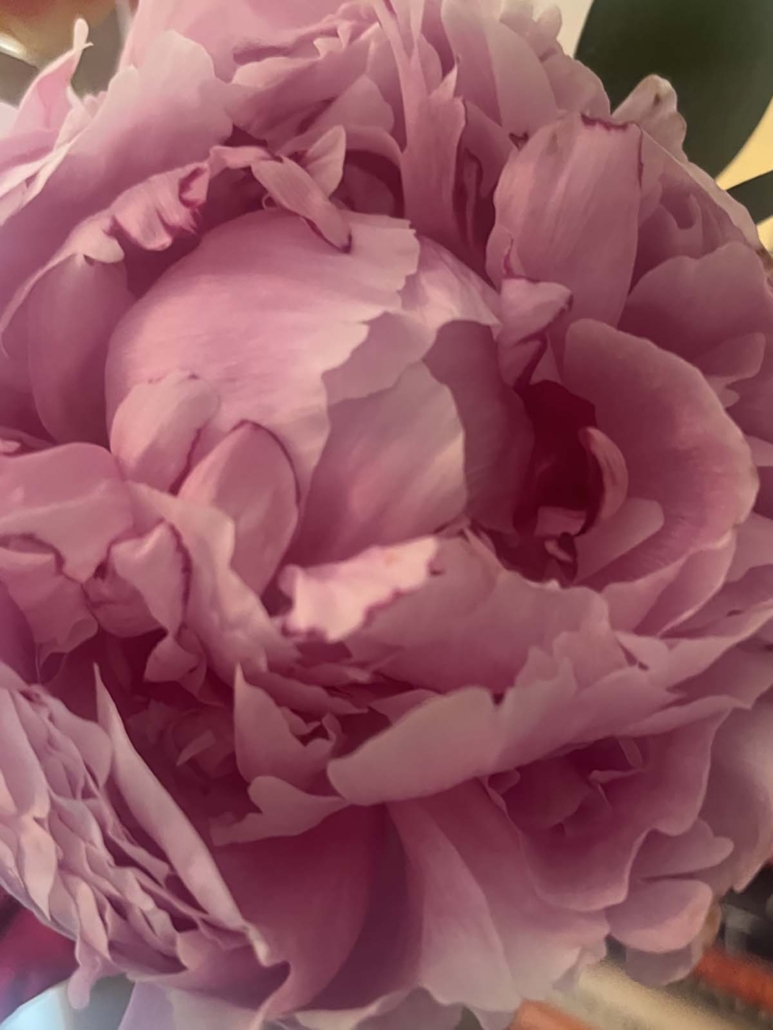
Peonies, she thinks, imagining blousy pink blooms in childhood gardens. She turns back towards the independent florist shop in the high street.
She has never been inside before, has always thought of flowers as an unnecessary luxury. As the bell announces her entry with a tinkling tune, an unfamiliar calm descends upon her. The owner is behind the counter, her fingers twisting stems into a bouquet of roses and gypsophila.
Walking between rows of zinc pots filled with a variety of blooms, her fingers drift across the petals, releasing a whoosh of perfume. She leans towards a rose, inhales it. She is an elegant lady in a Waterhouse painting.
“I need peonies. For my party.” She says to the florist, already visualising an imaginary soiree in her dining room.
Reaching home, she drops her parcel of blooms onto the rarely used dining table. As the children have grown into teenagers, they have migrated to sprawling on sofas at meal times. Screens have replaced conversation. But tonight will be different. She trims the stems and arranges them into a glass vase, rescued from beneath the sink. Soon she has covered the table with a glitter of forks and knives.
She can see the children’s shock when they return from school. They halt, stunned by the heady scent of flowers filling the hallway.
“Just time to change for dinner…” she announces in a calm voice. And smiles. The muscles in her face twitch at the unfamiliar upward movement.
The children nod, walking upstairs in bemused silence.
Tonight, she thinks, they will eat together and share stories of their day across the table. They will laugh, smile. And for one glorious night, she will be Mrs Dalloway.
Denise Bayes’ writing has appeared in various places including NZ Micro Madness, Oxford Flash, Free Flash Fiction, NFFD Anthology, 100 Word Story, Thin Skin, Temple in a City and Underbelly Press. Denise lives in Barcelona, Spain with her husband and a cavalier called Rory, who is usually under the desk. @deniseb.bsky.social
Just two days before this, I turned fifty. It’s possible, if unlikely, that the sun launched the coronal mass ejection that caused this display on my birthday; maybe even at the exact moment of my birth + a half-century.
I sat out under this sky for a couple hours, watching the lights dance for everyone but also for me. They were better by far than candles on a cake. I thought of Kurt Vonnegut’s uncle’s saying—If this isn’t nice, I don’t know what is—and I smiled.
Patrick Johanneson writes prairie-flavoured science fiction & fantasy. His work has been published in On Spec, Tesseracts 14, Daily Science Fiction, and Parallel Prairies, among others. He won the Manitoba Short Fiction contest in ’04. He’s also a WordPress Multisite maven, an amateur photographer who appreciates a good aurora, a judo instructor and referee, an aficionado of Canadian and indie cinema, and a lover of Norse mythology. Patrick lives in Manitoba with his wife Kathleen. Check out his website at https://patrickjohanneson.com/
https://templeinacity.com/wp-content/uploads/2025/02/Temple-In-A-City-Logo5.png00Eirenehttps://templeinacity.com/wp-content/uploads/2025/02/Temple-In-A-City-Logo5.pngEirene2025-11-12 11:11:312025-11-12 11:11:36Creative non-fiction micro, Patrick Johanneson
Welcome to JOY, a special popup edition of Temple in the City. This edition isn’t meant to change the world or make light of the darkness so many feel and see around them. But we hope it will act like a sudden sunburst. A reminder that good things, beautiful things, glorious things happen all the time, all around us. Life grows in the most inhospitable places. We grow with it, whether we like it or not.
Some of the work here is just a few words. Or just the right words. Sometimes nonsense words or nonsense use of words. Words to make you smile or laugh or feel, for a moment, the warmth of a friendly sun, the touch of a loving breeze, the touch of another being, human or animal, equally in the dark, equally looking for strength to keep going. That moment can fuel the next moment, and the next. It doesn’t need anything else. It just is.
This idea started as a single, one-off micro edition but joy can’t be captured or limited. So we’re going to keep it alive and moving by making it an ongoing, open-ended issue. When a spark of joy comes our way, we’ll add it here.
Please let this issue wash over you. Let it give you some relief amid the burdens of being alive, with all that trying. Don’t ask it to be anything more or less than it is, then give yourself that same kindness.
We hope you find joy, here and everywhere you can.
Contributors
Karen Baumgart, Denise Bayes, Jessica Coles, Kristin Houlihan, Patrick Johanneson, Rachel Abbey McCafferty, Ben MacNair, Lance Mazmanian, C. Oulens, Tracie Renee, Kathryn Reese, Slawka G. Scarso, Brigitta Scheib, Sumitra Singam, Karen Walker, Huina Zheng.
The day before the Dairy Princess finals at the State Fair, Lou sits in a refrigerated room for six hours while a sculptor carves her shoulders, her neck, her chin, her cheeks, her ears, her hair out of a 90 pound block of Grade A Minnesota butter.
Her mom promised this would be it, that if she just did this one last pageant, she’d never ask her to wear a dress again, and yes, fine, she could even cut off her hair. But Lou won her county last weekend, a surprise to everyone except her mother and Judge Mackey, her mom’s high school boyfriend, and now here she was, one of ten Dairy Princess finalists having their busts carved out of butter.
After, Lou waits in the cold room for her mother to pick her up. She stares at her butter self, at the smooth skin, at the gentle curve of the nose, at the high, feminine cheeks. She wonders if this is what others see when they look at her, if her own image of herself could be this far off. She runs her finger down the cheek. The sculptor had left off the scar on her forehead. The inch-long half moon above her right eyebrow is her favorite thing about her face. With her thumbnail, she cuts the scar into the butter.
*
The next afternoon, Lou stands in the kitchen holding her Runner Up sash while she watches her father make room in the refrigerator for the sculpture of her head. She’d gone straight to her room to change into shorts and a t-shirt when they got home, and then she’d practiced what she would say when she handed the sash to her mom. But now that she’s here, sash in hand, she can’t do it.
Lou’s dad stacks tupperware on the counter in order to make space. He works quickly because it’s 90 degrees in the kitchen and already the butter is starting to soften. They’d driven it home in the back of the air conditioned van, but moving it from the refrigerated room at the state fair to the van and then from the van to the kitchen in this summer heat has caused the left cheek to droop.
“You’re lucky,” her mom says, staring at the sculpture. “When I won Dairy Princess only the winner got to take home her bust. All the others were donated to Craymore’s for the pigs,” she laughs. “Those were some happy pigs!”
Lou’s dad lifts the head into the refrigerator. She notices he doesn’t look at it while he’s moving it. He hadn’t been at the judging this afternoon, said he had to help out at the calf barn because they were short handed. She wonders if he knew she was going to lose, if he didn’t want to be there with all the other fathers when her name wasn’t called.
“Done,” he says, and walks out of the kitchen. The screen door slams shut behind him as Lou’s mom turns the pale yellow sculpture a little bit to the right, and then back. She squints at the face, lit by the fridge light, the up-do that had been so carefully carved into hundreds of distinct strands now melted together into a helmet and the left eye slightly lower than the right. “So pretty, Louisa,” she says, and sighs.
“That’s not my name,” Lou says, which is as close to honesty as she can get.
Her mom shuts the refrigerator door. “Remember this moment,” she says, but all Lou can think about is the face in the fridge, stuck between the iced tea and a tupperware full of chicken broth.
*
Lou can’t sleep thinking about the head so she sneaks into the kitchen and opens the refrigerator. It’s late and the house is silent. It’s heavier than she imagined, and she knocks over the mayonnaise as she tries to lift it off the shelf.
“Need some help?” her dad says from behind her. He must have been sleeping in the living room again. He says it’s cooler. He doesn’t wait for her to answer, just reaches his hands in next to hers, and after a moment, they have the head on the table.
“It looks nothing like you,” he says.
“It melted some,” Lou replies.
“Even before,” he says, and then gestures at the head. “What next?”
“I hadn’t thought it that far through,” Lou says.
*
Lou’s dad cradles the head in his arms like a newborn calf. They stand by the creek, her favorite place on the farm. She used to fantasize about building a tiny house right on the bank with a porch that hung out over the water, but now all she can imagine is getting as far away from this town as she can, from people who will never see her.
“Sure you want to do this?” Her dad asks, and she nods. They take a step towards the water.
“I don’t know what to tell mom,” she says.
“I’ll take care of your mom,” he says. “She’ll get there, Lou.”
He passes her the head. The butter feels cool against her skin and she looks down at her face, at the girl looking up at her.
“I hate it so much,” she says. She waits for her father to say something, but he clears his throat and turns away.
Lou steps forward and drops the head into the water. She wants it to float away, to be carried swiftly by the current, but it just bobs for a moment and then floats into the bank, where it wedges against the exposed root of a tree. Her father takes off his boots and steps into the water. He leans over and gently pulls the head away from the bank. He guides it into the middle of the creek and lets go.
Emily Rinkema lives and writes in northern Vermont, USA. Her writing has recently appeared in Variant Lit, Flash Frog, Fictive Dream, Ghost Parachute, and Wigleaf, and she won the 2024 Cambridge Prize and the 2024 Lascaux Prize for flash fiction. You can read her work at https://emilyrinkema.wixsite.com/my-site or follow her on X, BS, or IG (@emilyrinkema)
There’s a pin beneath my skin. It’s lodged under my right breast, between the ribs, like a stubborn thorn. X-rays show nothing—I’ve been to five hospitals. The doctors all say it’s anxiety.
But at night, the sharp sting wakes me. My fingertips can trace its shape—sometimes upright, sometimes flat, sometimes slanted deep in the flesh.
Is the pin real?
Or just a figment of my mind?
Yet the pain is undeniable.
When my daughter runs through the park, the ache returns. Just as I open my mouth to call her, she falls on the gravel path, blood beading on her knee. Her cry sharpens the sting, drives it into bone. My husband’s key turns in the lock—it digs deeper. When he vents about clients, reeking of alcohol, I feel it drifting through my veins. My father’s fist. My mother’s trembling arms. The dull thud of flesh against flesh. Maybe that’s when it pierced me—quiet, unnoticed.
How do I ask a surgeon to find the pin buried between my bones?
The Cloud on the Balcony
When the humid spring days in Guangzhou came to an end, a tuft of white cloud appeared on the first-floor balcony behind iron railings in my building. The balcony faced the narrow path I took home from school, right beside the main entrance. Every day after class, I’d tiptoe to peer inside until one day, the cloud moved. It was a puppy. She let out two soft barks, her nose pressed against the gaps in the railing.
Before long, she learned to squeeze through the bars, darting toward me like a bolt of white lightning before rolling onto her back, pink belly exposed. “She wants you to pet her,” my mother said. “Dogs love that.” And she did. As I stroked her soft stomach and the fluffy fur on her forehead, her eyes would drift shut. But if my father was the one picking me up, he’d march straight upstairs, muttering “Disgusting,” the same word he used when fighting with my mother.
Seasons passed, and the puppy grew familiar with everyone in the building. On rainy days, her fur hung in damp clumps; on sunny ones, it fluffed up like dandelion seeds. One evening, I watched her bound joyfully toward a neighbor carrying grocery bags. But the woman kicked her away with a sharp “Scram!” The puppy whimpered. That same night, no matter how many times my mother explained the math problem about ratios and age differences, I couldn’t understand. She slapped me and I cried, but the numbers still refused to make sense.
Most days, the puppy had little freedom. Often, she was locked in a tiny cage, watching me pass with wide, dark eyes. Other times, they tied her up, and no matter how hard she strained against the rope, she couldn’t reach me. She never barked because her owners would beat her with clothes hangers if she did. My father would pull me upstairs, and we’d stare at each other through the bars until I was dragged out of sight.
Now, she’s gone. I don’t know when it happened. Just that one day, the balcony was empty, as if she’d never existed. Like my father, whose slippers vanished from the doorway one afternoon, whose clothes disappeared from the closet. “Don’t ask about him,” my mother said. “He is a terrible and irresponsible man.” So I filled my notebook with white clouds, one of them with chocolate-brown eyes, wagging its tail on the balcony.
Huina Zheng holds an M.A. with Distinction in English Studies and works as a college essay coach. Her stories have been published in Baltimore Review, Variant Literature, Midway Journal, and other reputed publications. Her work has been nominated thrice for both the Pushcart Prize and the Best of the Net. She resides in Guangzhou, China with her family.
She stood in front of the old house and breathed it in. The summer breeze lifted the dust from the warm pavement, ruffled the bushes at the front door with its fingers. The windows seemed different now, darker, empty of life. But the front garden looked broadly the same, just more tired. Overgrown shrubs framed the lawn, untidy limbs spilling out in all directions.
She hadn’t been here since the the clearing out of her mother’s furniture and belongings. The boxes of photographs, assorted cheap jewellery and tea sets still lay untouched in her garage two hundred miles to the south. She had selected one photograph from the box, her favourite, and put it into a silver frame. It was of her mother as a young woman wearing her new summer dress and a homemade daisy chain, hair windblown and eyes squinting into the sunlight.
Someone else lived here now. She didn’t want to trespass, but no one seemed to be around. The driveway sat empty of cars. Someone was sawing in a distant garage, and she could hear the murmur of a lawnmower further up the street.
The first paving slab on the path was still split in two and she traced the line with her toe. A parched little geranium at the front door tipped its head to the side and stared at her sadly. She raised her eyes to the windows again. The curtains were different, alien. Unfamiliar ceramic cats sat on the windowsill.
On summer days she had sat on this doorstep, mixing rose petals with water and sugar in jam jars, making perfume. On winter days she had kicked snow off her boots against the top step, fingers numb. Her mother would be there with a hot cocoa to grasp between freezing hands. Her mother was always there, for scraped knees, cut fingers, and later, wiping away tears when boys broke her teenage heart.
She had no memory of her father. He had left before she was two, and he was never spoken of afterwards. For her whole childhood it was just her and her mother.
For a moment she thought she saw movement at the window, and she caught her breath, but it was just the reflection of clouds scudding across the blue sky. No sound came from the house, no shuffle of slippers up the hallway, no call of a voice.
On either side, the neighbouring gardens were altered, fences pulled down, walls put up, driveways pushed into front gardens. She wondered if any of the ghosts of the long gone neighbours were still there, looking out of their windows, watching her.
She hadn’t been here much in her mother’s later years. Mainly because she lived so far away. She should have phoned more often, she knew, but after she moved, her mother was more sullen over the phone. She would give short, clipped answers to her questions, always giving the impression that there was something else she would rather be doing. And at the end… well she hadn’t made it up from Manchester in time. She swallowed hard at the memory. She should have left earlier, but there were things to be organised at work.
Her mother had died as she drove over the border. The hospital phoned. She sat in the lay-by for a long time, not sure how she felt, not sure what to do next.
In the end she had driven to the hospital to see her mother who was serene, but absent. She felt she should say something, but what? Goodbye? She couldn’t break the silence in the death room with words. None were sufficient or appropriate.
The next week was spent in activity, funeral preparation, lawyer’s meetings. She arranged for the house to be cleared except for the few boxes she took home with her.
She walked up the side of the house. The old lilac bush had seen better days. It still pushed out a few isolated blooms here and there between the bare twigs. She held back from pressing a blossom to her face. She was worried the remembered fragrance would be missing, or not the same. But the flowers reached out as she passed, and brushed her arm.
Like a thief, she padded round to the back. She remembered the ping and echo her footsteps used to make in the small narrow space between the two high walls. She breathed in the air, as if the same air would still be there after all these years. She did feel in a strange way that something of the small child she had been was left here. And she searched, in vain, for a sense of her mother.
The washing line between the two concrete posts was gone, replaced by a modern whirlygig hung with striped towels, spinning in the drying wind. There was a new garden hut, a scattering of colourful plastic toys across the lawn, and a swing with a shiny aluminium frame and a red seat.
She knew that her mother hadn’t come to terms with her move to England, but it was where the work was. She ran her fingers along the ridged plastic seat of the swing. She seated herself on it and scanned the back windows for signs of life. Nothing moved.
Slowly, slowly she moved her legs to and fro. Higher and higher she swung with flushed cheeks and hair blown backwards and forwards, above the fences and hedges. She laughed aloud. Just at that moment she pictured a dark haired woman hanging out the washing, sheets flapping on a summer day. The woman bent down to pick up a peg and a small child encircled her neck with a daisy chain. They exchanged a smile and the mother kissed her forehead.
Her sob caught in her throat. She whispered something but the sounds were fragile and got lost in the air. Then, louder over the fences and treetops she called out ‘Sorry’.
June Gemmell writes short stories and flash fiction. She is a reader for Fractured Lit. Her words have been published by Frazzled Lit, Trash Cat Lit, Moonlit Getaway, Gutter Magazine, Northern Gravy, Hooghly Review, Gone Lawn, and The Phare. She is working on her first collection of short stories.
https://templeinacity.com/wp-content/uploads/2025/02/Temple-In-A-City-Logo5.png00Eirenehttps://templeinacity.com/wp-content/uploads/2025/02/Temple-In-A-City-Logo5.pngEirene2025-09-17 04:54:002025-09-18 10:38:05Fiction, June Gemmell
There will be snow, abundant and thick, the branches of huge firs bowed down with its weight. Beneath such a canopy one can find a small room roofed by icy white and crisp green needles. She crawls in there and leans against the trunk for a minute to catch her breath. It is not quite as cold as you might think but still she rests for a little while and then gently, with no force at all, she exhales from her open mouth a prolonged sigh, the vapor crystallizing instantly, and as her breath turns to ice clouds, shapes begin to coalesce, large and furred with the slightly greyed white they need for camouflage, and one by one as she breathes out, they step away from the small room until seven or eight have gathered. Then as a pack they bound forth from that place into invisibility, the forest swallowing them whole.
They will have everything they need. She has seen to it. No other magic is required. Not by the wolves, and not by us.
Later, if you were to look there you’d see she is gone–leaving only her own large paw prints on the snow.
Kyla Houbolt is a poet and gardener living in North Carolina, USA. Her full length collection, Becoming Altar, is forthcoming from Subpress Collective in the fall of 2025. https://www.kylahoubolt.us/index.html
https://templeinacity.com/wp-content/uploads/2025/02/Temple-In-A-City-Logo5.png00Eirenehttps://templeinacity.com/wp-content/uploads/2025/02/Temple-In-A-City-Logo5.pngEirene2025-09-17 04:50:002025-09-18 10:36:00Flash fiction, Kyla Houbolt
Place hemp fibre in a mould along with mycelium, the root structure of mushrooms, the recyclers of nature.
Put aside thoughts of how you could never get your kids to eat mushrooms and now you never will.
Lie down in the mould to check you have the correct size.
Try to imagine you are stretching out for a long afternoon nap, in a giant cot. Resist the urge to fall asleep immediately. Climb out again.
Be patient. Just get on with it. Keep calm and carry on. Your coffin will be ready in less than a week. You don’t need to understand the science.
Think about the coffin as your baby, think about it when you wake up and when you go to sleep.
On the seventh day, fill the coffin with moss. Make it nice and squishy. This is your final resting place. Climb back into the coffin.
Wear something biodegradable, not that synthetic blouse you wear to the office, the one that clings to you, static and sweaty, the one that makes you feel like you’re wearing a costume.
Think of damp, shady places, think of that afternoon at the Beck when you forgot to take a blanket, when you sat on the dank earth and watched your kids fight over the rope swing, while you worried about childhood accidents, about unanswered emails, about unfulfilled dreams, about people you’d lost touch with, about haemorrhoids.
Allow the putrefaction process to neutralize the toxins in your body. Enrich the soil with your disappointments and failures, your paralysing fears, your pointless, petty ruminations.
Consider the fact that in the US alone they use enough wood, steel and concrete every year to build a tower of coffins the size of the Empire State Building. Ponder how many traditional coffins it would take to build the IKEA just off Junction 27 on the M62.
Imagine being a Compostable Mushroom Coffin Inventor and what a cool job title that would be.
Recall all those meetings you sat through, where people talked about thinking outside the box. Feel glad that you can still think of a pun, even under these circumstances.
Contemplate how easy it would be to break out of this coffin before you start to turn into decayed organic matter, compost to compost, mulch to mulch.
Ask yourself, where do you see yourself in 5 years’ time? and although you still have no idea what the answer is, realise it does not involve being eaten by insects, earthworms, beetles, or centipedes.
Miss your kids. Miss your friends. Miss the things you haven’t done yet. Miss the rocks and the hard places. Dig deep.
Remember this coffin is alive. Notice how the moss gives beneath your weight, then how quickly it springs back as you push yourself to standing.
Hear the soothing voice of your yoga instructor, perhaps after making an imperceptible adjustment to your posture, asking, Different feeling now?
Laugh. Loudly, wildly. And don’t cover your mouth.
Whisper to yourself, to the trees and the stars, to the network of fungal threads that support you: Yes. Yes. Yes.
Monica Dickson writes flash fiction and (longer) short stories. Her work has been published in Anti-Heroin Chic, jmww, Splonk, X-R-A-Y and elsewhere online, as well as in various print journals and anthologies. Her story ‘Receipts’ was selected for the inaugural Best British and Irish Flash Fiction award (BIFFY50). She won the 2019 Northern Short Story Festival Flash Fiction Slam and is a graduate of the Northern Short Story Festival Academy. More at writingandthelike.wordpress.com and @mondickson.bsky.social
He looked away sadly, picking at the seam of his hospital gown. “I thought it was something I might be good at.”
I knew what he meant. I had a memory of holding his hand as a boy while our daddy told us we’d always be failures.
That was the time after I’d been benched for the season, but between us later there would be hunting trips with no blooding, carpentry that resulted in wonky structures, creative writing classes that yielded no poetry, auto-tech training foiled by an aversion to dirty hands, marriages foiled by an inability to share.
I’d remember those things my brother tried later, after he jumped.
Elizabeth Rosen (she/her) is a native New Orleanian and a transplant to small-town Pennsylvania. She misses gulf oysters and Southern ghost stories, but has become appreciative of snow and colorful scarves. Colorwise, she’s an autumn. She still wants her MTV. Her stories have appeared in places such as North American Review, Baltimore Review, Pithead Chapel, Flash Frog, and New Flash Fiction Review. Learn more at www.thewritelifeliz.com.
https://templeinacity.com/wp-content/uploads/2025/02/Temple-In-A-City-Logo5.png00Eirenehttps://templeinacity.com/wp-content/uploads/2025/02/Temple-In-A-City-Logo5.pngEirene2025-09-17 04:46:002025-09-18 10:34:20Micro fiction, Elizabeth Rosen
Maddie stands barefoot in a kitchen cluttered with crumpled newspaper and piles of halfway unpacked cardboard boxes, arranging a ring of devil’s food cake donuts onto her mom’s antique glass cake stand.
From a fresh dozen she selects the plain glazed next, placing them one after another atop the devil’s food. Layer upon layer, she stacks, alternating flavors before crowning her pyramid with her favorite, a sprinkled vanilla.
When she was little, Maddie always helped her mom make the cake for Maddie’s birthday. Nose and cheeks powdered white with flour. Lips smeared with cocoa—the evidence of a stealthily snatched spatula licked clean.
She loved cracking the eggs best. The pop that sounded when she knocked them against the edge of the bowl. The satisfying crinkle when she pulled the halves apart. Clean breaks didn’t come easy, though. No matter how careful Maddie was, a few jagged pieces of shell always slid into the mix. But her mom was right beside her, to make sure the sharp bits didn’t stick.
Every year, they followed the same recipe. A classic yellow two-layer round cake, frosted with store-bought chocolate fudge icing. Bedazzled by Maddie with a heaping sprinkling of rainbow nonpareils. And every year, after the kitchen was scrubbed clean and the plates were set for serving, Maddie made the same wish.
Eyes squeezed tight, she’d sit at the dining room table, holding her breath, anxiously waiting for her parents to finish singing Happy Birthday. Mom smiling soft and reassuring. Dad wearing his fair-weather grin.
Maddie’s birthday was one of the few predictably sunny days of the year, along with Thanksgiving and Christmas. Free from the eggshells she and her mom were so used to walking on around the house. As the smoke from the burning candles curlicued above her cake, Maddie would hope that this year, yes, this year, her wish would come true.
Maddie steps back, admiring the tower of fried dough. The memories of those days melt away when her mom walks into the kitchen, the last moving box tucked under her arm. An easy, bright smile thriving on her face.
August’s warm breeze sneaks in through the cracked open doorway of their townhouse. Maddie pokes thirteen candles into her sweet creation, strikes a match. She cups her hand around the flame to keep it burning steady, and takes a deep breath, looking forward to the wish that comes next.
Kendra Cardin creates a safe harbor for herself with poetry and storytelling. Her writings have been featured in a variety of publications including those of Rough Diamond Poetry, Sídhe Press, Blink-Ink, Little Thoughts Press, and Black Bough Poetry.
Alright, here goes. You’re not doing this for the LOLs anymore. You’ve seen how they do it in the movies, the specific cuts, and gory effects. It’s a lot different than that. Now it is time for you to make the choice. It’s a lot colder here than you think. And I know it’s scary, and you got that itch, and you want to scratch it raw and bleeding, and you know that’s not great for anyone, especially those who find you first. Instead, we’re going to try this. Think of all of the other moments that are simultaneously happening. Retreat into your mind palace, your hurt locker, whatever the fuck you wanna call it. At this point, it’s a lot of static and a little cancerous in spots. Think about those good ones, yeah, like all the times you navigated through life’s unexpected and devastating traumas. But also, all of the high points, the limelight, the fluttering euphoria in your chest. The last time you felt more like a furnace than a corpse. That’s right—no, don’t go backward. No more negativity! This is supposed to be a positive reinforcement exercise. You need to fantasize about putting a tourniquet around that bleeding heart. Ok, practice now, just leave it be—that’s it, good. Remember, you’re not scratching it, and it’s gonna get a lot cooler than you imagine. Continue being that way—you’re doing yourself a massive favor. You learned over time that scabs are a sign of healing unless interrupted prematurely. Your whole life has been a scab healing. It’s alright. It will fall off, and the pink raw flesh below will be sensitive at first. You can’t be afraid of scarring—it builds character. See? You don’t even feel itchy anymore! Go ahead, take that breath you’ve been holding in all this time. Your future self has earned this moment and all the ones that come after. Now, close your eyes and rest. You’re doing this for the Zzz’s now. You’ll awaken a rejuvenated, scabless person. Agree? Alright, here goes.
Josh Dale is a native Pennsylvanian. Introduce your cats to death metal. Read more at www.joshdale.co and most social media @jdalewrites
In the future, Marie will reinvent herself. But first she will disappear to have the baby. Then she will reappear to sit her exams, the baby safely delivered by her mother to a nice family that Marie will never meet, in a city she will never visit. She will get a place at Uni to study law, then she will use her natural talent for winning an argument to train as a barrister. She will drink too much. She will smoke too much. She will quit smoking. She will join a gym. One day she will write to Robert, the baby’s father, and she will tell him how well she is doing and how she hopes they did the right thing for all of them, and he will treasure the letter, but he will not write back. Marie will think about the child, and how and who they are, but she will only allow herself to do this for an allotted half-hour, every Friday, after work and before dinner.
In the future, Robert will sell insurance. But first he will party his way through an extended adolescence that lasts long into his third decade. He will drink and do drugs with a commitment bordering on a qualification. He will stop drinking and doing drugs when one of his friends has a stroke. He will barrel through a string of co-dependent relationships – with women who will cook and clean and care for him, until his tearful, late-night self-examinations become too difficult a form of mothering. When he finds himself alone, he will read and re-read the letter from Marie. He will keep the letter in a hanging file marked Miscellaneous and he will think about the child – now an adult – and how and who they are, and he will think about having a drink, but he won’t.
In the future, Theresa will watch as Marie’s star rises. She will congratulate herself on making the right decision. She will tell her friends how happy her daughter is, how she drinks cocktails with high-flying clients, how she stays in the best hotels. She will sometimes think about the baby’s tiny foot in Marie’s hand, just a child herself; the argument Marie couldn’t win. One day, Theresa will write to the adoption agency and she will ask them to pass on another letter, from her, to the child – who will always be a child in her mind – but Theresa will be told, kindly and efficiently, that it is not allowed under the terms of the non-contact agreement they made all those years ago.
In the future, when Theresa dies, Marie will clear her house. She will break this task down into manageable timescales: Monday to Thursday, for half an hour, after work and before dinner. One day, Marie will find a sealed envelope, addressed, in her mother’s handwriting, to a person she doesn’t know. She will think about opening it, but she won’t. She will take the letter home, she will file it under Health – general, she will pour herself a large glass of wine and she will look forward to Friday.
Monica Dickson writes flash fiction and (longer) short stories. Her work has been published in Anti-Heroin Chic, jmww, Splonk, X-R-A-Y and elsewhere online, as well as in various print journals and anthologies. Her story ‘Receipts’ was selected for the inaugural Best British and Irish Flash Fiction award (BIFFY50). She won the 2019 Northern Short Story Festival Flash Fiction Slam and is a graduate of the Northern Short Story Festival Academy. More at writingandthelike.wordpress.com and @mondickson.bsky.social
A son this third time. Here. Take a laddoo. It is from your favourite shop. Jalaram’s. Motichoor. Not the Besan laddoo that you upturned a plateful during our third year Diwali celebration, leaving floury bits all around, like a bomb explosion. That day my heart sank at your disrespect.
There she is – your second wife. Here. Feed her a laddoo. She needs to be lauded. For producing a heir. For helping you shed your skin as my husband, the cover for all the love shared for thirteen years. You said I must learn from her, by drinking her urine, borrowing and sleeping on her pillow to absorb lessons on how to be a ‘good’ wife.
Where is your mother – the evil goddess who held your dubious honour aloft? Has she ever played any role other than being a yes-woman, refusing to see my side? You’d say I planted the bone of contention in the first place. In your eyes, she is infallible and tolerated all my mistakes too. You owe her for today. Celebrate with a laddoo.
Why am I at your son’s naming ceremony with a box of laddoo? Why laddoo? Because by its shape it represents the universe. The fried flour pearls are the human lives; the sugar syrup is the love that is supposed to give the binding. Fried cashews and raisins are the good and bad tidings and the cloves- those spicy bits are the real deal. They are the tests for love.
Fine, don’t buy all this. Don’t fret about guilt and conscience, duty or the failure of it or the energy exchange that has happened all these years in the give and take between you and me, just come forward. Take a laddoo.
Come on, take one; Make a move.
Vijayalakshmi Sridhar is a writer of features and fiction in Chennai, a coastal city in South India.
So, I go to Aisle 3 to grab whatever my wife instructed me to get. What was it? The, uh…organic canned beans? Some paprika spice medley? 5 pounds of pork loin? Maybe not in that order, but she’s the boss of the kitchen, and I’ve mastered pattern recognition. But look! A bumbling imbecile of a husband needs some entertainment. I turn the corner and see this badass display. Cans of Monster are stacked as tall as the shelves. Bundles of Doritos and Lays chips fill the area around the base of Coke and Dr. Pepper 12-packs. Two young men are wearing the company’s drab attire, plus an older gentleman in a button-up shirt and a clipboard. I reckon the store manager. In my experience, they can be austere assholes! So, get this. The one employee is up on a 6-foot ladder, and the other is handing him cans, right? This manager, with his graying combover, cracks some loose Monsters and launches them into the air. Both catch; neither spills a drop. They cheer. Crazy!
This all happens at 10:00 AM, which is important to the story. A certain song was playing on the speakers. “Takin’ Care of Business.” Big with the Boomers, but it’s a bop, not going to lie to you. Anyway, the manager starts to boogie. He’s dancing around, flipping the clipboard over his head, and smacking the boxes of cans. Metallic thuds galore. What a performer! “Hey, boss,” the ladder guy says. “Why do you always play this song at 10 AM?” The manager exhales and wipes some sweat off his brow. “Devote one hour a day to taking care of business, and it can change your life. My ex-wife remembers this song well. No cucumbers were harmed!” The employees laugh so hard. They look barely out of high school. I take it they haven’t a clue what marriage is like. The moment passes, shoppers move along, and the trio stays. The titular song overhead ends, and the weekly sales advertisement rings out. The employees and their manager survey their creation, much like artists do. From my perspective, it looks like a fireball. Hell yeah, I can see it. Taking care of business, fellas!
I finish up my shopping and visit the sole cashier. An older woman sits on a stool with a fancy badge. 10 years? Wow, that’s dedication! She coughs and shakes when the belt moves with my food. She was nodding off. Oops! I asked her about the music at 10 AM. She looks past me to a faraway place and giggles. Her forehead wrinkles like she’s recounting memories. The blip of the scanner keeps a steady beat. “His wife was the produce manager when he hired me. Ah, how he took a liking to me. They were arguing, and she called out, so I covered the produce department. One thing led to another, and we made love in the prep room. The goosebumps when that chorus kicked in…” She leans close to me. I’m bewildered, hearing this story frothing out of this woman’s mouth. “I regret nothing. This badge on my shirt outlasted their marriage. I still dream of his eggplant every so often.” I make that awkward smile where your eyes squint and your lips look like a worm. “Keep your business to yourself, now, ya hear? Have a lovely day.” She hands me the receipt, and I go on my way. The pictures in my head start flooding in. How many pieces of vegetables did they use in that affair? My groceries felt heavy in my arms, in the car, and in the house.
I open the door and wowzah, it smells so damn good! My wife is in a blitz preparing for the family reunion. Pots bubbling. Skillets sizzling. Emeril and Gordon: start blushing. She’s so good. She skirts around my lumbering ass, and I plop the bags on the island. I can smell the sweat on the back of her neck. Yummy. “Hey, babe, eyes up,” she commands me. A spatula in hand, she rattles off directions. “Dump the beans on the top right pot. 2 tablespoons of paprika. Get the pork on foil. Light oil. My auntie is coming in thirty minutes to help.” Now, the jester appears. I unpack the groceries and goddammit! Nothing she asked for is there! I look ready for a Super Bowl party instead of a curated family event. I start stammering, and it makes my wife pause. Among the chaos, she surveys the incorrect groceries. Her thick, black eyebrows narrow. She inhales deeply, sighs. “Ah, honey. It happened again?” I don’t know what to say, so I crack a Monster and guzzle some down. Liquid courage! “I was distracted by the fireball display, the guys building it, the taking care of business song, and the manager’s tryst with the cashier, the produce manager divorced him, and—” She struts toward me and puts a buttery finger to my lips. Zesty. Her chestnut eyes are stabbing me. “It’s alright. You may be a village idiot, but you’re my village idiot.” She removes her finger from my lips, and I salivate. I see that vein in her neck, just millimeters below her olive skin. It’s pulsing with anger. I want to lift her on the counter and suck on her neck like a hungry baby. I bet she tastes like rosemary. But yo, I’m a big dumb mutt in a man’s body and I’m on the clock! My wife, without skipping a beat, unsheathes a knife from the scabbard with one hand and hurls a tomato in the air with the other. She slices the thing in half in the blink of an eye. The two halves plop onto the cutting board, all gory. She’s a ninja, I swear! She smirks as I backpedal. “Good boy. You finish the job now, you hear?” I nod my head like a metalhead at a concert and bolt out the fucking door…
Josh Dale is a native Pennsylvanian. Introduce your cats to death metal. Read more at www.joshdale.co and most social media @jdalewrites
Before she came, there was only darkness. Unremitting night surrounded, moonless. Their limbs shrank, conserving energy within their bodies like bulbs sheltering in winter soil.
And then she dropped into their midst. One of them caught sight of her in the woods, a bright sphere of light, illuminating the world. They stared at her from the grey shadows. They watched the warmth of her smile that radiated light into dank corners of the forest. Her fingers stretched wide, leaking flashes of brightness into their world. They turned to each other, shaking their heads in puzzlement.
Could they trust her lightness? A few of the braver ones began to move towards her. As they tiptoed closer, their bodies shivered as brightness began to pulse through their limbs. An unfamiliar energy photosynthesised their veins. As their pinprick pupils began to adjust to the glare, they shrugged off the frowns of the dark years. Etiolated limbs began to stretch and lengthen in her powerful rays. Then she began to speak and her maple-syrup sweet voice reached them. She spoke of love and happiness, filling the woods with the beauty of words. Soon the reluctant ones drew closer, taking slow steps towards the new world, she had revealed. There was joy in their faces. They formed songs with their new vocabulary and smiled in her presence, shrugged off the old world. One morning, she was gone.
The people halted, fearful of the past returning as they gazed into the void she had left. They waited in silence for the darkness to return. But as they turned towards each other, they saw light throbbing through each of them.
Denise Bayes has been published in NZ Micro Madness, Free Flash Fiction, Oxford Flash,100 Word Story, Ellipsis Zine, Firewords ,Roi Fainéant press and the recent NFFD Anthology. Originally from Sunderland, Denise lives in Barcelona, Spain where she lives with her husband and a lively cavalier puppy called Rory. Bluesky @deniseb.bsky.social
We may request cookies to be set on your device. We use cookies to let us know when you visit our websites, how you interact with us, to enrich your user experience, and to customize your relationship with our website.
Click on the different category headings to find out more. You can also change some of your preferences. Note that blocking some types of cookies may impact your experience on our websites and the services we are able to offer.
Essential Website Cookies
These cookies are strictly necessary to provide you with services available through our website and to use some of its features.
Because these cookies are strictly necessary to deliver the website, refusing them will have impact how our site functions. You always can block or delete cookies by changing your browser settings and force blocking all cookies on this website. But this will always prompt you to accept/refuse cookies when revisiting our site.
We fully respect if you want to refuse cookies but to avoid asking you again and again kindly allow us to store a cookie for that. You are free to opt out any time or opt in for other cookies to get a better experience. If you refuse cookies we will remove all set cookies in our domain.
We provide you with a list of stored cookies on your computer in our domain so you can check what we stored. Due to security reasons we are not able to show or modify cookies from other domains. You can check these in your browser security settings.
Other external services
We also use different external services like Google Webfonts, Google Maps, and external Video providers. Since these providers may collect personal data like your IP address we allow you to block them here. Please be aware that this might heavily reduce the functionality and appearance of our site. Changes will take effect once you reload the page.
Google Webfont Settings:
Google Map Settings:
Google reCaptcha Settings:
Vimeo and Youtube video embeds:
Privacy Policy
You can read about our cookies and privacy settings in detail on our Privacy Policy Page.