Flash fiction, Chris Cottom

Salix Babylonica

We match on Treehugger.com. Sal is as slender as a wand, lives on a slip road, and has a drink problem. ‘I’m parched,’ she gasps, eyeing the watering can I’ve brought instead of flowers.

She fills out as I nourish her with organic mulch. Eventually, blossomed and glorious, she cascades over me, her pointy tresses tickling my skin. Soon, I’m spending every weekend with her, oblivious to the roar of the Corby Orbital.

I’ll lie cocooned in the dappled shade of her canopy while she teases me about my past. I tell her how it all started with a stately cypress at Sissinghurst, how I’ve dated sweet cherries and twiggy hazels, and even had a fling with a late-blooming jacaranda.

In time, graceful but scratchy, Sal sighs in the wind, groaning about brittle boughs and claiming I’ll leave her if she loses a limb. When I reply ‘never,’ I realise she’s weeping.  

I arrive one Saturday and she’s trying to hide something. Through her yellow-green curtains I glimpse a cross painted on her trunk. ‘Road-widening scheme,’ she sobs. I gabble about reviews and appeals but she stops me. ‘It’s too late. Go and find yourself a nice young sapling.’ 

Through the night, she talks of whips she surrendered for baskets she never saw, how kids never collected her catkins, how her broad-rounded crown never sheltered a courting couple. She admits she’s sad not to have lived in a meadow ‘or just near a stream.’ 

At dawn, Sal doesn’t flinch as bulldozers rumble and chainsaws growl. I tell her I’ll stay. ‘No,’ she insists. ‘Time to go.’ Instead, I press my lips to her silver furrows, squirt my palms with superglue, and wrap my arms around her.

Chris Cottom lives near Macclesfield, UK. His work’s appeared in 100 Word Story, Fictive Dream, Flash Frontier, NFFD NZ, NFFD UK, Oyster River Pages, The Lascaux Review, and elsewhere. In the early 1970s he lived next door to JRR Tolkien.

@chriscottom.bsky.social  | chriscottom.wixsite.com/chriscottom
Flash fiction, Hilary Ayshford

Our Lady of Sorrows 

It’s cold inside the church, as cold as charity. Maria shuffles up the nave under the anguished gaze of Jesus, her down-at-heel brogues slap-whispering on the flagstones dinted by thousands of feet before hers. The feeble winter sun stripes the grey pillars with pastel colour.

She eases her bag down carefully onto the altar steps and rubs her aching shoulder.

‘I brought you these,’ she says. ‘I couldn’t think what else to do with them.’ 

Her words bounce off smoke-stained pillars, echoing round the vast, vaulted roof. 

‘It’s not a peace offering,’ she adds, in case God gets the wrong idea. ‘I’ve not forgiven you for taking him.’

Her voice sounds strange, unfamiliar to her. These days, now Patrick isn’t there to to talk to, she listens more than she speaks. She still visits the hospice every day, even though he’s been in the ground for months. Now she sits with those who have nobody, holding their crepe paper hands and stroking wispy tendrils of hair from their faces as the end approaches.

Sometimes, they tell her things – shameful things they don’t want to be buried with: clandestine affairs; a secret love child; crimes that went unpunished; slights and spites, things said and unsaid. 

Maria doesn’t know what to do with these confessions, so she puts them in her tote bag and takes them with her. But they’re weighing her down, immobilising her; she can’t go back, but moving forward is like wading through treacle. Today, unable to bear the increasing heft of them any longer, she brings them here. 

‘They’re yours now,’ she tells God. ‘I never asked for them. I’ve got enough burdens of my own without carrying other people’s.’

She upends the bag, and a stream of guilt, regrets, recriminations, weaknesses and missed opportunities flows out across the chancel; they collect in crevices, form shallow pools, disappear down cracks. The surge of relief leaves her breathless. 

On her way out, she pauses to light a candle for Patrick. A wisp of smoke drifts upwards, lifting the weight from her soul; the flickering flame pierces the grey fog of her grief. Slinging the empty bag over her shoulder, she leaves the church with a renewed lightness in her steps and in her heart.

Hilary Ayshford is a former science journalist and editor based in rural Kent in the UK. She writes flash fiction and short stories and has been nominated for Best Of The Net and Best Small Fictions. She likes her music in a minor key and has a penchant for the darker side of human nature. https://hilaryayshford-writer.weebly.com Bluesky: @hilary55.bsky.social Threads: hilaryayshford X: @hilary553

Ekphrastic, Jay Parr

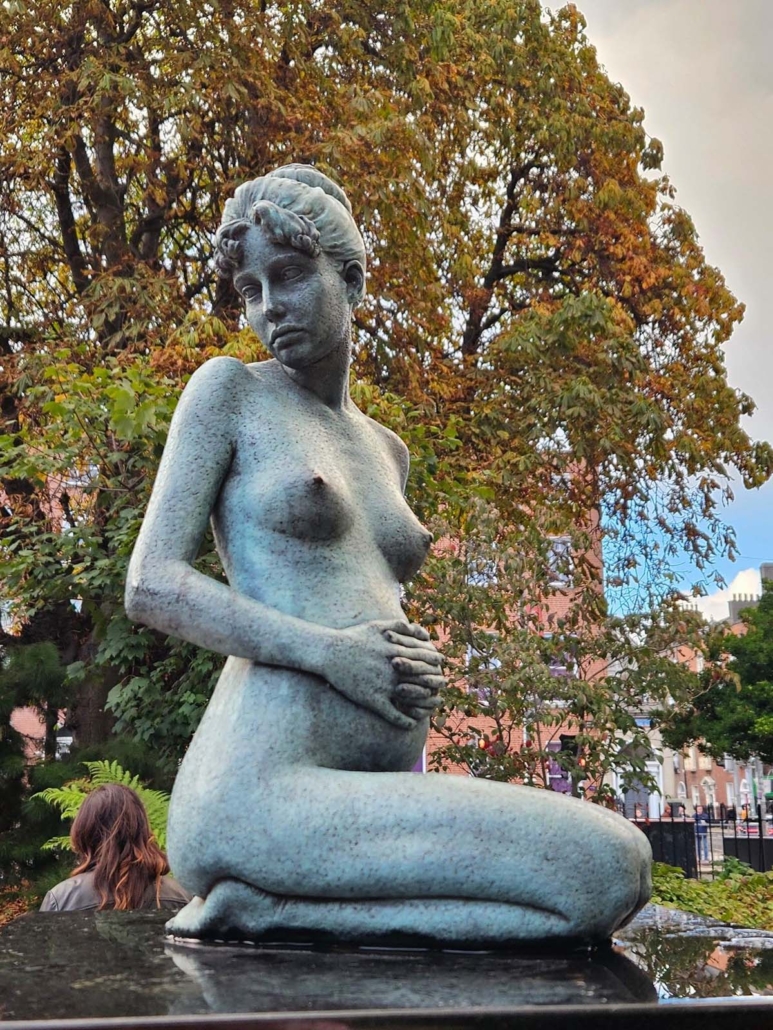
Photo credit: Nicole Dressen

Constance

[Regarding the Sculpture of Constance Lloyd Wilde Holland at the Oscar Wilde Memorial Statue in Central Dublin]

Naked and pregnant, kneeling small, exposed in your shame before all of Dublin, your face the frown of trust betrayed as you look back at your larger-than-life Oscar, who ignores your wounded gaze to leer at the lithe torso of the ancient Greeks’ licentious Dionysus (later rendered Sir Rubens’ voluptuous Bacchus) a man to whom you have turned your back, but the world has cast you and him of the same weathered bronze, while your sometime Oscar, rendered resplendent in colorful stones collected from four continents, his hands bedecked with your wedding ring flanked by scarabs of good and ill fortune, the tie of his beloved Trinity glazed at his throat, lounges on a boulder stolen and lugged from the Wicklow Mountains—Oscar, in death as in life, ever the fulcrum of the V, the focus of endless scandal, of scorn tempered with admiration, infamy with fame, as you are pushed to one side, to change your name yet again, from Wilde to Holland as once from Lloyd to Wilde, in the vain hope of pulling your sons from the shadow of your still-husband their father’s endless scandals, exiled by outrageous fortune to the continent, to die forgotten in the periphery, of a botched surgery for a condition yet to be understood, and to be immortalized here, naked and cold on a pedestal of his words—his words, not yours, in the park of his childhood, not yours, even your nude form borrowed from a friend of the artist—your humiliation and your shame laid bare for all to see.

Jay Parr (he/they) has never been to Dublin (unless you count Dublin, Virginia). He lives with his partner and child in North Carolina, where he did an MFA at UNCG in the early ’00s and is now a lecturer in their online liberal and interdisciplinary studies program. He’s honored to have work in Elegant Variations (at Stanchion), Roi Fainéant, Bending Genres, Five Minutes, MIDLVLMAG, Reckon Review, Bullshit Lit, Identity Theory, SugarSugarSalt, Discretionary Love, Streetcake Magazine, Variant Literature Journal, and elsewhere.

Website: https://jayparr.wordpress.com/.

Bluesky: @crankypacifist.bsky.social‬

Flash Fiction, Joanna Theiss

When You Get Old, You Become a Silly Goose

On the Singer your grandmother left you, you sew the bodice, tack a thousand white feathers to the paunch, and carve breathing holes into the black leather beak. Zip until you feel metal on the base of your neck, then flex your arms in their wire-and-mesh wings. On a lark, you honk until your granddaughter joins you in front of your full-length mirror. She anoints you Silly Goose with her plastic princess wand.

Wearing the costume out of the house – ducking through the doggie door, waddling across the cul-de-sac – brings you attention you forgot you missed. Men step into gutters when your painted orange flippers slap the pavement. Packs of teenagers intent on their phones clear the way after you honk with the bicycle horn sewn into your dewlap. Nice to be noticed, to be seen, to be invited to the Halloween parade, in step beside your granddaughter, who is wearing your old lace coronation gown, your tiara pinned in her hair.

You’re on top of the world until you’re not, until you totter past your granddaughter’s room and hear her asking a Magic 8 Ball if Grandma will ever come back. Outlook not so good. Until her little friends visit and your goosey excretions stain the trains of their taffeta dresses. Until you remember that geese aren’t made for company. 

When frost encrusts the lawn, the clover loses its flavor, and you decide you’ve had it with this disguise. You reach behind your back, but your wingtips can’t manage the zipper’s pull. You have no thumbs to unshod the flippers, no voice beyond your beak. You honk for rescue, for transformation, for your granddaughter to put on a sweater and help you out. You honk until the neighbor bangs on the fence and threatens you with cookery.

In this suburban backyard, it’s getting colder, and your granddaughter has pulled her curtains closed. You understand. You did the same to your grandmother. Your world was bright pink, and hers had turned downy white, her face an embarrassing reminder of the shortness of one’s reign. 

Settling your wings back into place, you hunker down in the crook of the fence, seeking the earth’s last bit of warmth before your end. A flock flies overhead, a rollicking V of Canada geese. Their honks are frivolous, reviews of golf courses and grubby inland lakes, but they stir something, nonetheless. In pining for what you’ve lost – satin slippers, petal-soft cheeks, golden thrones – you’ve forgotten what you’ve gained.

The backyard is just long enough for a runway. Once you begin, nature takes over. Air balloons under your feathers, feet flatten against your paunch. The higher you rise, the richer the winter smells. This is the world, this sky: bigger and stronger and wider and more permanent than princessy fixations. You may be a silly goose, but you, you have learned to fly.  

Joanna Theiss (she/her) is a former lawyer living in Washington, DC. Her fiction and poetry have appeared in The Penn Review, Chautauqua, Peatsmoke Journal, Milk Candy Review, and Best Microfiction, among others. You can find links to her published works and her mosaic collages at www.joannatheiss.com. Bluesky: bsky.app/joannatheiss.com